


The US ban on Chinese technology is growing faster than American factories can replace what it blocks. Since December, the Federal Communications Commission has stopped new foreign-made drones, consumer routers, robots and power inverters from getting the approval they need to be sold in the US. For robotics companies, labs and device makers, the result so far is higher costs and slower development, and the hardest deadlines are still ahead.
What the FCC actually banned
The main tool is the FCC’s Covered List, a register of equipment judged to be a national security risk. On July 28 the FCC added foreign-produced power inverters, the devices that connect solar panels and batteries to the grid, and “advanced robotic devices”, a category covering mobile ground robots such as humanoids, four-legged robots and autonomous mobile machines (Squire Patton Boggs). A newly covered device can no longer get FCC equipment authorization, without which it generally cannot be imported, advertised or sold.
The rules have important limits:
- they are based on where a product is made, not who owns the company, so a robot built in Germany is treated the same as one built in China;
- models authorized before July 28 can still be sold, and a companion waiver allows software and firmware updates until at least January 1, 2029;
- the only route for new foreign-made models is a conditional approval from the Department of Defense (for robots) or Defense or Homeland Security (for inverters).
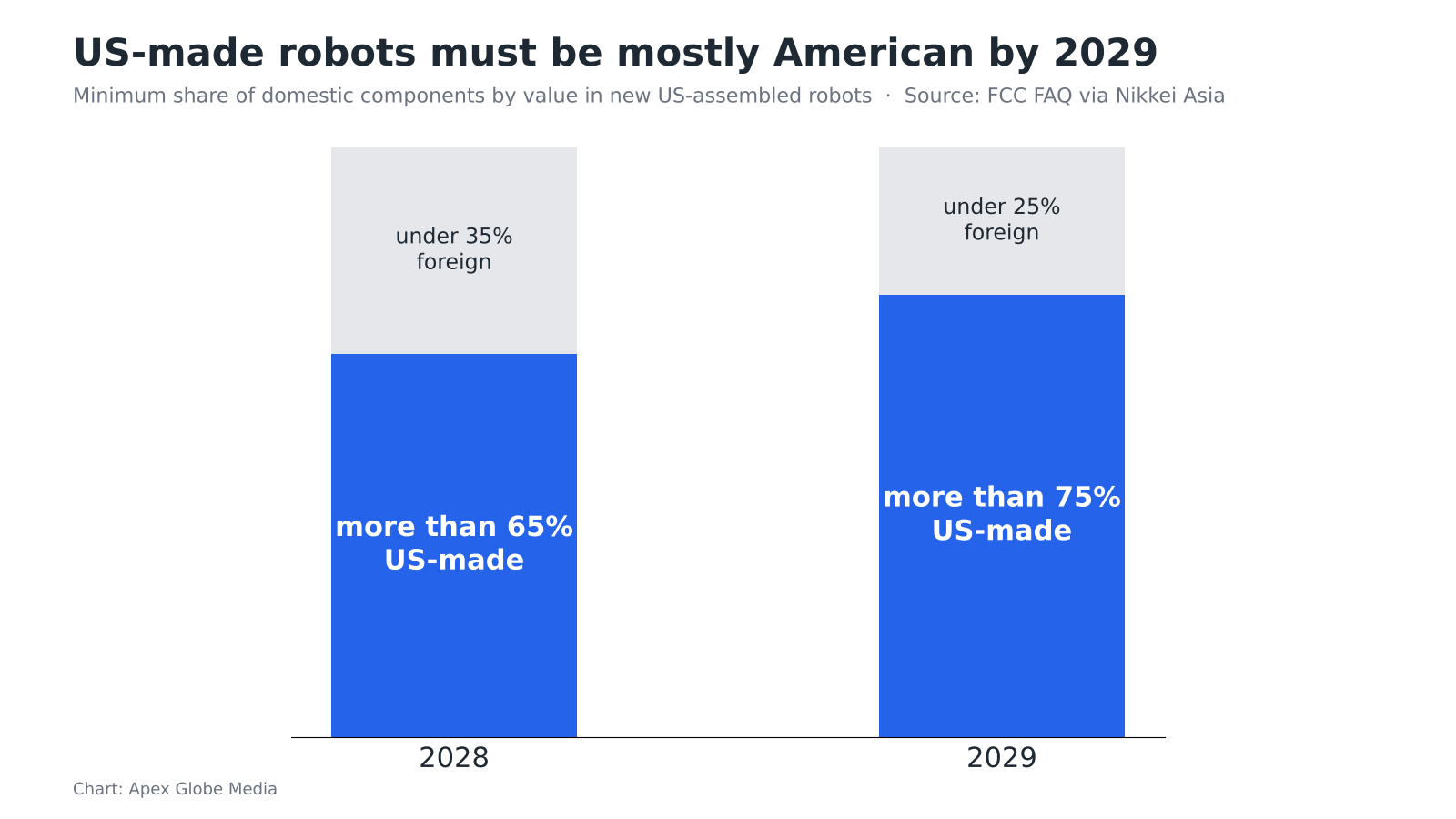
Robots assembled in the US face their own test: they must contain more than 65% domestic components by value in 2028 and more than 75% in 2029, according to the FCC’s FAQ, as reported by Nikkei Asia. The robot rules sit alongside a 100% tariff on Chinese electric vehicles, a ban on cars running Chinese software and drone tariffs that took effect in September.
Why swapping suppliers is so hard
The domestic-content targets are where the business problem shows. Actuators, the motors and gears that move a robot’s joints, typically make up 40% to 60% of a humanoid’s hardware cost, and China supplies most of the batteries, lidar sensors and motor controllers used to build robots, research firm Gavekal wrote in an August report cited by Nikkei Asia. “Chinese parts are not individually prohibited, but the cumulative reliance on Chinese supply chains will make it hard to hit those targets,” its authors wrote.
Company examples gathered by CNN’s Stephanie Yang show what that means in practice:
- Chef Robotics, a San Francisco maker of robot arms for food factories, assembles in the US but still sources the tools at the end of its arms from China. Founder Rajat Bhageria told CNN that some US machine shops simply said “we can’t do this”.
- Kopin, which makes micro displays for military drones, took more than two years to move some production from China to the US. Its CEO Michael Murray told CNN that US-made parts cost up to 25% more, and that China can make more micro displays in a week than the US can in a year.
- At the University of Illinois Urbana-Champaign, professor Sayan Mitra told CNN that replacing Chinese humanoids with US ones could cost ten times more, and that some drone types have no US alternative.
The robot category also reaches the home. New models of robot vacuums, pool cleaners and lawn mowers fall under it, and IDC analyst Jitesh Ubrani told CNN that US consumers are likely to “end up just paying a whole lot more.”
Who gets an exemption?
The conditional approval process is the main unknown for business. “What that determination process is like has not been particularly transparent,” Kevin O’Hanlon of the Global Electronics Association told Nikkei Asia. Some router makers have reportedly received temporary exemptions in exchange for commitments to manufacture in the US, but analysts question whether Chinese companies have any real path. Applications for conditional approval are due by January 1, 2028.
The magnet deadline
The sharpest near-term risk is in rare earth magnets, which go into almost every electric motor. Ghost Robotics, which builds robot dogs for industry and the military, has moved motor production to South Korea and buys neodymium magnets from a European supplier, but the raw material still comes from China and will be subject to a government ban starting in January, CEO Gavin Kenneally told CNN. “It’s an extremely difficult supply chain problem to solve in the short term,” he said, while adding that in the long run such bans “have had the stimulative effect that the government had designed them to have.”
The inverter part of the ban also touches the power grid, where AI data centers are already straining supply, as Google’s nuclear power deal in Finland showed.
Our take
The policy is a bet on sequencing: ban first, build domestic supply second. Its supporters have a point that long-signaled rules push companies to move, as Ghost Robotics shows. But the gap years carry a real cost, and they fall hardest on startups, universities and smaller hardware makers that cannot absorb 25% higher component prices. For businesses, the practical steps are clear: check which products were authorized before July 28, plan for the 65% domestic-content rule now, and watch how many conditional approvals the government grants in the next few months, because that number will show whether the rules are a reshoring policy or a closed door.