

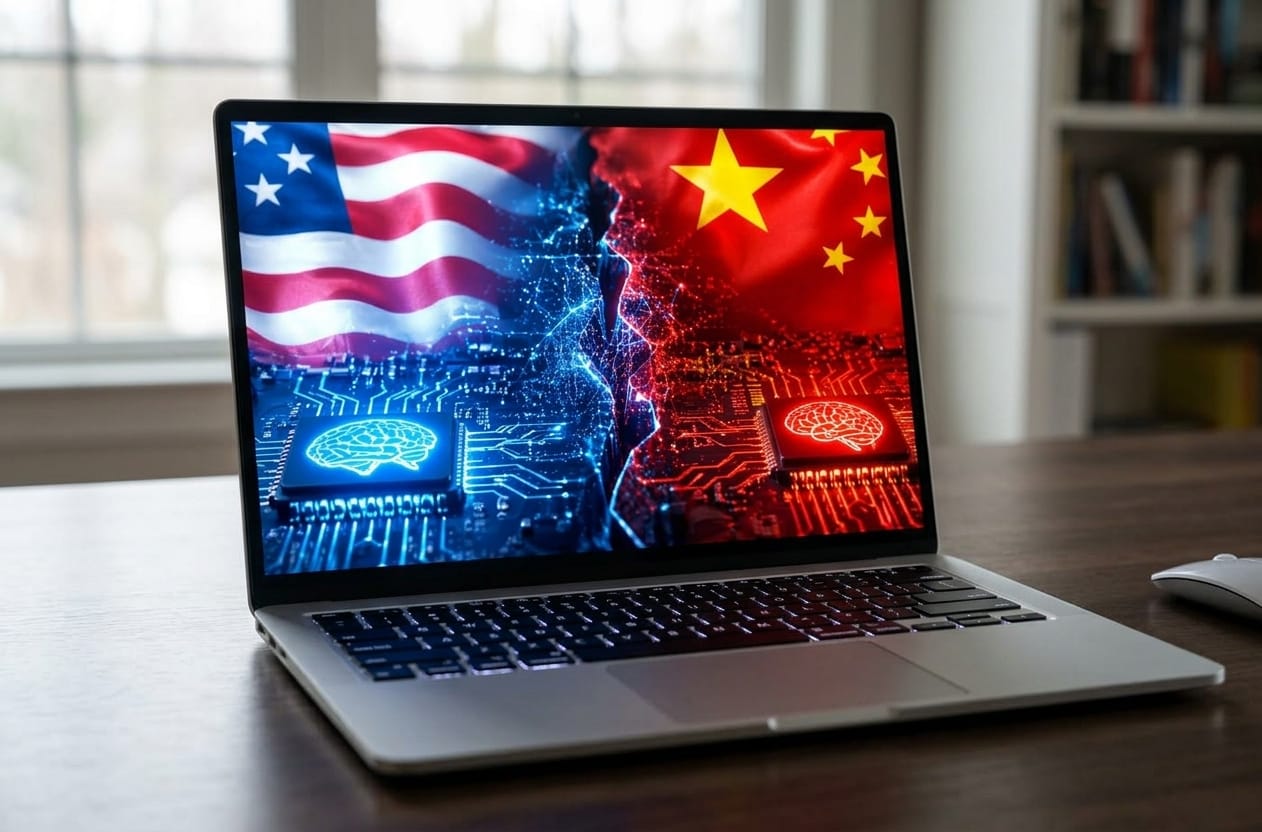

The US accuses Chinese AI firms of copying American artificial intelligence models on an “industrial scale.” In a joint advisory released on September 8, the National Security Agency (NSA), the Cybersecurity and Infrastructure Security Agency (CISA) and the FBI said six China-based companies had systematically used a technique called distillation to extract the capabilities of leading US models, according to the advisory.
The six companies named are DeepSeek, Moonshot AI, Alibaba, MiniMax, StepFun and Z.AI. The agencies say they “extracted billions of tokens across millions of exchanges/requests from U.S. frontier AI models” since at least late 2024, “likely with Chinese government awareness.” The targeted models include versions of Anthropic’s Claude, OpenAI’s GPT, Google’s Gemini and xAI’s Grok.
What distillation is
Distillation is a common method in AI development. A smaller “student” model is trained on the answers of a larger “teacher” model, so it learns to imitate the teacher’s abilities at a fraction of the cost. AI labs regularly distil their own models to create faster, cheaper versions.
The problem, according to the advisory, is when a company does this to someone else’s model without permission and at enormous scale. That usually breaks the terms of use of the AI service, and it lets the copier skip much of the expensive research and computing that went into the original. The agencies use the term “tokens,” the small chunks of text that AI models read and write, to describe the volume of data extracted.
What each company is accused of
The advisory goes into unusual detail. It says DeepSeek used distillation to obtain reasoning, legal and agentic capabilities, meaning the ability to carry out tasks on its own, to help train its R1 and V3 models. Moonshot AI is accused of extracting software engineering and maths abilities linked to its Kimi K2 and Kimi K3 models. Alibaba allegedly used distilled data to improve its Qwen models, MiniMax its M2 model, and StepFun its Step 4 model, while Z.AI is said to have targeted step-by-step reasoning.
The agencies argue that distillation is “not a supplement to these companies’ AI model development, but the critical core of it.” That is a direct challenge to the idea that Chinese labs closed the gap with American ones mainly through their own innovation.
How the extraction allegedly works
US AI services restrict access from China, so the advisory says the companies used workarounds. These include “transfer stations,” grey-market services that resell access to US models through intermediaries and hide where requests come from. The companies also allegedly spread their activity across many accounts and providers to avoid detection.
What US companies are told to do
The advisory recommends four kinds of defence:
- Better detection: stronger identity checks and alerts for unusual patterns, such as new accounts that immediately hit maximum usage.
- Changing responses: giving suspected distillers answers that are less useful for training, without telling them.
- Sharing intelligence: exchanging warning signs between AI labs, cloud providers and companies that resell access to models.
- Standard controls: rate limits, which cap how many requests a user can send, plus logging and access controls based on published security frameworks.
Why the advisory matters
Washington has already restricted China’s access to advanced AI chips. The advisory suggests the competition is now also about protecting the models themselves, which can be copied through their answers without any chips or code changing hands. For the companies named, the accusations could bring reputational damage and possibly further US measures, although the advisory itself does not announce sanctions.
The models listed as targets are among the most widely used AI services in the world, including Grok, which recently expanded its mobile features, as described in our report on Grok AI on Android.
Why it matters for businesses
For AI companies, the advisory is a reminder that a model’s value can leak through its public interface. Any business that offers AI through an API, the connection other software uses to send requests, should monitor for unusual usage. For companies that use Chinese AI models, the allegations add a new legal and reputational question to consider alongside cost and performance.
Our take
These are allegations from US government agencies, not findings by a court, and the companies named have not yet had a chance to answer them in detail. But the level of detail is striking, and it fits concerns that US labs have raised for some time. The deeper issue is that AI models are hard to protect: anything a model can say, it can teach to a competitor. Detecting and blocking large-scale copying will become as important for AI companies as building better models.