

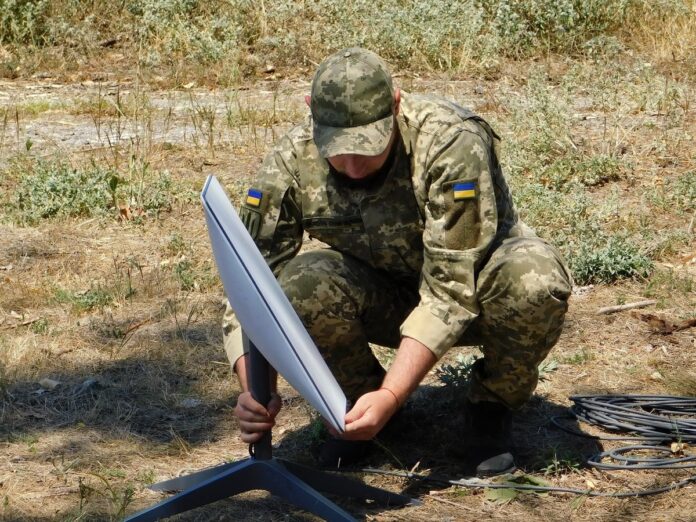


Starlink in Ukraine is working at full speed again, but the argument over who slowed it down has only grown louder. Elon Musk said on X over the weekend that SpaceX did restrict the service because Ukraine’s military had used it for “offensive drone strikes to kill people,” and that “that loophole was closed last week.” Kyiv says that was technically impossible. Behind the dispute is a simple speed limit that SpaceX first introduced in February to stop Russian drones, and that in October ended up hitting Ukraine’s own.
A speed limit built against Russia
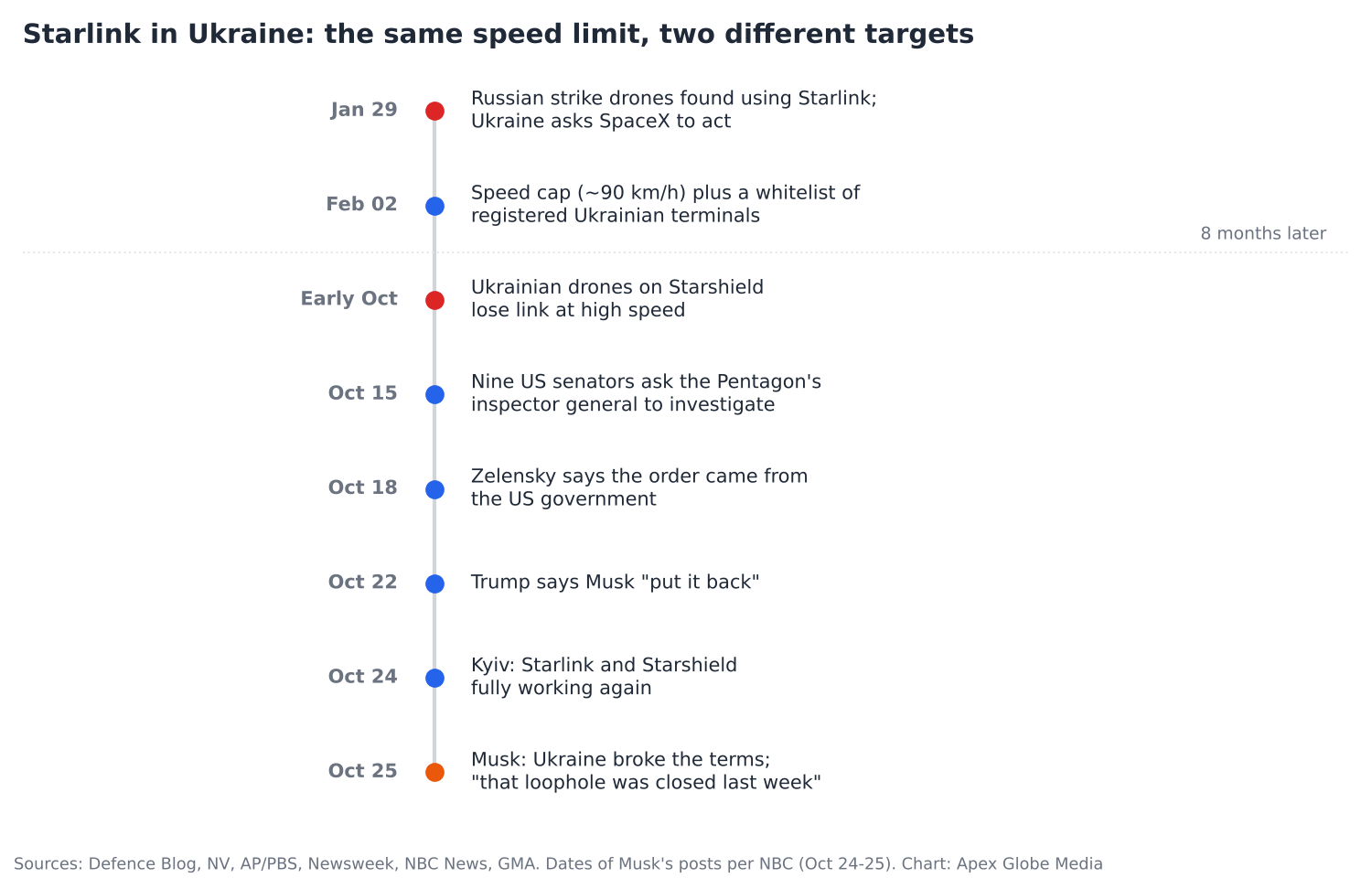
The story starts in January. Ukrainian officials found Russian long-range strike drones flying over Ukrainian cities with Starlink terminals on board. Ukrainian minister Mykhailo Fedorov said on January 29 that his team had contacted SpaceX within hours, Defence Blog reported. SpaceX’s fix was blunt: terminals moving faster than roughly 90 km/h would stop working, a threshold set just below the cruising speed of Russia’s fixed-wing drones, according to DroneXL.
To keep Ukraine’s own equipment online, terminals registered to Ukrainian units could be exempted through a whitelist. On February 2 Fedorov announced that only verified, whitelisted terminals would keep working, NV reported. Russian units relying on smuggled terminals lost much of their connectivity.
That February system is the key to the current dispute. It means commercial Starlink in Ukraine was already capped for anything moving fast, which is why Ukrainian officials say Musk’s accusation does not add up.
October: the cap hits Ukraine’s own drones
Early this month, Ukrainian drones connected to Starshield, the military version of Starlink that the US government pays for, began losing their link at high speed, AP reported. Ukrainian officials said the restriction came without warning and capped terminals in motion at about 100 mph (160 km/h), NBC News reported. That was enough to disrupt the interception of Russia’s jet-powered drones, and some missions were cancelled.
For two weeks no one claimed the decision. Musk wrote that for Starshield, “any limits on speed or usage are decided by the US military and ultimately POTUS.” President Trump said “it wasn’t me, and I don’t think it was Elon,” according to NPR. Zelensky said on October 18 that the instruction came from the US government, Newsweek reported. Nine US senators, four of them Republicans, asked the Pentagon’s inspector general to investigate and to brief them by November 1, ABC News reported. Senator Thom Tillis suggested the problem “may have occurred more locally within DOD Starshield systems, not with Starlink or SpaceX.”
On October 22, asked whether he had spoken with Musk, Trump said Musk “put it back.” By October 24, Kyiv said Starlink and Starshield were fully working again.
Musk’s new account
Then Musk changed the story. In posts on the night of October 24 into October 25, he wrote that “Ukraine military violated Starlink terms of service and used it for offensive drone strikes to kill people” and that “we simply enforced our terms of service when they were bypassed,” NBC News reported. Starlink’s terms do say the service is “not designed or intended for use with or in offensive or defensive weaponry.” Musk added that “were Starlink to be turned off, the Ukrainian front line would collapse immediately,” then wrote: “This is NOT a threat, it is simply a statement of fact.”
Kyiv rejects the claim. “It’s very strange that Elon Musk doesn’t know about the restrictions on Starlink’s operation in Ukraine,” said Serhii Beskrestnov, an adviser to Zelensky on defence technology. He said drones on civilian Starlink were already limited to 70 to 90 km/h, so “we physically cannot use commercial Starlink for deep strikes or medium-range strikes,” AP reported. Serhii Sternenko, a former drone adviser, said that missions needing satellite links could only run on Starshield, with moving terminals on a special list.
The two versions cannot both be complete. If the October limit was SpaceX enforcing its commercial terms, it is hard to explain why it hit Starshield, a government service, and why Musk earlier said such limits are set by the US military. If it was a Pentagon decision, Musk’s “we simply enforced” framing is misleading. SpaceX did not respond to NBC’s request for comment.
Why it matters beyond this week
This is not the first time. In September 2022 Starlink was interrupted during a Ukrainian push to retake territory; a 2025 Reuters report said Musk ordered that shutdown, which SpaceX called “inaccurate,” NBC noted. We described earlier how Russia, Ukraine and Iran now treat Starlink as a military target, and how SpaceX is expanding into mobile spectrum as well. Europe has looked for alternatives since 2025, with Eutelsat’s OneWeb network offering itself as a replacement, but as of 2025 its terminals in Ukraine numbered only in the thousands, compared with tens of thousands of Starlink dishes.
Our take
The technical facts here are fairly clear: a speed cap built to deny Russia satellite-guided drones was later applied in a way that hurt Ukraine’s air defence, and it was lifted after public pressure. What remains unclear is who decided, and that is the real problem. A country at war depends on a network whose owner, his government customer and the White House each gave a different account within two weeks. The senators’ request for an inspector general review is the right step, and its answer by November 1 will matter more than any post on X. For Europe, the lesson is not new, but it is now harder to ignore.