



OpenAI’s newest model is not its smartest, and that is the point. GPT-6.1 Terra, released on October 26, is built to operate computers: to look at a screen, click through applications, fill in forms and finish routine office tasks, quickly and cheaply. OpenAI says it does this at half the price of its previous models in the API. The launch shows where the competition in AI is moving, from who has the best model to who can run agents at a cost businesses will accept.
What Terra is for
Terra is the smaller, faster sibling of GPT-6.1 Sol and GPT-6 Astra, OpenAI’s flagship models. According to TestingCatalog and BleepingComputer, OpenAI describes it as a model for visual reasoning, computer use and everyday work, and highlights proposals, technical drawings, forms and video editing as tasks where it improves most on its predecessor, GPT-5.6 Terra.
“Computer use” means the model reads a screenshot as an image and decides where to click or what to type, so it can work in software that has no API. That makes it useful for the many business tasks that still live in browser forms and old desktop programs, and it is the technology behind agents that book travel, process invoices or update CRM records.
Terra is available to Plus, Pro, Enterprise and Edu subscribers in ChatGPT Work and in Codex, OpenAI’s coding agent, and to developers in the API as gpt-6.1-terra. API prices are $1 per million input tokens and $5 per million output tokens, which OpenAI says is 50% below GPT-5.6 Terra and GPT-6.1 Sol.
The benchmark claims
All the performance figures so far come from OpenAI and have not been checked independently. On Terminal-Bench 4.0, a test of coding tasks done in a command line, OpenAI says Terra solves 50.3% at maximum effort, against 21.5% for GPT-5.6 Terra. On an internal test built to provoke mistakes, its error rate at low effort fell from 53.6% to 16.7%, and at maximum effort it dropped 18 percentage points to 4.3%, close to the bigger models.
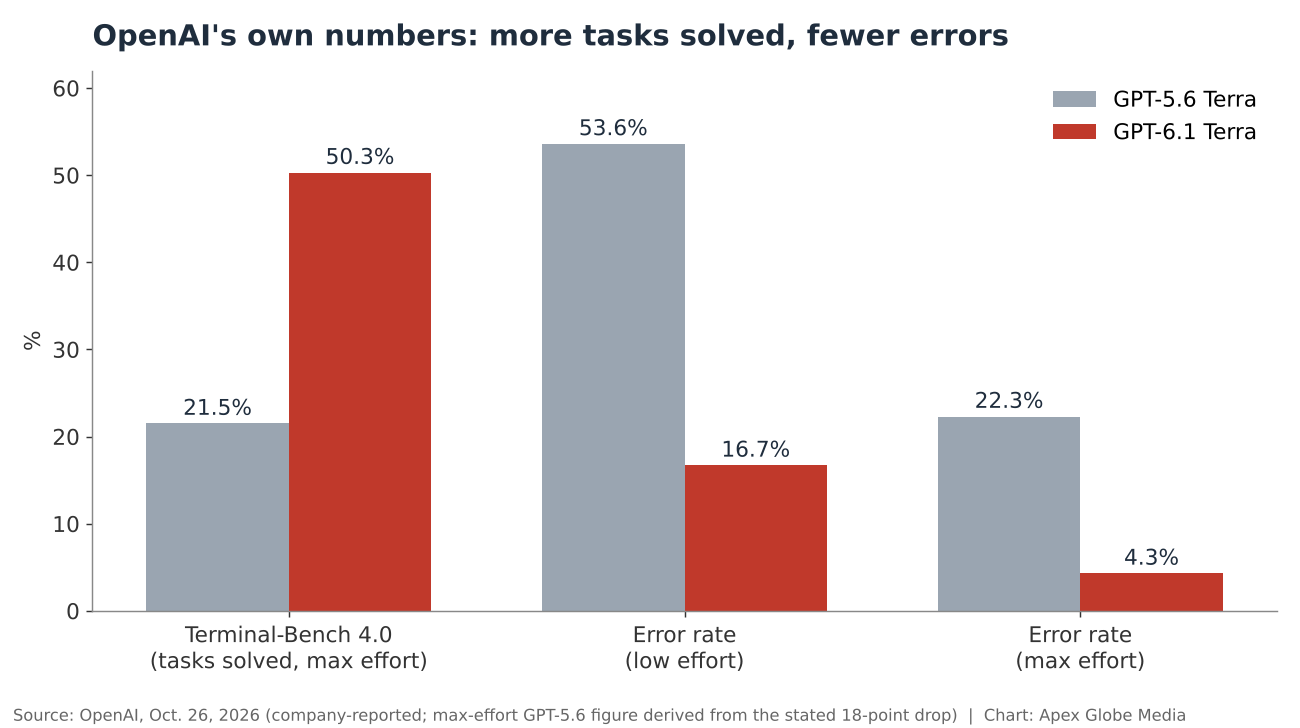
OpenAI also says Terra finishes tasks more than three times faster than Sol and Astra, matches Astra on its Agents’ Last Exam benchmark at a tenth of the price per token, and needs about a ninth of the cost per task of Anthropic’s Claude Opus 5.5 at maximum effort. OpenAI’s pitch is not that Terra beats every rival on accuracy, but that it gets close for far less money.
The company is open about the limits. It still recommends Sol or Astra for the most complex coding work.
A cheap model with a “Critical” cyber rating
One detail in the system card deserves more attention than the prices. OpenAI says Terra reaches the “Critical” cybersecurity threshold under its Preparedness Framework, the internal scale it uses to judge how much a model could help attackers, and that it carries over the safeguards used for GPT-6 Astra. OpenAI also reports better resistance to prompt injection, where instructions hidden on a web page or in a document hijack an agent, and says Terra more candidly reports what it could not do.
That combination matters. A model that can operate a computer, write working exploits and costs a dollar per million input tokens is a model that many more people can run at scale. The safeguards therefore carry more weight than they did when such capability was limited to expensive flagship models. We saw how hard containment can be in OpenAI’s own frontier training incident this month.
Why the price war matters
Agents use far more tokens than chat. A single task can involve dozens of screenshots and reasoning steps, so the cost per task, not the price per token, decides whether a business deploys an agent at all. By publishing cost per task next to accuracy, OpenAI is selling Terra to finance and operations managers, not to AI researchers.
It also puts pressure on Anthropic, whose Claude models have led on computer use and coding agents and whose Claude Duet pushed agents toward acting on their own. Terra arrives the same day Anthropic made its IPO filing public, a reminder that both companies now need revenue from volume use, not just from the most capable model. Our coverage of the GPT-6 Astra launch has more on OpenAI’s current model line-up.
Our take
Terra is a sensible product and probably a commercially important one: most companies do not need the smartest model, they need one that finishes ordinary tasks reliably at a predictable price. The caveat is that every number here comes from OpenAI’s own charts, and agent benchmarks have a poor record of predicting how agents behave in messy real software. Businesses should test Terra on their own workflows before trusting the cost-per-task figures, and security teams should note that a “Critical” cyber rating now comes in the budget tier.