



Greece has joined Australia as one of the few countries with a national social media ban for young teenagers that is actually on the books. Parliament approved the measure overnight on October 22 to 23, barring children under 15 from social networks such as Facebook, Instagram and TikTok from January 1, 2027. The politics drew the headlines, but the harder part is technical: how do you check the age of millions of users without building a new database of children’s identities?
What the law requires
According to Athens News and Global Banking & Finance Review, the ban covers online platforms where users create profiles, post messages, photos or videos and interact with others. Ordinary private messaging is not automatically treated as a social network, and general internet use, educational sites and government services are untouched. Parents cannot give their children permission to use covered platforms, and existing accounts must be checked as well as new ones.
Responsibility sits with the platforms, not parents. They must put “reliable age-verification systems” in place. Reports from Greek Reporter say Greece’s broadcasting council and data protection authority will supervise compliance, and that fines can reach 6% of a company’s global annual turnover, the ceiling under the EU’s Digital Services Act, the law that governs large online platforms in Europe.
The vote split along party lines. Only the governing New Democracy party backed the bill. PASOK, which proposed a more flexible regime for 13 and 14 year-olds, abstained, and the left and right-wing opposition parties voted against, several of them criticising how much the law relies on the platforms themselves.
Age checks through a government wallet
The interesting part is the technology Greece wants platforms to use. The government has built two apps, Kids Wallet and Gov.gr Wallet, that can confirm a user’s age. According to the reporting, the wallet tells the platform only whether the user is over or under 15, without passing on a name or date of birth. Technically, this is an age token: a signed yes-or-no answer from a trusted issuer, similar in principle to the digital identity wallets the EU is rolling out to all member states.
The law does not force platforms to use the government apps. Other solutions are allowed if they meet Greek and EU rules. That matters because the alternatives the industry has used so far, such as uploading an ID document or estimating age from a selfie, either collect sensitive data or make mistakes. A wallet-based check moves the identity question to the state, which already knows citizens’ ages, and leaves the platform with a single bit of information.
It is not a perfect fix. A token proves that someone with a verified identity confirmed the age, not that the person holding the phone is that someone. Shared family devices, borrowed accounts and VPNs, which make a user appear to be in another country, all remain possible ways around it.
Why France failed and Greece might not
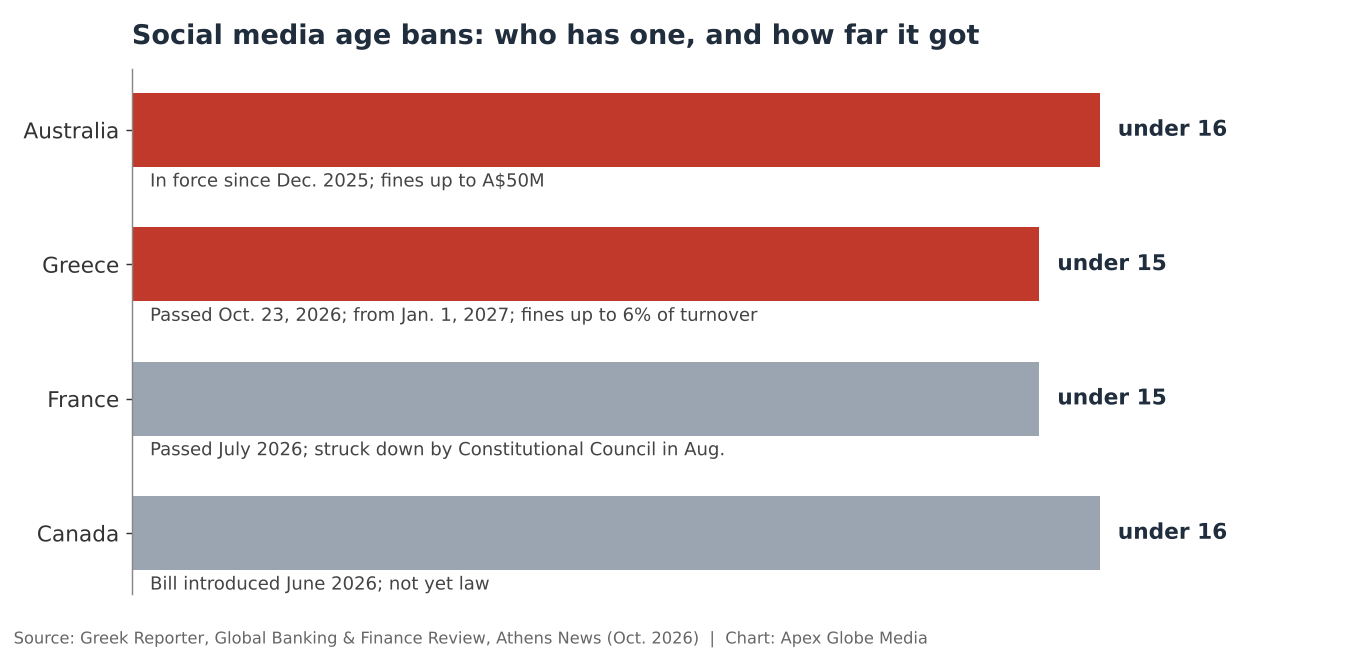
Greece is not the first EU country to try. France passed an under-15 law in July 2026, but its Constitutional Council struck it down in August as a disproportionate restriction on freedoms. Australia’s under-16 ban has been in force since December 2025, with fines of up to A$50 million. Canada’s proposed Safe Social Media Act, which would bar under-16s, has not yet passed Parliament.
Greece has tried to avoid France’s fate by tying its law to the Digital Services Act and by working with six other EU countries and the European Commission on a shared age verification solution. Reports also say the Greek measure is designed to give way automatically if the EU adopts its own rule on the same issue. The government had delayed the bill from August precisely because Brussels was preparing child protection rules of its own.
For platforms, the pattern is becoming hard to ignore. Each new national law brings its own age, its own deadline and its own verification method, and the fines now scale with global revenue. Brazil’s new government is also keeping pressure on Big Tech, and the companies face the prospect of a patchwork of rules unless the EU sets one standard.
Our take
The privacy-preserving wallet is the most useful thing in this law, because it shows that age checks do not have to mean handing passports to social networks. Whether the ban itself works is a different question: critics of Australia’s ban have long warned that determined teenagers will find ways around such rules, and the real effect may be on design choices platforms make for younger users. Greece’s bet is that Europe will follow with a common rule. If it does, the Greek wallet could become a template; if not, Athens will have built a strict law that a single EU regulation can switch off.