

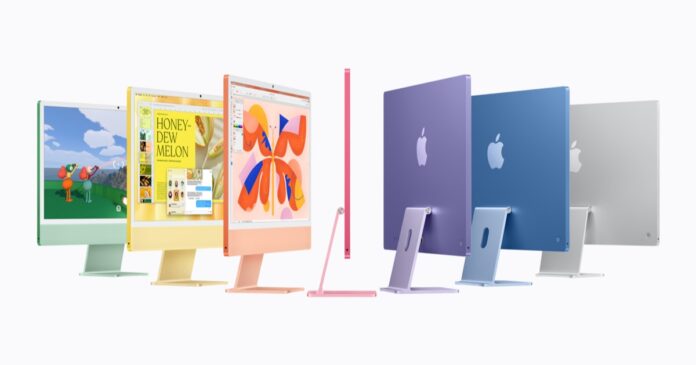

Apple’s new Macs are, on the surface, routine updates. The iMac and the 14-inch MacBook Pro announced on October 27 look exactly like the models they replace and cost the same. What has changed is inside: the M6 chip, built on TSMC’s 2-nanometre process, and a set of performance claims that put running AI models on the computer itself, rather than in the cloud, at the centre of the pitch.
What Apple announced
According to Apple’s press release, the 24-inch iMac comes in two versions. The $1,499 model has a 10-core CPU, a 10-core GPU and two Thunderbolt ports; the $1,699 model has 12 CPU and 12 GPU cores, four Thunderbolt ports and an optional 2.5 gigabit Ethernet port in the power adapter. Both come in the same seven colours as before.
The 14-inch MacBook Pro starts at $1,999 with 16GB of memory and a 1TB drive. MacRumors reports that its M6 has a 12-core CPU and 12-core GPU, two more of each than the M5, and that Apple claims up to 30% faster graphics and up to 25% faster AI workloads than the previous model. Both machines add Wi-Fi 7 and Bluetooth 6. Pre-orders open on October 28 and the computers ship on November 6.
The M6 has what Apple calls a dual 16-core Neural Engine, its block of circuits dedicated to AI calculations, and puts a “Neural Accelerator” in each GPU core. Memory bandwidth, the speed at which the chip can read data from memory and a key limit on how fast AI models run, rises to 170GB/s. MacRumors notes a catch on the MacBook Pro: the base 16GB version stays at 153GB/s, and only the 24GB and 32GB configurations get the full figure.
The AI numbers
Apple’s comparisons tell you what it thinks buyers care about. Against the M4 iMac, it claims up to 1.5 times faster Excel performance and up to twice the graphics speed in photo editing. The largest number is for AI: up to five times faster prompt processing in LM Studio, an app for running open-source language models locally. Against an M1 iMac, Apple puts that figure at 12 times.
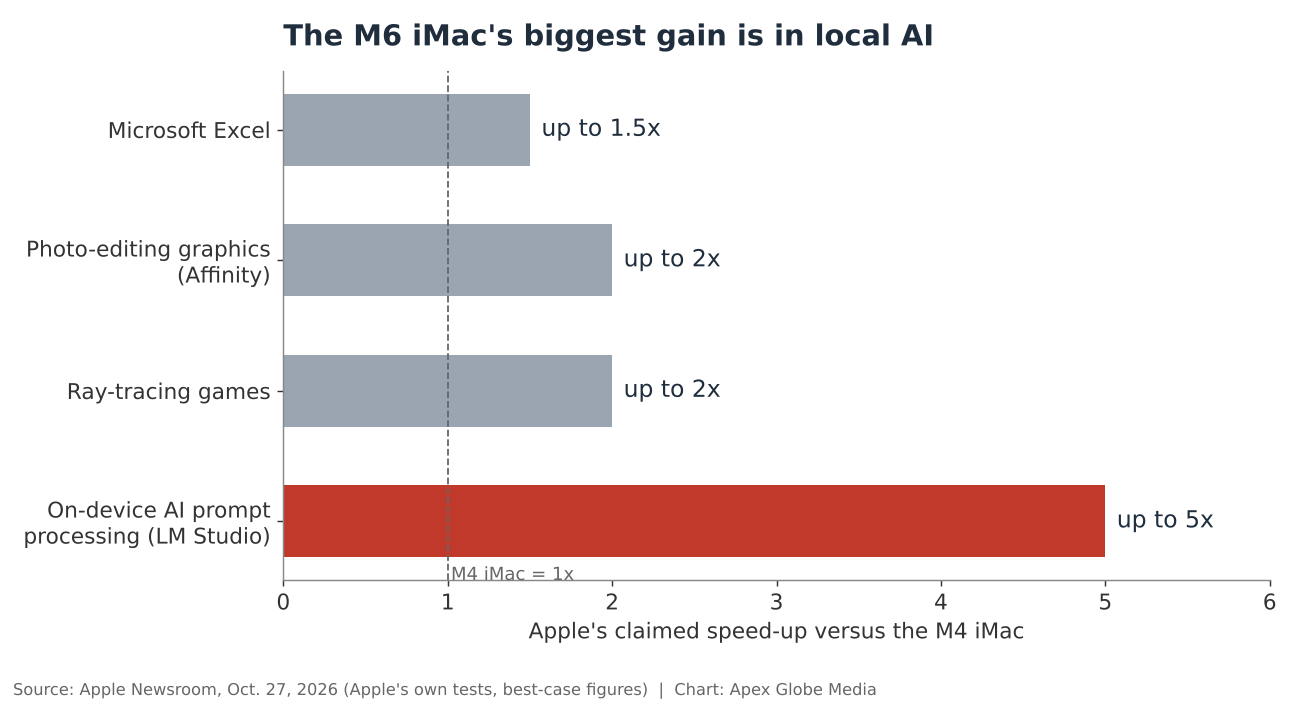
These are Apple’s own best-case tests, measured against specific configurations, and independent benchmarks are not out yet. Prompt processing is also only one part of using a language model: it measures how quickly the model reads the input before it starts writing an answer. Still, the direction is clear. As AI assistants become part of everyday software, the speed at which a computer can run a model locally becomes a selling point, both for privacy, since data does not leave the machine, and for cost.
That last point matters more than it used to. Apple’s own release notes that server-side AI features, including the new Siri AI, have daily usage limits, and that expanded access will cost money in the future. The more a Mac can do on its own chip, the less users depend on paid cloud capacity. We saw the same economics from the other side this week, when Meta announced plans to raise up to $95 billion to pay for its AI data centers.
Who should upgrade
Probably not owners of the previous models. MacRumors’ buyer’s guides conclude that most M4 iMac and M5 MacBook Pro owners have little reason to switch, and that a discounted M4 iMac remains a good buy for everyday use. The case is stronger for anyone on an M1 or Intel Mac, and for people who already run AI models locally and are limited by speed.
The timing also leaves a question. Apple is expected to show higher-end 14- and 16-inch MacBook Pro models with touch-screen OLED displays at its “Pro and Tell” event on October 28, the day after this launch, according to MacRumors and Bloomberg. Buyers weighing a $1,999 MacBook Pro may want to wait a day to see what sits above it. For more on Apple’s hardware this autumn, see our report on iPhone Duo screen cracks.
Our take
The M6 is a solid, evolutionary chip, and Apple is right to sell it on local AI rather than on bigger Excel numbers that few people notice. But the headline five-times figure covers one narrow task in one app, and the best memory speed is reserved for configurations that cost more. The more interesting signal is in the small print about Siri AI’s daily limits and future fees: Apple is preparing users to pay for cloud AI, and the M6 is the hardware argument for doing more of it on the device instead.