


For most of the AI boom, Big Tech paid for data centers out of its own pocket. Meta has just shown the limits of that model. On October 26 the company announced plans to raise up to $95 billion by selling new stock to fund its AI infrastructure and what Mark Zuckerberg calls superintelligence. The shares fell about 2% on the day and are down almost 10% since its earnings report last week.
How the $95 billion is built
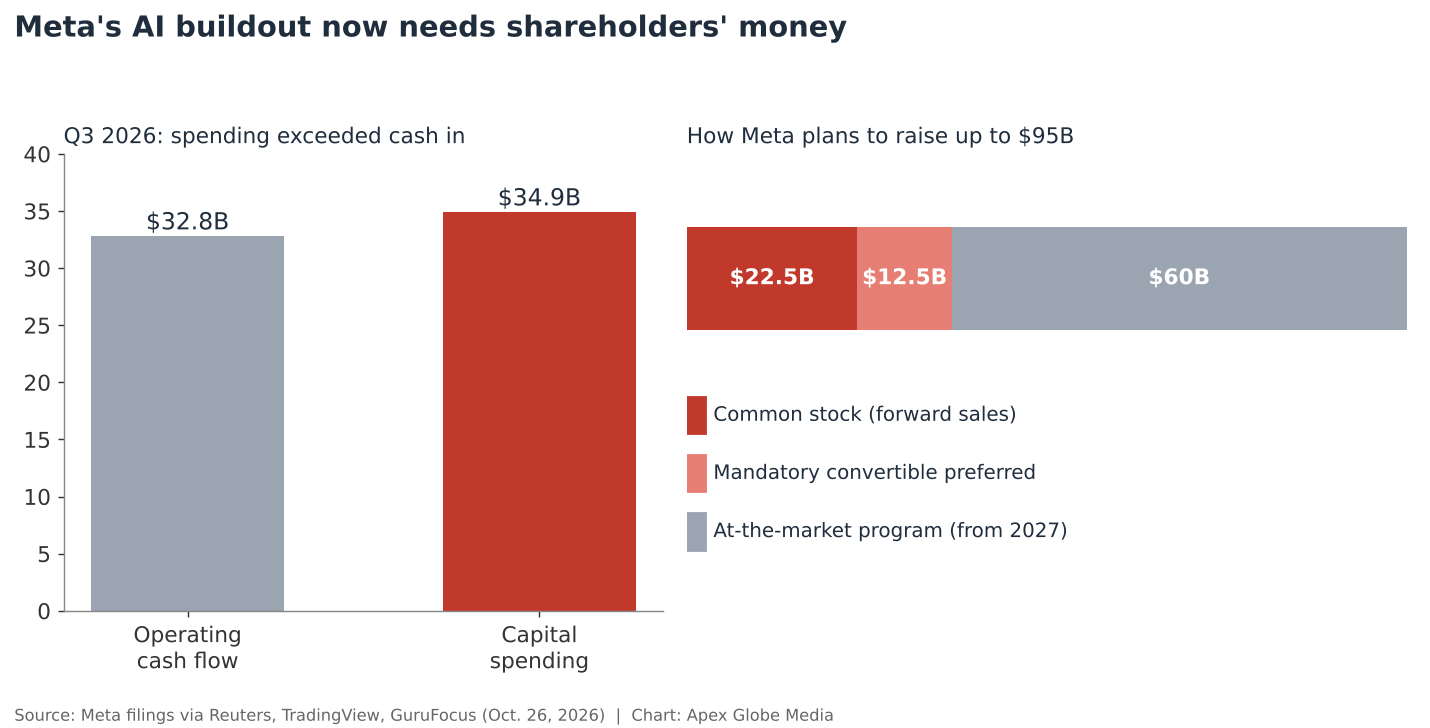
The plan has three parts. According to TradingView and GuruFocus, which summarised the offering documents, the first tranche of about $35 billion consists of $22.5 billion of Class A common stock and $12.5 billion of mandatory convertible preferred shares, which automatically turn into ordinary shares later.
The common stock is sold through forward sale agreements, so Meta does not receive the money straight away. It can draw it later, when it needs it. The remaining $60 billion would come from an at-the-market programme, in which a company sells shares gradually into the market at current prices. That part would use a new class of non-voting Class C shares, expected to begin trading in early 2027. GuruFocus stresses that the $95 billion is potential fundraising, not cash already secured.
One unusual detail: Nvidia, AMD and Broadcom, which sell Meta the chips and networking hardware it is buying, have indicated non-binding interest in buying up to $5 billion of the shares between them. Suppliers investing in their biggest customer is becoming a pattern in AI, and it ties the chipmakers’ fortunes even more closely to Meta’s spending.
Why Meta needs the money
The third-quarter numbers explain the decision. Revenue rose 26% to $64.6 billion, but the business no longer generates enough cash to cover its building programme. Operating cash flow was $32.8 billion and capital spending, including finance lease payments, was $34.9 billion, leaving free cash flow at minus $2.1 billion for the quarter. Reported operating profit fell 37% to $13 billion, partly because of a $9.9 billion litigation charge.
Spending is still going up. Meta now expects capital expenditure of $135 billion to $145 billion in 2026, after raising the bottom of its range. It ended September with $82.5 billion in cash and marketable securities, but also $80.9 billion of long-term debt.
Equity is the expensive option. New shares dilute existing shareholders, meaning each share represents a smaller slice of the company. Companies usually prefer to borrow, especially when interest is tax-deductible. Meta’s choice suggests it does not want to add much more debt on top of what it already carries, or that the debt market is demanding a higher price for AI projects. Investors have grown wary of lending against data centers whose returns are years away, a mood we described in this morning’s report on SpaceX’s $40 billion GPU lease, which took a different route by leasing chips from a private credit fund.
Three ways to pay for AI
This week shows how varied the funding has become. SpaceX shifted the cost of chips to Apollo and its partners through leases. Anthropic is heading for the public market with an IPO, as its S-1 filing showed. Meta, already public and profitable, is asking its own shareholders to put in more money. In each case the message is the same: the cost of the AI buildout has outgrown the cash flow of even the richest companies.
For Meta the question is what the extra computing power will earn. It has early signs to point to: the company says more than 10 million users in the U.S. and Canada joined its Muse product in its first weeks, with shopping as the main use. But those are engagement numbers, not revenue, and the market reaction suggests investors want to see the returns before they fund more of the spending.
Our take
Selling stock to fund capital spending is what younger, cash-hungry companies do, not one of the most profitable businesses in history. That Meta is doing it says a lot about the scale of the AI race and about how far Zuckerberg is willing to go to stay in it. The structure is clever, since forward sales and a slow at-the-market programme let Meta raise money only as it needs it. But shareholders are being asked to pay twice: once through dilution and again through years of negative free cash flow, on the promise that superintelligence will be worth it.