


The Anthropic IPO is now official. On October 26 the maker of Claude made its registration statement public, opening its books ahead of a planned listing on the Nasdaq under the ticker ANT. The headline numbers are extreme in both directions: $16.3 billion in revenue for the first half of 2026 and an $80.7 billion net loss. The more lasting story, though, is in the governance pages, which show that investors buying shares will get almost no say over how the company is run.
The numbers behind the headline loss
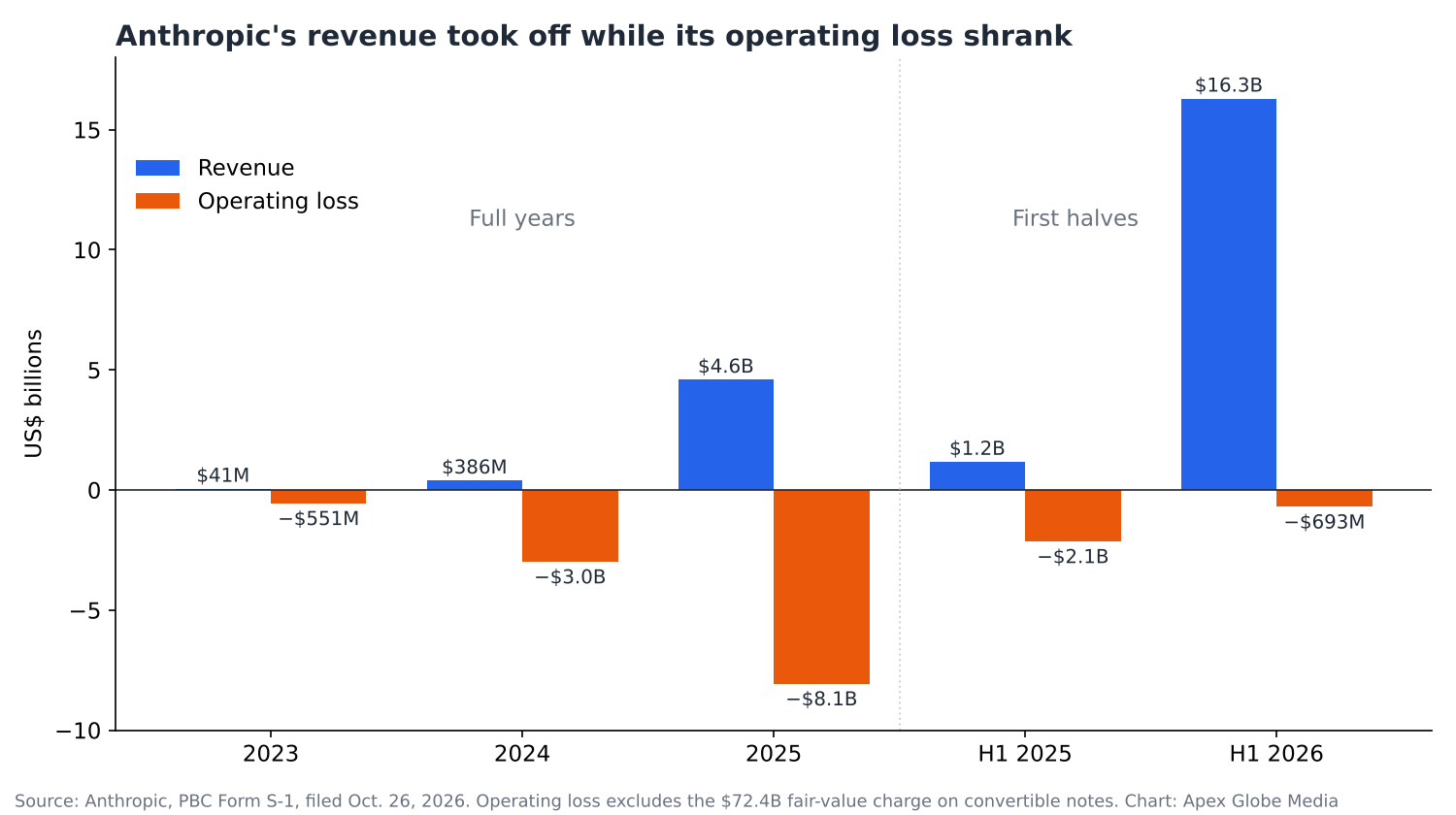
According to the Form S-1 filed with the SEC, Anthropic’s revenue for the six months to June 30 reached $16.29 billion, up from $1.16 billion a year earlier. For full years, revenue went from $41 million in 2023 to $386 million in 2024 and $4.59 billion in 2025.
The $80.7 billion loss looks catastrophic, but most of it is an accounting effect. Anthropic has borrowed from Amazon, Google and others through convertible notes, loans that can turn into shares. As the company’s estimated value rose, so did the value of those notes, and that increase is recorded as a loss. Fortune calls it “one of the largest half-year losses any company has ever recorded,” with $72.4 billion of it coming from that charge.
The operating figures tell a different story. The operating loss for the first half was $693 million, down from $2.1 billion a year earlier and $8.1 billion for all of 2025. By Anthropic’s own adjusted measure, which strips out some costs, it made a $1.6 billion operating profit, a 10% margin. Compute and infrastructure, the cost of the chips and data centers that run Claude, was the largest expense at $8.9 billion for the half year.
Growth metrics to read carefully
The filing leans on a few striking metrics. Customers paying Anthropic at least $100,000 a year grew from more than 950 to more than 11,900 between September 2025 and September 2026. Net revenue retention, which compares what existing customers spend now with what they spent a year earlier, was about 900%. In other words, the average large customer spends roughly nine times more than a year ago.
The company also reports “Run-Rate Revenue,” but the filing is candid about its limits. It is calculated by multiplying the last 28 days of usage fees by 13 and monthly subscriptions by 12, and the S-1 warns that it “is not a substitute for revenue” and that it assumes recent activity continues for a full year. The actual figure was still blank in the filing. Investors should treat any run-rate number quoted around the IPO as a snapshot, not a forecast.
Two more details stand out. About 80% of revenue in the first half came from pay-per-use fees, mostly from businesses building on Claude. And 48% of revenue was sold through the cloud marketplaces of Amazon, Google and Microsoft, which bill customers and pass the money on. That makes Anthropic’s biggest investors also some of its most important sales channels and competitors.
Who will control Anthropic after the IPO
This is where the S-1 departs most from a normal tech listing. Anthropic is a public benefit corporation, a company legally required to weigh a stated public purpose alongside profit. Its purpose is “the responsible development and maintenance of advanced AI for the long-term benefit of humanity.”
Control will be split between two groups that hold no economic stake. A Long-Term Benefit Trust, an independent body of five “financially disinterested” trustees with expertise in AI safety, national security and public policy, will hold Class T stock that lets it elect and remove a majority of the board. Separately, the seven co-founders, including CEO Dario Amodei and President Daniela Amodei, will hold a single share of Class F stock through a jointly owned company. That one share carries 50.1% of the total voting power on most shareholder matters. Employees get a separate class with limited voting rights.
The Class A shares sold to the public carry one vote each, but with the founders’ share holding a permanent majority, outside investors cannot outvote them. The filing says Anthropic will be a “controlled company” under Nasdaq rules, which exempts it from some board independence requirements. The founders’ control ends only if fewer than three of them remain in the arrangement or the special share is redeemed. Anthropic has also put 5% of its fully diluted shares into a wholly owned public benefit fund.
What comes next
The price range and share count are still blank. Goldman Sachs and Morgan Stanley lead the offering, and Fortune reports that a listing is expected around Thanksgiving week at a valuation of $1.5 trillion to $2 trillion. We covered the risk warnings in the confidential draft in our earlier piece on the Anthropic IPO prospectus, and the context of OpenAI putting its own IPO on hold.
Our take
The financials are better than the $80.7 billion headline suggests: Anthropic is close to breaking even on operations while growing more than tenfold. The governance is the real trade-off. Buyers of ANT shares will be betting on the business while handing control to the founders and a trust whose job is to put safety ahead of their returns if the two conflict. For a company that warns its own product could be dangerous, that may be the right design. But investors should price it in, because a stock with no real voting power depends entirely on trusting the people who hold it.