

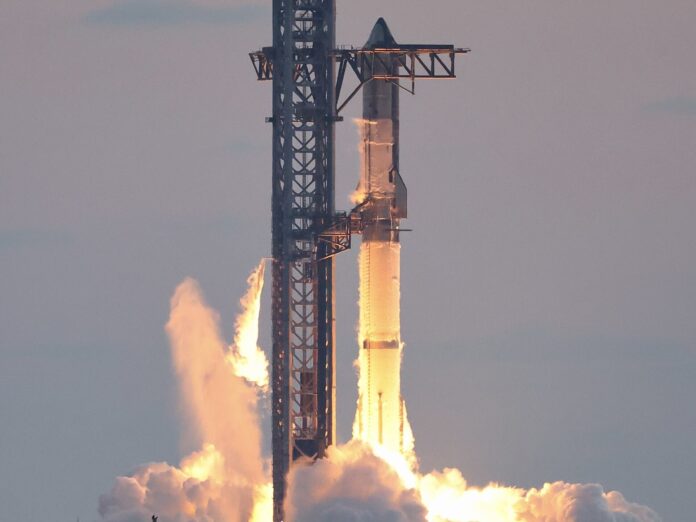


Tesla and SpaceX have each set up a special committee of independent directors to study a possible merger, Elon Musk said on SpaceX’s third-quarter earnings call on October 20. It is the first official confirmation that the two companies are talking. A Tesla-SpaceX merger would combine businesses worth roughly $2 trillion (SpaceX) and $1.5 trillion (Tesla), according to Reuters, which would make it the largest deal ever.
“Because I’m a conflicted party, I can’t actually be in the discussions of the special committees,” he said. “Do I think it would be a good idea? Yes. But at the end of the day, the shareholders have to be supportive of this.” Asked whether a deal was certain, he answered: “I think that would be overstating it.”
Two companies moving in opposite directions
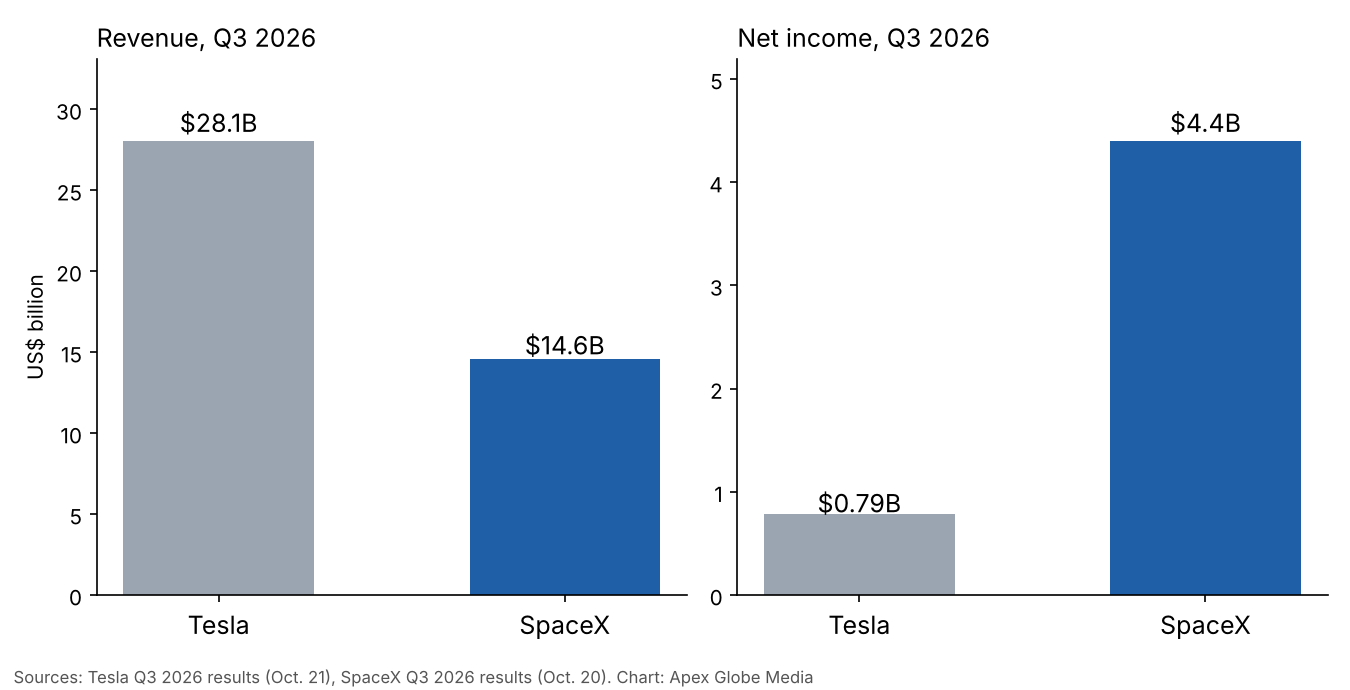
The numbers released the same week explain why SpaceX, not Tesla, is seen as the natural buyer in any Tesla-SpaceX merger. SpaceX reported revenue of $14.6 billion, up 161% from a year earlier, and a net profit of $4.4 billion, reversing a loss of $1.05 billion a year earlier, AP reported and Al Jazeera. A day later, Tesla reported roughly flat revenue of $28.05 billion and a 43% drop in net income to $787 million as spending on AI, self-driving and the Optimus robot climbed.
SpaceX itself is no longer mainly a rocket company. Since merging with Musk’s AI company xAI in February, its largest business by revenue is the AI unit it calls Super Intelligence, which brought in $7.56 billion in the quarter, Via Satellite reported. Starlink is still where the profit comes from. The company spent $19.6 billion on capital projects in the quarter, nearly triple a year earlier, and expects $35 billion to $40 billion in the current quarter, AP reported. Musk said the two companies have a lot to gain from cooperating on AI, chip design, robots, launch and connectivity.
The vote that makes it hard
On SpaceX’s side, approval looks simple. Musk owns just under half of SpaceX’s shares but controls more than 80% of the voting power through a dual-class structure, according to Bloomberg as cited by Reuters. Tesla is different. Musk owns nearly a fifth of it, and he said a deal would need “a 50% vote of all shares – not just those who vote – but of all shareholders, and that’s quite a high hurdle.”
The difference between “votes cast” and “all shares” is the key. Tesla has a large base of individual investors, a group that typically votes far less often than big funds. Under a votes-cast rule, a deal could pass with a majority of whoever turns up. Under an all-shares rule, every shareholder who stays home effectively counts as a “no.” Even if Musk’s own stake of roughly 20% counts toward the total, the deal still needs about 30% of Tesla’s remaining shares to actively say yes. Tesla has introduced an “auto-vote” option that lets shareholders have their shares cast automatically in line with the board’s recommendation, but according to Autoevolution it takes effect only at the meeting after December 3.
Why insiders worry about Musk’s comments
The independent committees exist precisely because Musk sits on both sides of the deal. Reuters reported that some people working on the talks fear his public comments could invite shareholder scrutiny and delay the process by several weeks; one source called the disclosure a “mess.” According to Reuters, SpaceX approached Tesla in recent weeks, and options include SpaceX buying Tesla outright or both companies combining under a new holding company, possibly in an all-stock deal.
The Bloomberg Billionaires Index estimates that a deal could add more than $110 billion to Musk’s fortune if it counts as a change of control under his Tesla pay awards, letting about 286 million shares vest now instead of in January 2028.
Many involved see parallels with Tesla’s 2016 purchase of SolarCity, a solar company founded by Musk’s cousins. Shareholders sued, arguing that Musk had steered Tesla into rescuing his investment. The courts eventually upheld the deal as fair, but the case took years, and Tesla’s directors settled related claims for $60 million. This time the legal ground is different: both companies have moved their incorporation from Delaware to Texas, where shareholders face higher hurdles to sue. “The Texas thing is a wild card,” Columbia law professor Eric Talley told Reuters. “No one knows how Texas deals with cases like this.”
What happens next
Nothing is agreed. Barclays has suggested a deal could be announced before Tesla’s annual meeting on December 3, while Bloomberg reported a push to complete one in the first half of 2027. On Tesla’s own earnings call the day after SpaceX’s, no merger questions were taken, and Musk later said he had already said everything he should, describing the topic as “tap dancing through a minefield.”
For Tesla shareholders, the question is what they would own afterwards. Today they hold a carmaker with an expensive AI and robotics bet. After a merger they would hold a slice of a rocket, satellite internet and AI company whose biggest costs are data centers. We have covered both sides of that story, from the SpaceX lockup expiry and its spectrum purchase to the federal audit of Tesla’s Cybercab.
Our take
The business case for combining the two companies is real but thinner than Musk suggests: chips, robots and connectivity can in principle be shared through commercial agreements, without a merger. The stronger force is financial. SpaceX is growing fast and profitable, Tesla’s profit is shrinking, and a deal would simplify Musk’s control and could accelerate his pay awards. That is exactly why the independent committees, and the 50%-of-all-shares vote, matter. If a Tesla-SpaceX merger does come, Tesla’s ordinary shareholders, who rarely vote, will decide the largest merger in history simply by whether they bother to show up.