



Dark energy, the unknown force that drives the expansion of the universe faster and faster, may not be constant after all. A new catalog of 2,884 exploding stars, assembled by an international team led from the University of Queensland, adds to the evidence that dark energy has changed over cosmic time. The result does not settle the question. What it does is remove one of the main reasons to doubt last year’s hints, and that matters more than the headline number.
What the astronomers built
The catalog is called Unite. It combines the two largest existing collections of Type Ia supernovae: Pantheon+, a compilation of earlier surveys, and the five-year sample of the Dark Energy Survey (DES-SN5YR). A Type Ia supernova is the explosion of a white dwarf star. These explosions reach a similar peak brightness, so astronomers use them as “standard candles”: the fainter one looks, the farther away it is. Comparing distance with how much the light has been stretched by expansion shows how fast the universe grew at different times.
“We’ve rebuilt 3 decades of astronomical observations into a single, consistent framework,” lead author Ryan Camilleri, a PhD candidate at UQ, said in the university’s announcement. The data come from seven surveys, including the Dark Energy Survey, Pan-STARRS and the Sloan Digital Sky Survey. According to the paper on arXiv, the 23 authors applied the same modelling, selection rules and bias corrections to every supernova and re-measured the mass of the host galaxy for more than 98% of them.
The preprint was posted in early September and has been submitted to the Publications of the Astronomical Society of Australia. It has not yet been through peer review. Wider coverage followed this week, including a ScienceDaily summary on October 22.
Why the old hints needed a referee
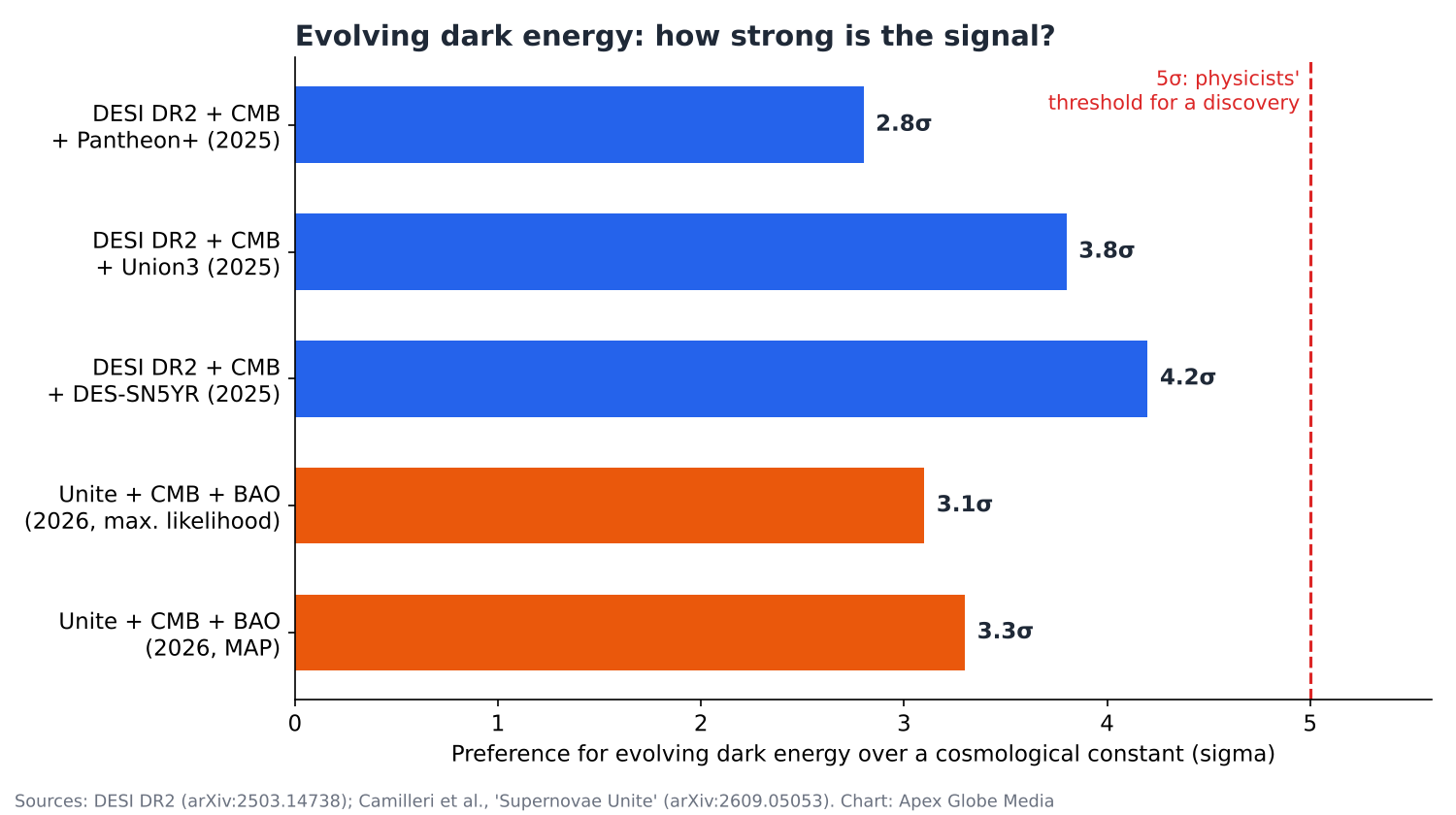
In March 2025 the Dark Energy Spectroscopic Instrument (DESI), which maps millions of galaxies to measure a pattern called baryon acoustic oscillations (BAO), reported that its data fit better with dark energy that changes over time. But the strength of that preference depended heavily on which supernova catalog was added to the mix. According to the DESI DR2 cosmology paper, combining DESI and the cosmic microwave background (CMB) with Pantheon+ gave 2.8 sigma, with the Union3 catalog 3.8 sigma and with DES-SN5YR 4.2 sigma.
Sigma measures how unlikely a result would be if nothing unusual were going on. Physicists usually require 5 sigma before calling something a discovery. A spread from 2.8 to 4.2 depending on the supernova sample was a warning sign: the answer seemed to depend on bookkeeping choices as much as on the sky. Critics could reasonably ask which catalog to trust.
What Unite actually found
Unite is that referee. When the team combined it with CMB data and BAO measurements from both DES and DESI, a model with constant dark energy left a strong tension between the early-universe CMB data and the later-universe measurements. Letting dark energy vary reduced that tension. The preference for the evolving model came out at 3.1 sigma using one statistical method and 3.3 sigma using another, the paper reports. The authors also note that a Bayesian comparison, which penalises a model for having extra free parameters, shows only a weak preference.
Cosmologists describe dark energy with a number called w, the ratio of its pressure to its density. A cosmological constant, the simplest option and the one built into the standard model of cosmology, has w equal to exactly −1 forever. Unite’s best fit puts today’s value at about −0.86 and adds a term that makes w change over time. In plain terms, the fit suggests dark energy behaved somewhat differently in the past and may now be weakening, which is how researchers at the University of Waterloo summarised the DESI hints last year.
The combined data shrink the allowed range for these parameters by about 30% compared with earlier constraints. That is the real scientific gain: a tighter target for the next generation of surveys.
Two methods, slightly different directions
The UQ team argues that the case is getting stronger because the evidence comes from independent methods. “Our supernova data from DES in 2024 first showed hints that dark energy may be time varying,” co-author Tamara Davis said in the announcement, adding that DESI’s galaxy maps found similar hints, “so, 2 completely independent measurements have found hints of time variation in dark energy.”
There is a catch that the press release mentions only briefly. According to the ScienceDaily summary, the new compilation deviates from the standard model “in a slightly different direction” than the 2024 DES data did. The measurements agree that something may be off, but not yet on exactly what. The corrections needed to merge decades of data from different telescopes, for cosmic dust, galaxy mass and gravitational lensing, are also places where small systematic errors can hide.
More data are coming. The team plans to add supernovae from the Dark Energy Bedrock All-Sky Supernova program (DEBASS), which is finding hundreds of explosions closer to Earth. Nearby supernovae anchor the whole distance scale, so better ones should make the next result harder to argue with. Big physics questions are increasingly being answered by large detector collaborations, as we saw with the IceCube neutrino observatory.
Our take
The honest reading of Unite is “less noise, same signal.” It did not push the evidence toward a discovery. Its 3.1 to 3.3 sigma sits in the middle of last year’s range. But it showed that the hint survives when the two biggest supernova samples are handled the same way, and that answers the most obvious objection to the DESI results. Whether dark energy changes over time is now a question that the next few years of nearby supernovae and galaxy surveys can realistically answer. Until then, “may be changing” is the correct headline, and anything stronger is ahead of the data.