

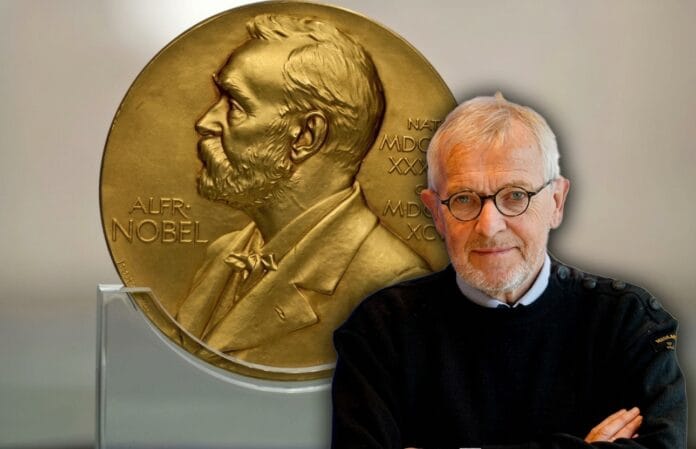

For almost four decades, Francis Halzen pursued an unusual idea: use the ice beneath the South Pole to catch particles that pass through almost everything. On October 6, the Royal Swedish Academy of Sciences awarded him the 2026 Nobel Prize in Physics “for decisive contributions to the IceCube Neutrino Observatory and the discovery of high-energy neutrinos of astrophysical origin,” according to the official announcement. The IceCube Nobel Prize rewards a new kind of telescope. It does not yet reward an answer to the question that telescope was built for.
Halzen, born in 1944 in Tienen, Belgium, is a professor at the University of Wisconsin–Madison and IceCube’s principal investigator. As the sole laureate, he receives the full 12 million Swedish kronor, about €1.1 million, at the ceremony in Stockholm on December 10, Euronews reported.
Particles that ignore matter
Neutrinos are tiny, electrically neutral particles that almost never interact with anything. Trillions pass through your body every second without effect, and most go straight through the Earth. That makes them very hard to catch, but also valuable. Light from distant objects can be absorbed by dust or lost over vast distances, and charged particles such as protons are bent by magnetic fields, so their direction says nothing about where they started. Neutrinos travel in straight lines and arrive intact. “This means they can provide information that is not available in any other way,” the Nobel committee wrote.
The universe contains natural particle accelerators that reach energies up to a million times higher than any machine on Earth. What they are and how they work is still largely unknown. High-energy neutrinos are made in the same places, so catching them is a way to find those accelerators.
How the ice became a detector
When a neutrino does hit an atomic nucleus, it produces a charged particle that gives off a faint blue flash. In clear water or ice, light sensors can record that flash and work out the direction it came from. The problem is volume: cosmic neutrinos are so rare that you need an enormous amount of transparent material to see enough of them.
Halzen’s insight in the 1980s was that the Antarctic ice sheet offered that volume for free. With John Learned, who worked on a similar ocean project off Hawaii called DUMAND, he presented the idea at a conference in Poland in 1988. The South Pole had a research station, stable ground and clean ice.
Reality was harder. The Nobel committee’s popular science background recounts that the first sensors, lowered in the early 1990s for a smaller predecessor called AMANDA, gave disappointing results because air bubbles in the upper ice scattered the light. Below about 1,400 meters, though, the ice turned out to be so clear that light could travel 300 meters. AMANDA worked, but it was too small.
IceCube was the answer: 5,160 light sensors on 86 cables, lowered into holes melted with hot water to depths between 1,450 and 2,450 meters, filling a cubic kilometer of ice. It reached full size in 2011.
What IceCube has found, and what it has not
Most of what IceCube records is background: more than a hundred million particles from the atmosphere each day. In 2013, the team reported the first evidence of neutrinos from far beyond the solar system, and within a couple of years it had enough data to be sure. That discovery is what the prize recognises.
Pinning down where those neutrinos come from has proved much harder. In 2018, IceCube and other observatories linked a neutrino detected in September 2017 to a flaring blazar, an active galaxy with a jet pointed at Earth, called TXS 0506+056. Later work pointed to the active galaxy NGC 1068, from whose direction 79 neutrinos appear to come. The Nobel committee itself says the NGC 1068 evidence “is not robust enough to definitively identify” it as a source. IceCube has also seen high-energy neutrinos from our own Milky Way. Most of the cosmic neutrinos it has detected still have no known origin.
A long line of neutrino prizes
Neutrino physics has a strong Nobel record. Raymond Davis Jr and Masatoshi Koshiba shared the 2002 prize for detecting neutrinos from the Sun and from a supernova, and Takaaki Kajita and Arthur McDonald won in 2015 for showing that neutrinos change type as they travel. Halzen’s prize extends the field from nearby sources to the far universe.
The next step is already planned: IceCube-Gen2, which would cover eight cubic kilometers of ice. Water-based neutrino telescopes are also being built in Lake Baikal, the Mediterranean, the South China Sea and off Canada’s west coast.
The prize was one of three in the same week that rewarded new ways of seeing nature, along with optogenetics in medicine and the chemistry prize for explaining life’s one-handedness.
Our take
It is notable that the Nobel committee rewarded an instrument and a first detection, and openly said the follow-up question remains unsolved. That is an honest prize. IceCube proved that cosmic neutrinos exist and can be caught, but after more than a decade it has named only a handful of possible sources. The lesson for science funding is that new kinds of observatories take decades to pay off, and that their first discovery is often only the start. Gen2, eight times larger, is the bet that the bigger answers are a matter of collecting more data. Given IceCube’s record, it looks like a good bet.