

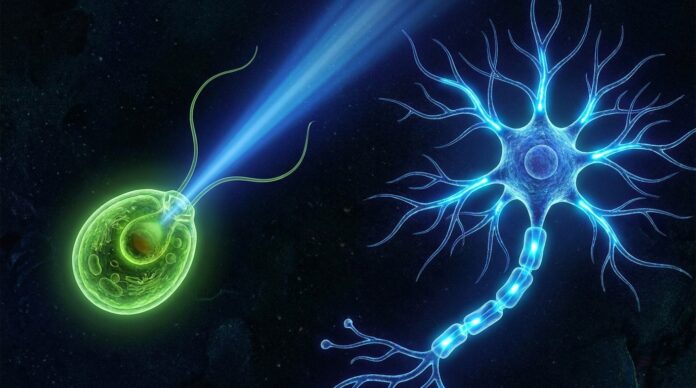

The optogenetics Nobel Prize went on October 5 to Karl Deisseroth, Peter Hegemann and Georg Nagel, who shared the 2026 Nobel Prize in Physiology or Medicine “for their discoveries concerning light-gated ion channels and optogenetics”, the Nobel Assembly at Karolinska Institutet announced. Their work turned a protein from a pond alga into a light switch that lets scientists turn chosen nerve cells on and off inside a living brain.
The laureates
- Karl Deisseroth, Howard Hughes Medical Institute and Stanford University, USA;
- Peter Hegemann, Humboldt University of Berlin, Germany;
- Georg Nagel, University of Würzburg, Germany.
They share 12 million Swedish kronor, about $1.2 million, equally. The medicine prize opened Nobel week; physics followed on October 6 and chemistry on October 7, which we covered in the IceCube physics prize and the chemistry prize for molecular handedness.
What optogenetics is
Nerve cells communicate with electrical impulses created when charged particles, ions, flow through channels in the cell membrane. Optogenetics combines optics and genetics: researchers insert the gene for a light-sensitive ion channel into a selected type of nerve cell, usually with a harmless virus, and then shine light on it through a thin optical fibre. Blue light opens the channel and the cell fires; other light-sensitive proteins can silence cells instead.
The key advantage is precision. Older methods, such as electrodes or drugs, affect many cells at once. Optogenetics can target one cell type, in one brain region, at millisecond timing. According to the Nobel Committee, this has allowed researchers to reveal the neural circuits behind specific memories, feelings and behaviours relevant to neurological and psychiatric disorders. “Optogenetics provides opportunities for mapping the brain in a way that we could once only dream of,” said committee chair Per Svenningsson.
From a swimming alga to a brain tool
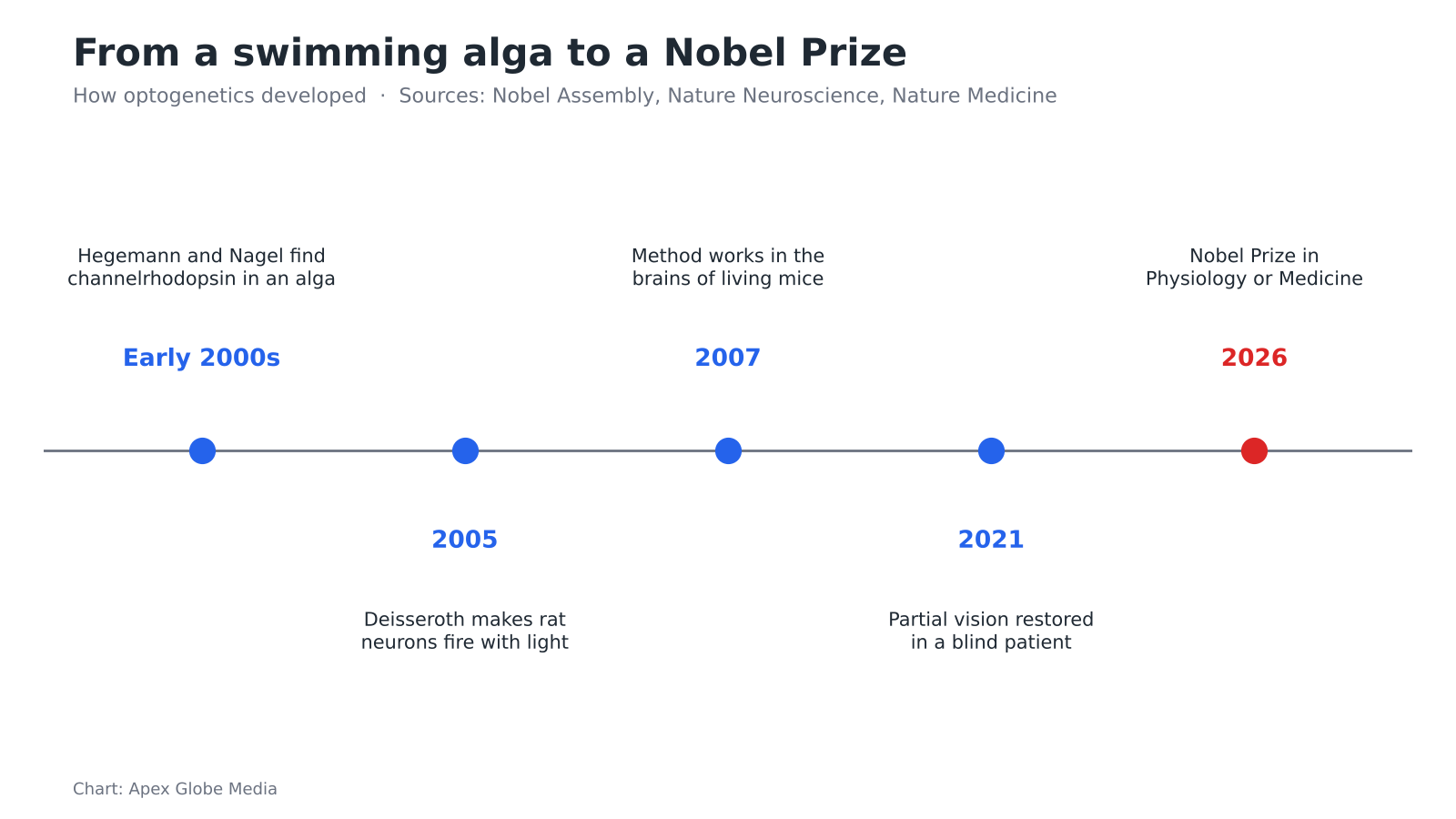
The story began with basic curiosity. Hegemann wanted to know how Chlamydomonas, a single-celled green alga, manages to swim towards light. In the early 2000s he and Nagel identified channelrhodopsin, a protein on the alga’s surface that opens a channel when hit by blue light, letting ions flow in and creating an electrical impulse. Nagel showed it worked in frog egg cells, and the pair found that any cell carrying the protein became light-sensitive.
Deisseroth’s team put the channelrhodopsin gene into rat nerve cells and triggered nerve signals with blue light, publishing the result in 2005 in Nature Neuroscience; the paper’s first author was Ed Boyden, then working in Deisseroth’s lab. Two years later Deisseroth made the method work in the brains of living mice. Nobel rules allow at most three laureates per prize, so several scientists who contributed to the field were not included.
Is it used in patients?
Only at an early stage. The Nobel Committee says researchers are using the method in attempts to restore sight. In 2021 a team reported in Nature Medicine the partial recovery of visual function in a blind patient with retinitis pigmentosa, an inherited disease that destroys the light-sensing cells of the retina. Researchers made other, surviving retinal cells light-sensitive with an optogenetic protein, and the patient, using special goggles, could locate and count some objects. Committee member Anna Wedell described this as the one example so far of use in humans.
For most of medicine, optogenetics remains a research tool. It requires gene delivery and a light source inside the body, both of which are hard to do safely in the human brain.
Why it matters beyond the lab
Optogenetics has become standard equipment in neuroscience laboratories, supporting a market for genetic tools, viral vectors, lasers and implantable fibres. It is also used in drug research, where companies test how candidate medicines affect specific brain circuits in animals. Our report on the race to build brain-computer interfaces shows the commercial side of brain technology; optogenetics offers a more precise, but far more invasive, way of reading and steering neural activity.
The timeline is also a lesson for research funding. A question about how an alga finds sunlight led to a protein in the early 2000s, to nerve cells in 2005 and to a Nobel Prize about two decades later. Nobody set out to build a brain tool.
Quick answers
Who won the 2026 Nobel Prize in Physiology or Medicine? Karl Deisseroth, Peter Hegemann and Georg Nagel.
What is optogenetics used for? Mainly to study which brain cells drive memory, emotion and behaviour; in medicine, it is being tested to restore vision.
Why algae? Chlamydomonas uses channelrhodopsin to sense light, and the protein works as a ready-made light switch in other cells.
Our take
This is a classic Nobel for a method rather than a cure, and it is well deserved: few tools have changed neuroscience as quickly. The vision-restoration case shows real medical potential, but one patient with partial improvement is a starting point, not a treatment. The bigger lesson is about basic science: the most useful brain technology of the century came from studying how an alga swims. Governments and companies weighing cuts to curiosity-driven research should keep that in mind.