

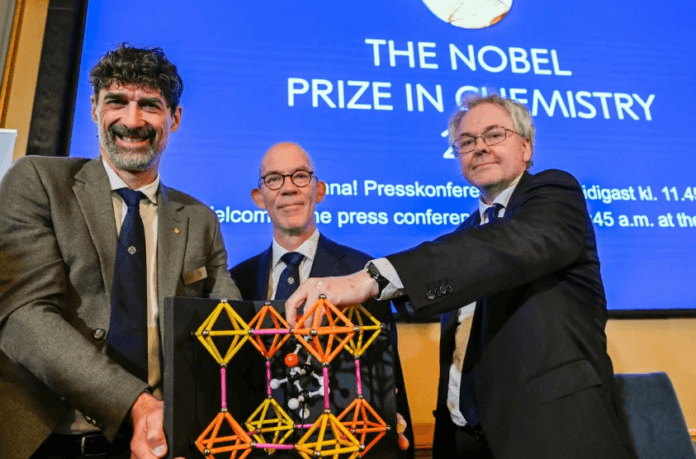

Look at your hands. They are exact mirror copies of each other, and yet a left glove will never fit your right hand. Now imagine the same trick played with molecules. That is the idea behind the Chemistry Nobel Prize 2026, which went on October 7 to Henri Kagan and Kenso Soai, and it touches on one of the strangest facts about life on Earth.
What does “handedness” mean for a molecule?
Many molecules come in two versions made of exactly the same atoms, connected in the same order, but arranged as mirror images. Chemists call this chirality, from the Greek word for hand. Like gloves, the two forms look alike, but they behave differently.
Here is the strange part: life picked a side. The amino acids that build your proteins and the sugars in your DNA all come in one hand, even though the mirror versions are chemically just as possible. Chemists call this homochirality, and for over a century nobody could explain how it could start by itself.
Why should you care?
Because your nose and your medicine cabinet both care about handedness.
One famous example is carvone. One mirror form smells like spearmint, and the other smells like caraway seeds. Same atoms, different hand, different smell. Your nose can tell the difference.
Medicine works the same way. The two mirror forms of a drug can act very differently in the body, and often only one is the one you want. Being able to choose which form a reaction makes means purer medicines, less waste and fewer unwanted effects. According to Chemistry World’s Phillip Broadwith, that choice is also crucial for flavors and fragrances. (A famous example is thalidomide, although the story is more complicated than “one good twin, one bad one”: its two forms convert into each other inside the body.)
The puzzle: how does a coin toss become a rule?
In the early 1950s, physicist Charles Frank suggested how one hand could take over. Picture a pencil balanced on its tip. Which way will it fall? The tiniest nudge decides, and once it starts to tilt, it keeps going until it lies flat. Frank’s idea was a chemical version of that: a molecule that helps make more copies of itself, so that a tiny random excess of one hand snowballs into complete dominance.
On paper it looked perfect. In a flask, nobody could make it work for about 40 years.
The first trick: mismatched gloves (Kagan, 1986)
Kagan found the first missing piece. Chemists assumed that a catalyst with a slight excess of one hand would give a product with a proportionally slight excess. Kagan mixed left- and right-handed versions of a catalyst and found something odd: some of the combinations barely worked at all. Roughly speaking, mismatched pairs sat idle, which left the majority hand to do the work.
The result was a nonlinear effect: a small imbalance in the catalyst created a much bigger imbalance in the product. It was the first lesson that tiny differences can be magnified.
The second trick: the snowball (Soai, 1995)
Soai built the rest. In 1995 he reported a reaction in which the product helps make more of itself. He started with a tiny head start for one hand, just 2%, and ended with 87%. It is the pencil falling over, as a chemical reaction.
Nobel committee member Peter Somfai called the Soai reaction “probably the coolest experiment in organic chemistry.” The committee chair, Heiner Linke, explained why it is special: it is the first reaction that spontaneously creates only one mirror image, with no help from other chiral molecules.
So is the origin of life solved?
Not quite, and the honest answer is more interesting. The Soai reaction is artificial and isn’t the chemistry of living cells. Nobody has shown that life actually began this way.
What the prize shows is that Frank’s idea works in principle: a tiny accident can grow into a rule. It is a working model for how one-handed chemistry could have started, and it turned a century-old puzzle into something chemists can test.
Nobel Week: the tool, the telescope and the snowball
This is the third science prize of the week. On Monday, the medicine prize went to optogenetics, a way to switch nerve cells on and off with light. On Tuesday, Francis Halzen won the physics prize for turning Antarctic ice into a telescope. Literature follows on Thursday, peace on Friday and economic sciences on Monday, October 12.