



A personalized mRNA melanoma vaccine from Moderna and Merck lowered the risk of the cancer coming back, or of the patient dying, by 42% in a phase 3 trial, according to detailed results the companies released on October 22 ahead of the ESMO Congress in Madrid. It is the first time an mRNA-based cancer treatment has succeeded in a late-stage trial. Moderna’s shares fell sharply the same day.
Doctors and investors read the same data very differently. A number most headlines left out helps explain why: what the vaccine did in the first six months.
A vaccine built for one patient
The trial, called INTerpath-001, enrolled 1,137 people with high-risk stage IIB–IV melanoma whose tumors had already been removed by surgery. Two out of three received the vaccine, intismeran autogene (also known as V940 or mRNA-4157), together with Merck’s immunotherapy drug Keytruda. The rest received Keytruda and a placebo.
Intismeran is not one product but a recipe. Each patient’s removed tumor is sequenced, and the vaccine is written to encode up to 34 neoantigens, small protein fragments that carry mutations found only in that person’s cancer cells, according to BioPharma Dive. The idea is to teach the immune system’s T cells to recognize exactly those fragments and destroy any cancer cells that survived surgery. Patients received 1 mg every three weeks, up to nine doses.
The comparison is a demanding one. Keytruda is already the standard treatment after melanoma surgery, and in the earlier KEYNOTE-054 trial it reduced the risk of recurrence or death by 43% compared with placebo, BioPharma Dive noted. The vaccine had to add a benefit on top of that.
What the results show
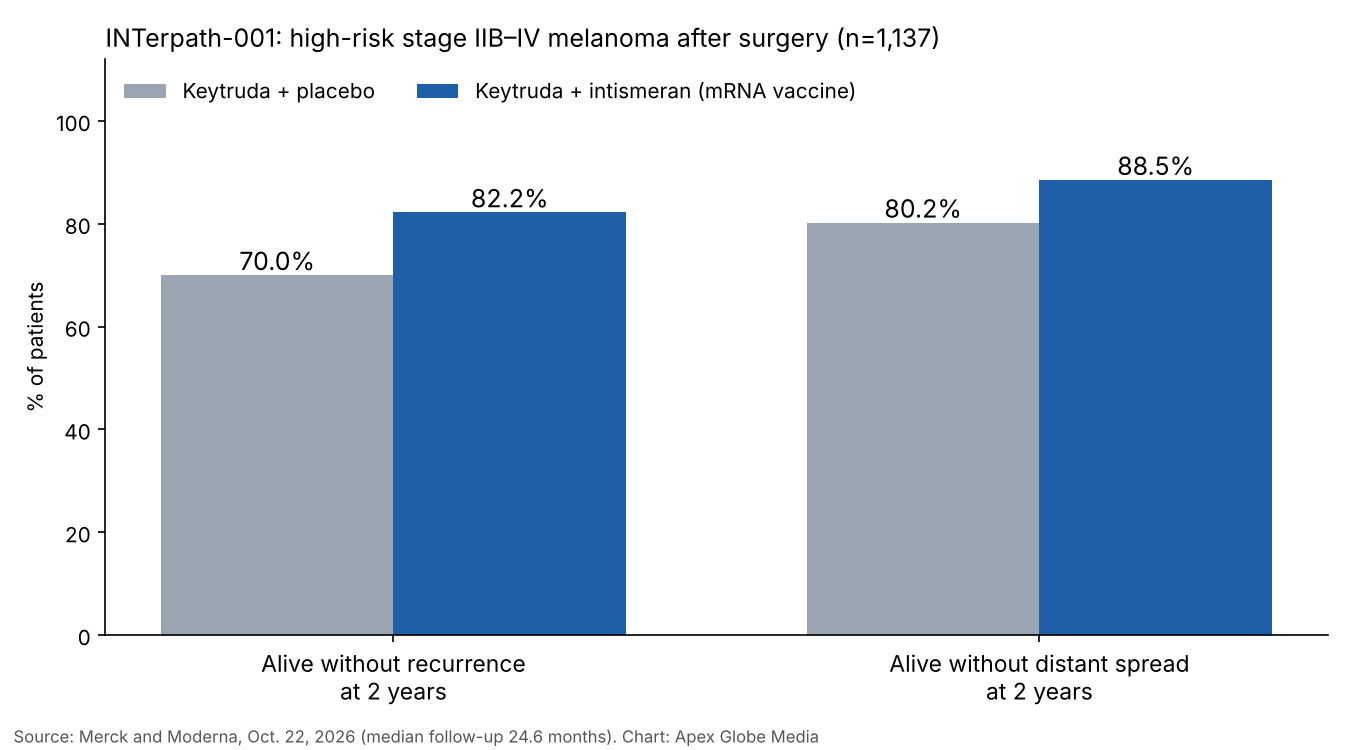
After a median follow-up of 24.6 months, the hazard ratio for recurrence-free survival was 0.58 (95% confidence interval 0.45–0.75). A hazard ratio compares how often an event happens in two groups over time; 0.58 means the risk of relapse or death at any moment was 42% lower with the vaccine. At two years, an estimated 82.2% of patients in the vaccine group were alive with no sign of the cancer returning, against 70.0% on Keytruda alone.
The risk of the cancer spreading to distant organs, or death, fell by 38% (hazard ratio 0.62). Two years in, 88.5% of vaccinated patients were free of distant spread, compared with 80.2% in the control group. The companies say the benefit was “generally consistent” across subgroups. The results have been accepted by The New England Journal of Medicine.
Side effects were more frequent but mostly mild. Treatment-related adverse events affected 95.8% of patients on the combination and 90.0% on Keytruda alone; serious (grade 3–5) events occurred in 14.2% and 13.4%. Fever and injection-site pain were the most common. Overall survival is not yet mature; the companies describe only a “favorable trend.”
Six months of nothing, then a large effect
The press release includes a split analysis that changes how the 42% should be read. During the first six months, the hazard ratio was 0.99, meaning the vaccine group did no better than the control group. After six months, in a pre-specified sensitivity analysis, it fell to 0.42, a 58% reduction in risk.
The dosing schedule suggests a likely reason. Nine doses given three weeks apart take about six months to complete, and each vaccine first has to be made from the patient’s own tumor. Patients whose cancer returns early are unlikely to be helped, while those who make it past the first months appear to get substantial protection. The headline 42% averages both periods.
If the later effect holds, the gap should keep widening with longer follow-up. It also means the vaccine may help least those at highest risk of very early relapse.
Why the stock fell
The detailed data were supposed to be presented on Saturday, October 24, but leaked online on Thursday morning and were quickly taken down. BioSpace reported that Moderna fell 21% to $193.65 during the session, while Merck slipped just over 1%.
Expectations were the problem. A smaller phase 2 trial had produced a hazard ratio of 0.51, and RBC Capital Markets said investors had been hoping for something between 0.50 and 0.59, which put 0.58 at the weak end. “These results are not enough to drive confidence amidst elevated expectations,” BMO Capital Markets wrote. RBC added that approval looked likely but commercial success less certain. Even after the drop, William Blair pointed out, Moderna’s shares were still up about 525% for the year.
Merck’s Jane Healy, head of oncology early clinical development, rejected the idea that the result was marginal. “This is not a subtle benefit,” she said.
What comes next
Merck and Moderna say they are “engaging with regulatory authorities” but have not given filing dates. Intismeran is being tested in nine phase 2 and phase 3 trials, including three phase 3 studies in non-small cell lung cancer, and in kidney, bladder, gastric and pancreatic cancer.
The open questions are also practical. The companies have not disclosed how long it takes to produce each patient’s vaccine or what it will cost, and a drug made for one person at a time is harder to scale than any standard medicine. It joins a broader shift toward treating cancer earlier and more precisely, from personalized vaccines to efforts to intercept pancreatic cancer before it develops.
Our take
For decades, cancer vaccines failed in late-stage trials. This melanoma vaccine succeeded against the toughest possible comparison, the best drug already in use. The market’s reaction says more about a stock that had multiplied this year than about the medicine. The figure we would watch is the six-month split: if the benefit after the vaccination course holds up, the long-term data could look considerably better than the headline. The real test will be whether a treatment made individually for each patient can be produced quickly and cheaply enough for ordinary hospitals to use.