

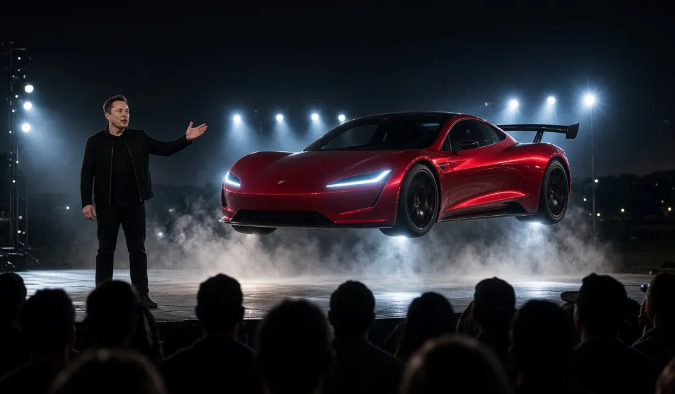

The Tesla Roadster finally had its public reveal on Thursday evening, nearly nine years after Elon Musk first showed a prototype, and it arrived with the stunt he had been teasing for months: a car that lifts itself off the ground. At a SpaceX test site in McGregor, Texas, a driverless demonstration car drove upside down on a ramp, flipped in the air on thrusters and landed on its wheels. What Tesla did not announce is a price or a delivery date for customers.
What Tesla showed
The white two-seater, developed with Musk’s rocket company SpaceX, used a suction system to cling to the underside of a ramp, then turned in mid-air and landed using built-in thrusters, Reuters reported. Later it used the thrusters to jump over a truck and other vehicles. “This is the culmination of incredible work by Tesla and SpaceX engineers working closely together,” Musk told the crowd.
The thrusters are not rocket engines. They run on compressed air from onboard high-pressure tanks feeding nozzles that point in different directions, Core77 reported, and Musk said the car can refill its own air tank. The suction system, he said, is meant to give the car extra grip in fast corners. Nobody was inside during the stunts, “to make sure we don’t kill anyone,” Musk said.
The numbers Tesla claims
Tesla vehicle engineering chief Lars Moravy said the Roadster can reach 60 mph from a standstill in less than one second and has a top speed of over 230 mph, according to Reuters. Britain’s PA news agency put the claimed 0 to 60 mph time at 0.81 seconds. The quoted range is over 300 miles on a charge, which Reuters noted is less than half of what Musk promised in 2017.
These are company claims from a staged event, not independently tested results.
Tesla says production will start in 2028. Its reservation page after the event listed three versions, according to Reuters:
- Performance, with a $50,000 deposit;
- Thrust, which adds “acceleration thrusters,” with a $250,000 deposit;
- Rocket, a single-seat, “invite only” model with a “full flight system.”
Core77 noted that the Rocket version appears unlikely to be approved for public roads.
Is it a flying car?
Not really. The car is not built for sustained flight, and in Core77’s words it is “closer to a grasshopper than a butterfly.” Before the event, The Information had reported that the demonstration car would be remotely operated because of the force and noise of the thrusters, and that the extreme version was not expected to be the Roadster most buyers could get, Drive Tesla Canada reported in August. Tesla is said to be developing a street-legal standard model alongside it.
A long road to the stage
Tesla first showed the second-generation Roadster in 2017 and said deliveries would start in 2020. That target was missed, and so were later ones. In September Musk said the car would be unveiled on October 1, Reuters reported. On September 28 Tesla postponed the outdoor-only event to October 15, citing severe weather in central Texas, Electrek reported.
The original Roadster, sold from 2008 to 2012 and built on a Lotus Elise chassis, was Tesla’s first car. The new one arrives at a very different moment for the company.
Why it matters, and why it may not
The Roadster is a halo car, a low-volume model meant to show off a brand’s best engineering rather than to sell in large numbers. “Tesla does not currently have a halo car,” Morningstar analyst Seth Goldstein wrote last month, according to Reuters. Musk himself has called the Roadster a “small potato situation” that would not “move the needle in a major way financially.”
Investors seem to agree. Gene Munster of Deepwater Asset Management, a Tesla investor, called the event “an engineering flex with no commercial value beyond embarrassing traditional car makers.” Tesla reports third-quarter results on October 21, and analysts say margins and cash flow will matter far more than the reveal. The company is also steering its focus toward self-driving cars and robots: it stopped selling the Model S and Model X this year, and its Cybercab robotaxi began paid rides in Austin in September. Earlier this month SpaceX also made news on the business side with a nationwide spectrum purchase, and some observers read the joint Roadster project as another sign of how closely Musk’s companies now work together.
Our take
As a piece of engineering theatre, the demonstration worked: it was memorable, and it happened in front of a live audience. As a product, the Roadster is still a set of claims with a 2028 date attached, from a company that has missed every previous Roadster deadline. Buyers putting down $50,000 or $250,000 are funding a promise, not reserving a delivery slot. The thing to watch is whether a street-legal Performance version reaches customers on time, because that is the only one most people could ever drive.