

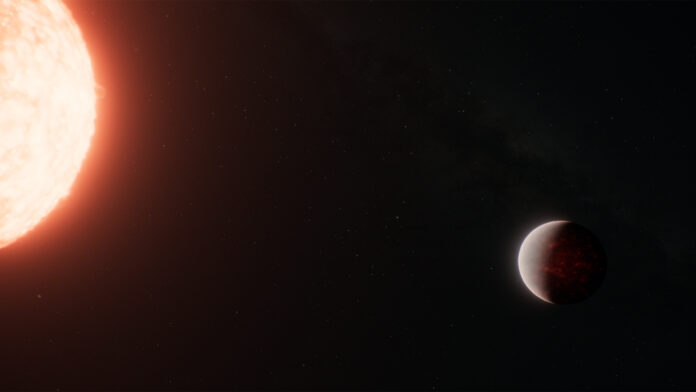

A planet that orbits its star in less than 11 hours should be a bare, glowing rock. TOI-561 b, a lava world about 280 light-years away, does not fit that picture. A new analysis of James Webb Space Telescope data finds that the planet reflects roughly 75% of the starlight that hits it, about as much as Venus. The most likely explanation is a global atmosphere topped by clouds made of rock vapour.
What the new paper measured
The study, led by Samuel Boucher with Lisa Dang and 16 co-authors, was first posted as a preprint in August and is now published in The Astronomical Journal. The University of Birmingham announced it on October 26.
The team used Webb’s NIRSpec instrument to record a phase curve: the planet’s brightness in infrared light as it circles the star and shows different faces to the telescope. Webb watched for about 37 hours, covering nearly four complete orbits. From the way the planet’s brightness and heat changed along the orbit, the researchers could estimate two things at once: how much starlight is reflected straight back into space, and how much heat is carried from the permanent day side to the night side.
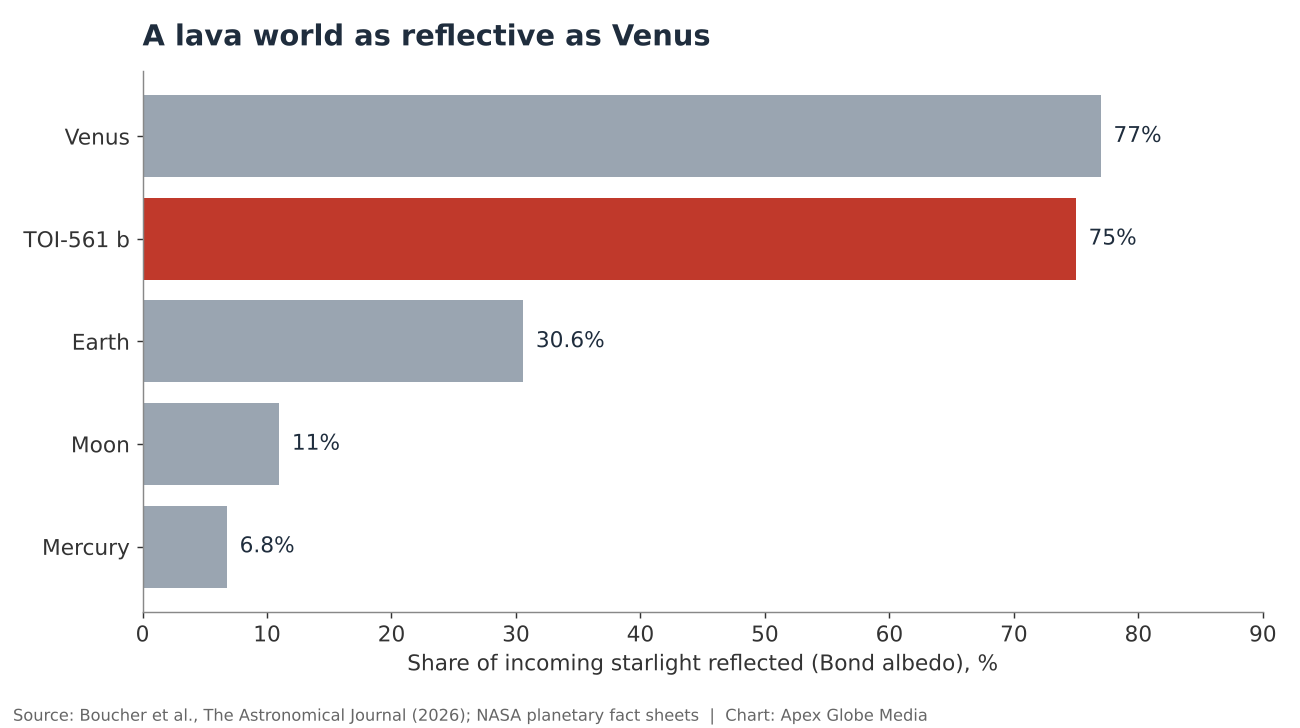
The answer, in the paper’s words, is “high Bond albedo and moderate global heat transfer.” Bond albedo is the share of all incoming light a body reflects. For TOI-561 b it is around 75%. That is far brighter than a dark lava surface could manage on its own, and it points to something reflective sitting above it.
Clouds made of rock
On Venus, sulphuric acid clouds do the reflecting. On TOI-561 b the day side is hot enough to melt rock, so the candidates are very different. The authors find that clouds of silicon dioxide (the mineral in quartz) and magnesium silicate could condense on the day side near the boundary with the night side, and that such clouds would explain the measured brightness. The planet underneath is thought to be covered by a magma ocean.
Webb has not yet identified any specific gas in the atmosphere. The companion modelling work lists carbon dioxide, as on Venus, or sulphur dioxide, as on Jupiter’s volcanic moon Io, as possibilities. Neither is confirmed. What the data do show is that the atmosphere has to be thick enough to move heat around the planet and support a reflective cloud layer.
Why this planet should not have an atmosphere
TOI-561 b was found by NASA’s TESS satellite in 2020. It has about twice Earth’s mass and 1.4 times its radius, yet it is less dense than expected for a rocky planet of that size. It orbits an old, metal-poor star so closely that a year lasts less than half an Earth day.
Planets that small and that close to their stars are expected to lose their atmospheres: the star’s radiation heats the gas until it escapes into space. Over billions of years, that should leave bare rock. “Our discovery challenges current theories,” said co-author Anjali Piette of the University of Birmingham. “Instead, the evidence suggests it still has a significant atmosphere today.”
The new paper does not stand alone. In December 2025, a team led by Johanna Teske, who is also a co-author here, reported in a NASA Webb release that the planet’s day side was cooler than a bare rock would be and concluded that it likely had a thick atmosphere above a magma ocean. The Boucher paper uses a different measurement, the full phase curve rather than only the day side, and reaches the same conclusion while adding the reflectivity.
For an atmosphere to survive, the authors say, gases must keep moving between the magma ocean and the air above it. In effect, the molten interior would keep releasing what the star strips away.
What it means for the search for rocky worlds
Webb has spent much of its exoplanet time on a basic question: can small rocky planets around other stars hold on to air at all? Several hot rocky planets observed so far looked like bare rock. TOI-561 b is now the best case on the other side, and it shows that at least one extreme rocky world can keep an atmosphere for a very long time.
It also shows a practical problem. A planet’s temperature is often used as a sign of whether it has an atmosphere. If reflective clouds keep a planet cooler, a temperature measurement alone could be misread. Phase curves, which separate reflected light from redistributed heat, are a better test, but they need long stretches of telescope time. We covered a different cosmology result built on careful statistics in our piece on dark energy and 2,884 supernovae.
Our take
This is a solid result built on two independent Webb analyses that agree, which is more than many exoplanet headlines can say. The open question is what the atmosphere is made of, and until Webb or a later telescope detects a specific gas, the rock-vapour clouds remain the best model rather than an observation. Still, the lesson for astronomers is clear: “too hot for air” turns out to be a hypothesis, not a rule, and the next rocky planets Webb looks at should be judged with that in mind.