

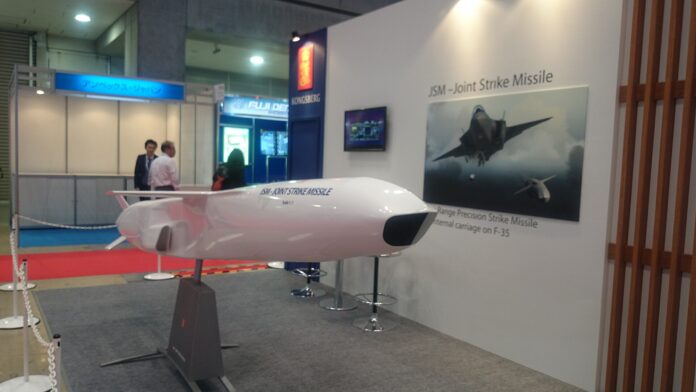


Denmark will buy the Anthem cruise missile, a ground-launched weapon from a US startup that came out of stealth only in September, together with Norway’s Joint Strike Missile for its F-35 fighters, Defence Minister Jeppe Bruus announced on October 22. The Anthem cruise missile has never been used in combat and is still being tested. What makes the order notable is the price tag the maker is aiming for: a fraction of what Western militaries usually pay for a long-range missile.
What Denmark is buying
According to the Danish Ministry of Defence statement, the Joint Strike Missile (JSM), made by Kongsberg, will be fired from Denmark’s F-35s, while Anthem, made by Covenant, will be launched from land. The ministry said NATO had asked for these capabilities and that the purchase follows a recommendation from the Chief of Defence. The government had decided in principle in September 2025 to acquire long-range precision weapons.
“The acquisitions are a significant step towards making Denmark better able to defend itself,” Bruus said. “We are sending a strong signal that we have the ability to strike back.” No quantities, prices or delivery dates were disclosed.
The JSM is a mature, stealthy weapon. It fits inside the F-35’s internal bays, uses a passive infrared seeker that is hard to jam, and has a range of more than 300 nautical miles (about 550 km), according to Kongsberg as cited by TWZ. Kongsberg says Denmark is its seventh customer. TWZ puts its reported unit cost at about $2.8 million.
A missile designed to be cheap
Anthem is the opposite kind of product. Covenant, based in Washington, D.C., emerged from stealth on September 9 with more than $250 million raised from investors led by Andreessen Horowitz and about $150 million in orders. It says Anthem has flown more than 200 times since August 2025 and is built mostly from commercial off-the-shelf parts. The company has not published range or price. Reuters, cited by TWZ, reported that Covenant expects the missile to eventually cost “in the mid-six-figure range.” Unconfirmed reports put its range at about 1,200 km and its warhead at more than 200 kg.
The production plan is what sets it apart. Covenant has opened factories in Texas, near Leipzig in Germany and in northern Israel. It plans to build 1,000 missiles in 2027 and up to 5,000 the following year, Rapporteur reported, in a story republished by Eurasia Review. Denmark’s missiles will come from the German plant. “That’s where we will be sourcing them from, so we can be sure it’s a European supply chain,” Bruus said, adding that the goal is “rapidly building up cost-effective capacity.”
The price gap
Official unit prices are rarely published, so the figures below are approximations, several of them our own estimates from contract totals.
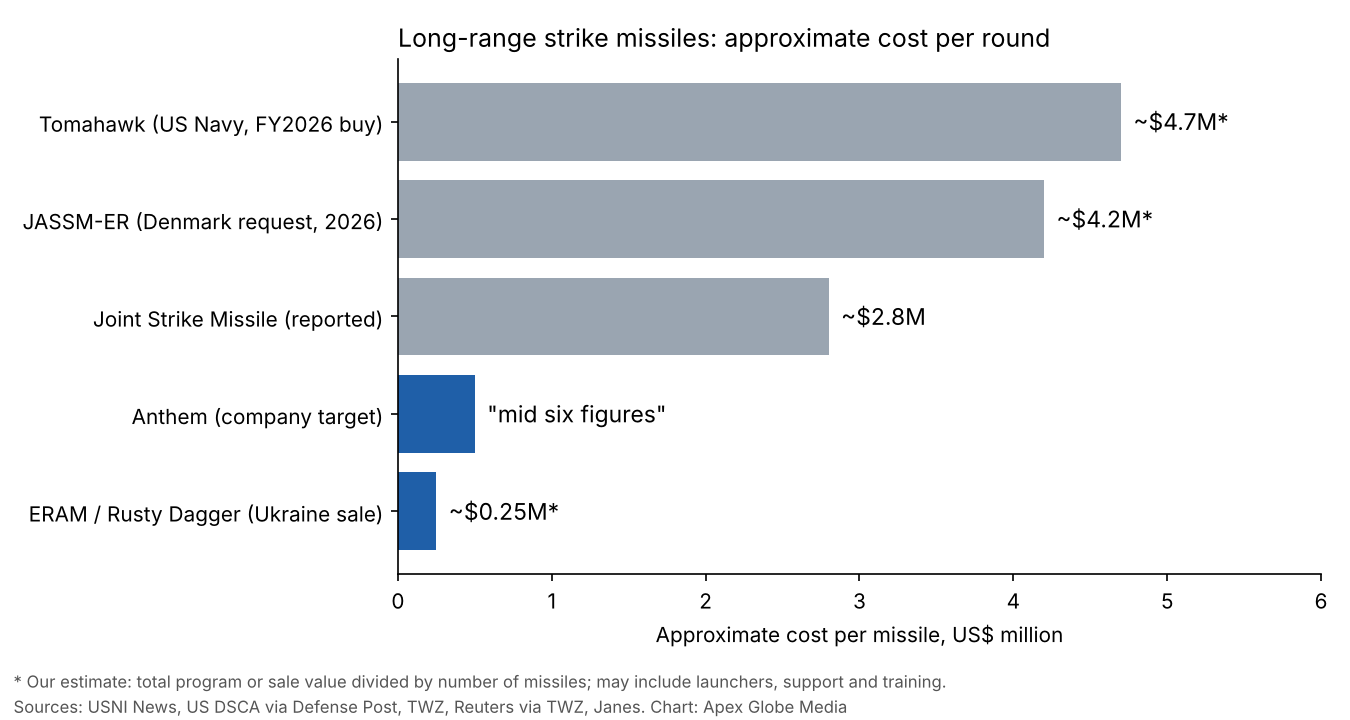
The US Navy bought 55 Tomahawks for $258 million in fiscal 2026, USNI News reported, which works out to roughly $4.7 million each. In June, the US approved a possible $842 million sale of about 200 JASSM-ER missiles to Denmark, The Defense Post reported, around $4.2 million per missile including support. At the other end is the US Air Force’s ERAM program, the AGM-188 Rusty Dagger built for Ukraine. Its $825 million sale covers up to 3,350 missiles, according to Janes, or about $246,000 each before subtracting containers, pylons and training.
The difference is not only price. A cheaper missile usually gives up something: stealth, jam-resistant seekers, a bigger warhead or proven reliability. Anthem has none of the combat record the JSM or Tomahawk have. Denmark seems to be accepting that trade on purpose. It keeps a small number of expensive, high-end weapons for its F-35s and adds a ground-launched weapon that, if Covenant hits its targets, could be bought in much larger numbers for the same money.
Why numbers matter now
The war in Ukraine has shown that long-range strikes are fought in volume. Air defenses shoot down a share of incoming missiles, so attackers need many of them, and stockpiles of expensive weapons run down fast. A confidential European Defence Agency report, according to Rapporteur, urged EU countries to expand missile production to reach “battle-decisive” quantities by 2030.
Denmark is not alone. Latvia moved in September to buy Anduril’s Barracuda cruise missiles, and France, Germany, Italy, Poland, Sweden and the UK are working together under the European Long-Range Strike Approach (ELSA) to speed up development of new weapons, TWZ notes. Denmark has also requested JASSM-ERs; it is not yet clear whether the JSM replaces that order or adds to it.
Moscow reacted sharply. Russia’s embassy in Copenhagen accused Denmark of pursuing confrontation and warned of “inevitable disastrous consequences,” according to TWZ. The confrontation increasingly reaches beyond traditional weapons, as we described in our report on how Russia, Ukraine and Iran treat Starlink as a military target.
What is still unknown
Almost every number that would let outsiders judge the deal is missing: how many missiles Denmark will buy, the unit price it will actually pay, how far Anthem flies and when the first deliveries arrive. Covenant’s factories are new, and serial production has not started. A small country is effectively betting part of its deterrent on a start-up meeting an ambitious schedule.
Our take
Denmark’s order is less about one missile than about a change in what European militaries are willing to buy. For decades, the West chose small numbers of exquisite weapons; Ukraine has shown that quantity can matter as much as quality. Pairing a proven, expensive missile with an unproven cheap one is a sensible hedge, and sourcing it from a factory in Germany answers Europe’s worries about depending on US production lines. But the bet only pays off if Covenant delivers at the price and pace it promises, and so far those promises are mostly on paper.