


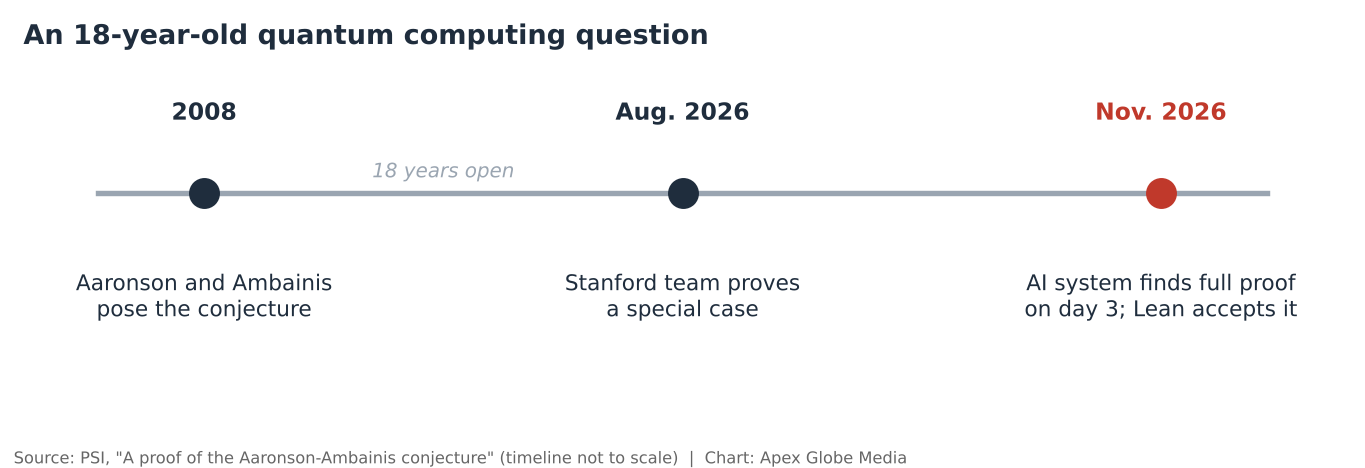
An AI research system has produced a proof of the Aaronson-Ambainis conjecture, one of the best-known open problems in quantum computing theory, according to the startup that ran it. Physical Superintelligence (PSI) said on November 6 that its system, running a non-public model from Anthropic, found a complete proof on the third day of its run, and that the Lean proof assistant has checked every step. If the result holds up, it answers an 18-year-old question about where quantum computers can and cannot beat ordinary ones, and it is the latest sign that AI is starting to settle problems that human mathematicians left open for years.
What the conjecture says
Scott Aaronson and Andris Ambainis posed the conjecture in 2008. It is about when quantum computers can be exponentially faster than classical computers. Famous quantum speed-ups, such as Shor’s algorithm for breaking encryption, rely on problems with a hidden structure. The conjecture says that without that structure, on random inputs, a quantum computer can only be polynomially faster, not exponentially faster.
Formally, it is a statement about polynomials: any bounded low-degree polynomial with enough variance must have at least one input bit that strongly influences its value. In plain terms, PSI’s write-up says, a quantum computer answering yes-or-no questions about a random string cannot save exponentially many reads of that string unless the string has a rare pattern. That matters for anyone trying to work out which real-world problems quantum computers will speed up, and which they will not.
How the AI found the proof
PSI says the work was done by an internal research system that runs many instances of an unreleased Anthropic model on PSI’s own infrastructure. David Turturean, a member of PSI’s technical staff, built the system, chose the problem, ran it and prompted the model to write a first draft of the paper, which he reviewed. He is responsible for its correctness. After finding the proof, the system kept working on related problems and improved the result twice.
Two kinds of checks have been done so far. First, the proof was formalised in Lean, software that checks each logical step mechanically, and Lean accepted it, including the final improved version. Second, PSI advisor Jim Halverson audited the proof. The full proof and formalisation are on GitHub.
Outside experts are now reading it. Guy Blanc, Jordan Docter, Carmen Strassle and Li-Yang Tan of Stanford, who proved a special case of the conjecture in August, are reviewing the proof and writing a shorter explanation for specialists. “This is a huge result,” they said, according to PSI. “Everything is brought together in a rather magical way.”
What is still uncertain
There is also a reason for caution in the conjecture’s own history. In November 2019, Nathan Keller and Ohad Klein announced a proof, which Aaronson welcomed on his blog. They retracted it within weeks, after Paata Ivanishvili found what Aaronson called “a fatal flaw in Lemma 5.3,” as he wrote in an update to that post. The difference this time is the Lean formalisation, which rules out that kind of hidden gap in the logic, though not a mismatch in the statement itself.
The proof has not been peer reviewed, and as of Friday there was no public assessment from Aaronson or Ambainis themselves, FourWeekMBA noted. A Lean check is strong evidence that the logic is sound, but experts still need to confirm that the formal statement matches the conjecture as mathematicians understand it. That is a common source of errors in machine-checked proofs.
Little is known about the model. Anthropic has not said which model PSI used or when, if ever, it will be released. The announcement adds to a run of claims from AI labs. Last month OpenAI said its models had cracked several famous problems in computer science and mathematics, results that experts are still checking. Anthropic itself has warned that its models are speeding up AI research, as we reported in our story on its recursive self-improvement warning.
Our take
This announcement stands out from earlier AI maths claims for two reasons. The proof comes with a full Lean formalisation, so its logic can be checked by anyone, and respected outside researchers who know the problem well are already calling it a huge result. That is a much stronger starting point than a press release.
It also shows how the frontier has moved. Models that are not yet public are being used by small specialist teams to attack research problems, and the gap between what labs have internally and what the public can use is clearly widening. For quantum computing, a confirmed proof would sharpen the industry’s map of where quantum advantage is possible. For AI, it would be another sign that the bottleneck in research is shifting from finding proofs to checking them, and that peer review will need to change as quickly as the tools do.