



The European Commission said on November 6 that TikTok’s “For You” feed breaks the EU’s Digital Services Act, because its recommendation algorithm pulls users into “rabbit holes” of harmful content about subjects such as weight loss and mental health. The preliminary TikTok DSA finding goes to the heart of how an AI recommendation engine ranks content, not just a platform’s add-on features. If it is confirmed, TikTok could be fined up to 6% of its global annual turnover and forced to redesign the feed that made it famous.
What Brussels found
The Commission’s case is about the way TikTok’s recommender system learns from behaviour. Every time a user watches a video to the end, re-watches it or likes it, the algorithm treats that as a signal and serves more of the same. “Every time a user scrolls or likes a video on TikTok, the algorithm serves more of the same,” Henna Virkkunen, the Commission’s executive vice-president for tech sovereignty, said, as quoted by RTÉ.
For most topics, that is what makes the app addictive. For sensitive ones, the Commission says it is dangerous. Users who linger on body image or weight loss videos can end up in a feed dominated by them, which the Commission links to anxiety, body dissatisfaction, lower self-esteem and worsening eating disorders, Eunews reports. Minors and vulnerable adults are most at risk.
The Commission also found that TikTok’s safety tools do not work well enough. Its techniques to “disperse” content and break up repetitive feeds were judged ineffective. Refreshing the feed only helps for a while before the system drifts back to the old content. And the “Not interested” button is used by only 0.2% of TikTok users, according to an EU official, and does not reliably reduce how often harmful content appears.
What TikTok would have to change
EU officials were unusually specific about the fixes they want. According to Eunews, the Commission wants TikTok to:
- base recommendations on explicit preferences that users choose, rather than on implicit signals picked up from their behaviour;
- stop using viewing time as a signal for what to recommend;
- make control tools easier to find and use, and make “Not interested” choices stick;
- test the algorithm regularly for these risks.
Watch time is one of the most important signals in almost every modern feed, from TikTok to YouTube Shorts and Instagram Reels. Removing it would change how the product works at a basic level. An EU official said the measures match Article 10 of the proposed European Children’s Act and could become a model for all platforms.
TikTok pushes back
TikTok called the Commission’s statements “fundamentally inaccurate” and said it has a strong record of protecting users and gives them control over what they see. The company can now study the investigation file and respond in writing before any final decision. The European Board for Digital Services will be consulted, and Ireland’s media regulator, Coimisiún na Meán, has supported the case, since TikTok’s European headquarters is in Dublin.
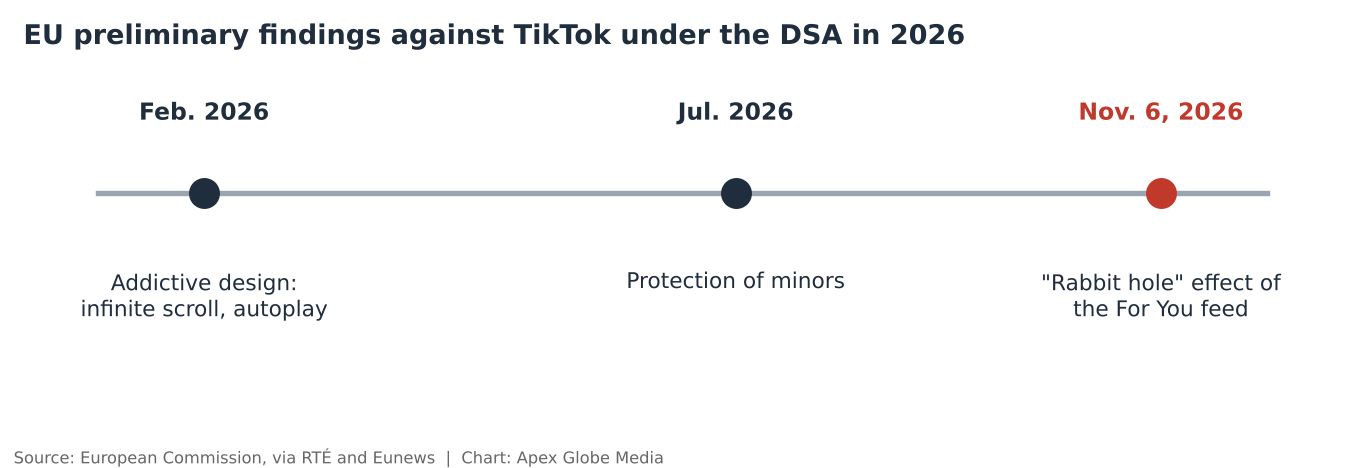
The finding adds to a long list of problems for TikTok in Europe. Earlier this year the Commission issued preliminary findings on addictive design features such as infinite scroll and autoplay, and then on the protection of minors. National governments are moving too, with Greece pushing ahead with a social media ban for children under 15. In the US, TikTok has already settled a landmark child privacy lawsuit.
Why it matters for AI
The DSA was written before the current AI boom, but this case shows how it applies to AI systems. A recommender is a machine learning model that is trained to maximise engagement. The Commission is not asking TikTok to remove specific videos. It is asking it to change what the model is trained to optimise. That puts the design choices behind AI ranking systems, which companies treat as trade secrets, under legal review. It is the same logic that is pushing the EU to look at chatbots like ChatGPT under the DSA.
Our take
This is one of the most important DSA cases so far, because it goes after the engine, not the bodywork. Fines for missing reports or weak age checks are a cost of doing business. An order to stop using watch time and rely on explicit preferences would hit the formula that keeps people scrolling, and it would set a standard that Meta, Google and Snap would struggle to ignore in Europe.
There are real risks. Regulators are not experts in ranking systems, and a feed based only on what users say they want may be worse at finding content they actually enjoy. The final decision may also be softer than the preliminary one, as often happens in EU cases. But the direction is clear. Europe is moving from regulating what platforms host to regulating how their algorithms think, and every company that builds AI-driven feeds should expect the same questions.