

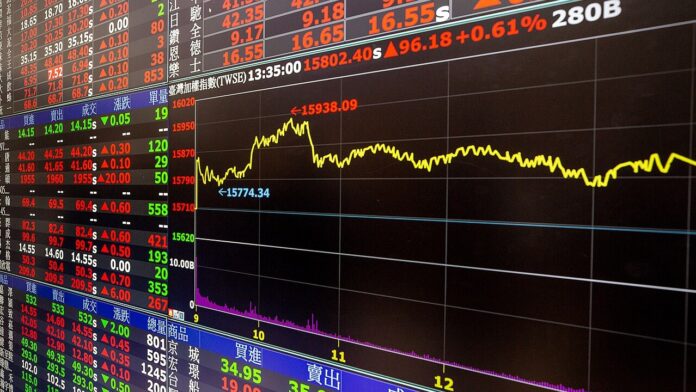

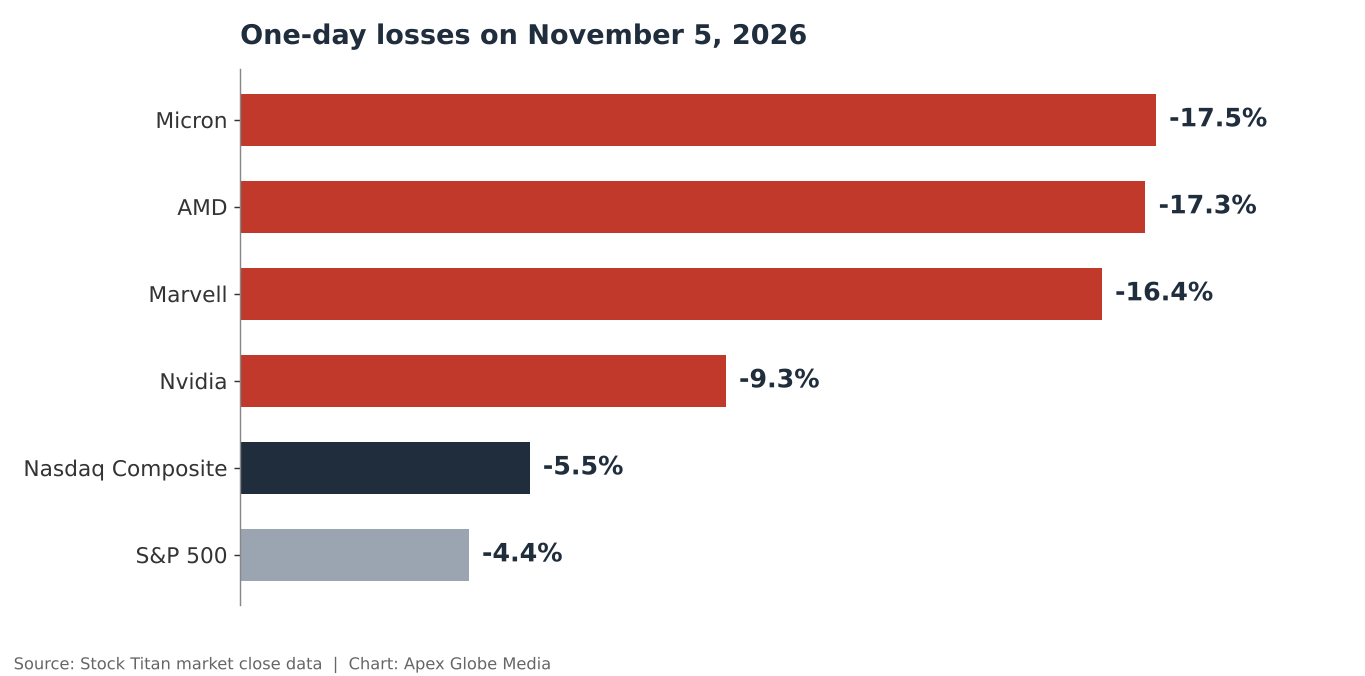
The AI trade had its worst day in years. On Thursday, November 5, the Nasdaq Composite fell 5.5% and the S&P 500 dropped 4.4%, its biggest one-day fall since April 2025, as investors bet that the Democrats’ sweep in the US midterm elections will slow the construction of AI data centers. Chipmakers took the heaviest hits, and on Friday the AI stocks selloff spread to Asia, where trading in South Korea was briefly halted and Taiwan’s market suffered its biggest intraday point drop on record.
A rout led by chips
The damage was concentrated in the companies that supply the AI build-out. Memory maker Micron fell 17.5%, AMD 17.3% and Marvell 16.4%, according to closing data compiled by Stock Titan. Nvidia, the most valuable company in the AI boom, lost 9.3%. The tech-heavy Nasdaq 100 fell more than 6%, its worst day since March 2020, wiping out somewhere between $1.8 trillion and $2.5 trillion in market value depending on the tally, with Axios noting that the Nasdaq Composite had slipped into a correction.
Why the election hit AI stocks
The trigger was politics, not earnings. On November 3, voters in 10 states sided against data center development in 40 of 41 local ballot measures, as we reported in our look at how data centers became a ballot issue. Democrats also won control of Congress and several key governorships. In Texas, governor-elect Gina Hinojosa has called for a moratorium on new data center construction until stronger protections are in place.
Analysts started putting numbers on that risk. UBS estimated that about 30% of the data center capacity expected to come online by 2028 is now at risk. Research firm Cleanview found that roughly 40% of pending US data center capacity is planned for states where newly elected governors have pledged to stop or pause construction, Bloomberg reported. Citi Research flagged the political backlash as a new risk to data center spending, according to Benzinga.
The logic for investors is simple. Chipmakers, memory suppliers and power companies have been valued on the assumption that hyperscalers will keep spending hundreds of billions of dollars a year on new data centers. If permits, power connections and local approvals slow down, that spending gets pushed back, and so do chip orders.
Asia takes the hit on Friday
Asian markets, home to the world’s biggest chip and memory factories, fell hard the next morning. South Korea’s Kospi dropped as much as 8.8%, triggering a trading halt and briefly falling below 5,000, before closing about 6% lower. Japan’s Nikkei 225 also ended down 6%, below 60,000 for the first time in nearly six months, and Taiwan’s Taiex fell around 9% in morning trading before closing 4.5% lower, Bloomberg and CNN reported. Memory maker SK Hynix, one of the biggest winners of the AI boom, led the losses in Seoul.
The companies are already adjusting
The industry had seen the backlash coming. On the same day as the selloff, Google announced a $17 billion data center in Wyoming and promised to pay for all of its power, while OpenAI pledged to drop secret NDAs from its data center deals, as we covered in Google and OpenAI’s new pitch to communities. Meta’s president, Dina Powell McCormick, said building new US data centers will be “harder” after the election but that expanding existing sites will be easier, The Wall Street Journal reported.
Our take
Thursday’s selloff was partly a panic and partly a long-overdue repricing. For two years, AI stocks have priced in almost unlimited growth in data center construction, and investors had already begun asking harder questions about the AI data center gold rush. The election showed that the build-out has a political limit as well as physical ones like power and chips.
Still, a slower build-out is not the same as no build-out. Demand for AI computing is real, the biggest companies are already promising to pay for their own power, and many projects are in states that did not change hands. Chipmakers will feel it if orders slip from 2027 into 2028 or later, and memory makers, whose prices had soared on AI demand, are the most exposed. The next test comes with the big tech companies’ spending plans for 2027: if they hold up, Thursday will look like an overreaction. If they are cut, it will look like the start of the AI boom’s first real correction.