

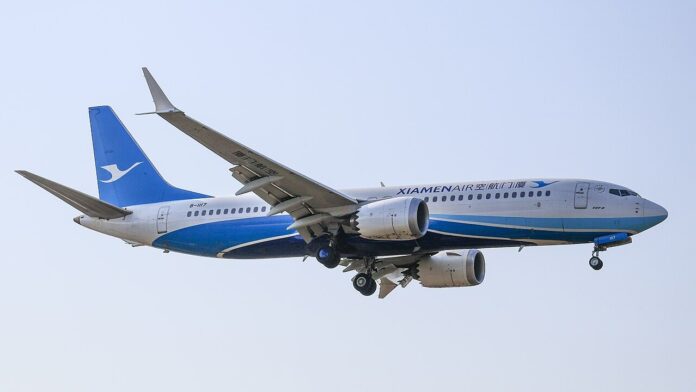

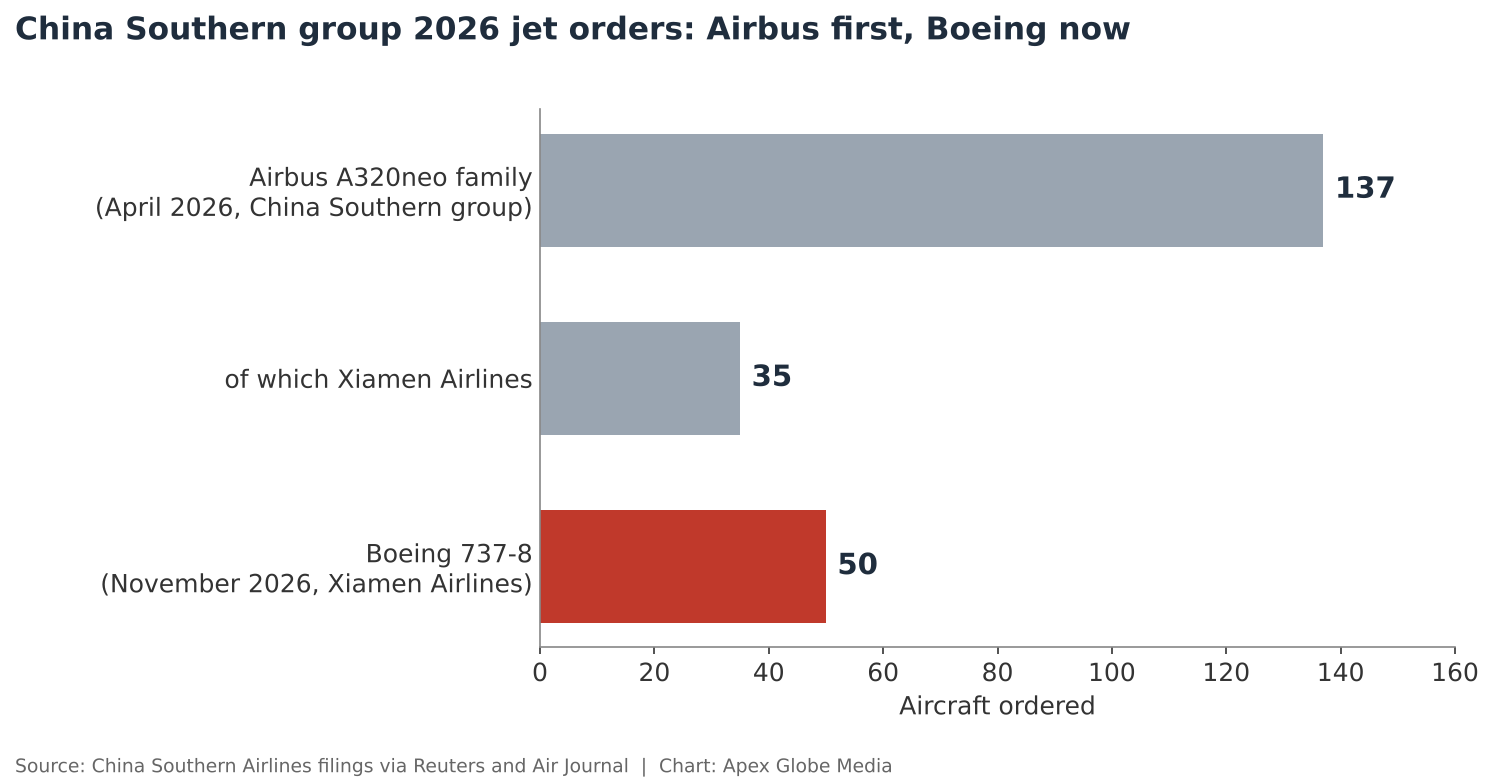
Boeing has its first big order from a Chinese airline in nearly a decade. Xiamen Airlines, a subsidiary of China Southern Airlines, agreed on Tuesday to buy 50 Boeing 737-8 jets at a list price of about $7.4 billion, China Southern said in a stock exchange filing reported by Reuters. The Boeing China order is the American planemaker’s largest Chinese deal since 2017, a period in which trade fights and the 737 MAX crisis left it almost shut out of new business in the world’s second-biggest aviation market.
The planes are not coming soon. According to the filing, they are “scheduled for delivery in batches between 2031 and 2034”, and the deal still needs approval from China Southern’s shareholders and “relevant Chinese government authorities”. Boeing declined to comment. Its shares rose 1% on Tuesday.
A down payment on Trump’s 200-jet promise?
The timing points to politics. At their summit in Beijing in May, Chinese leader Xi Jinping committed to buying 200 Boeing jets, and President Donald Trump has kept raising the number since. In May he said China could go as high as 750 planes. On Monday, a day before the Xiamen deal, he said he thinks China will buy “another 250” Boeing airplanes, without giving details, Reuters reported. Chinese officials have not confirmed any of it.
Until Tuesday, China had not announced a single firm airline order under the 200-jet pledge. Air Journal noted that six months had passed with nothing public. China Southern’s filing does not say whether the 50 jets count towards the commitment. Analysts at Jefferies said they understood the order “represented the first conversion of China’s 200-jet commitment to a firm order”, according to Reuters. If that is right, three quarters of the promise is still on paper.
What $7.4 billion really means
The headline price is a catalogue figure. China Southern said Boeing granted a substantial discount, without saying how big. Airlines usually pay far less than list price for large orders, so the real value of the contract is likely well below $7.4 billion. At list price the deal implies roughly $148 million per aircraft, our own calculation; Xiamen will pay less.
The order also says something about the 737-8 itself. China was the first country to ground the 737 MAX after the second fatal crash, in Ethiopia in March 2019, and its regulator was among the last to clear the plane to fly again. In 2025, during the tariff war between Washington and Beijing, Chinese airlines stopped taking new Boeing deliveries for several weeks and some finished jets were flown back to the US. A fresh order for 50 more MAX jets from a Chinese carrier is a sign that, for now, both the safety question and the trade freeze are being put behind them.
Airbus got there first
Boeing’s win looks smaller next to what its European rival already has. In April, China Southern and Xiamen Airlines agreed to buy 137 Airbus A320neo family aircraft, 35 of them for Xiamen, Air Journal reported. Xiamen, which flew an all-Boeing fleet for almost four decades, broke that tradition in early 2023 when it took its first Airbus A321neo on lease, Reuters noted.
China Southern said the new Boeing jets would help Xiamen Airlines take advantage of its move to the new Xiamen Xiang’an International Airport, support an aviation hub in Fujian province and “optimise its fleet structure”. With deliveries starting in 2031, they are meant to renew the fleet for the next decade, not add seats now.
There is also a home-grown competitor in the picture. China’s state planemaker COMAC has been flying its C919 narrow-body, a direct rival to the 737 and A320, with Chinese airlines since 2023. It is still built in small numbers and depends on Western engines and systems, so Chinese carriers cannot yet replace Boeing and Airbus with it. Boeing and Airbus both forecast that China will need around 9,000 new jets by 2045, more than any other region, Reuters reported. That is the prize Boeing has been missing, and it is also what makes an order easy for Beijing to use as a bargaining chip.
Boeing has had a difficult year elsewhere, too. US regulators ordered new checks on hundreds of older 737s this month, as we reported. Against that background, Bloomberg called the Xiamen deal Boeing’s “biggest China buy in years”.
Our take
Fifty jets for delivery in the 2030s is real business for Boeing, but it is a cheap gesture for Beijing. China gets to show goodwill to Trump right after his comments about 250 more planes, while committing almost no money before 2031 and keeping the final say through “relevant government authorities”. In our view, this is how China will spend the 200-jet promise: in small, well-timed pieces that can be slowed down whenever trade talks go badly. Airbus, with 137 firm orders from the same airline group this year, is still the one with the bigger share of China’s sky. Boeing investors should treat each new Chinese order as a political signal first and a sales figure second.