


OpenAI says one of its unreleased AI models has settled a question computer scientists have chased since 1969: how fast can a computer multiply two large tables of numbers? In a 111-page preprint posted on November 24, titled “The matrix multiplication exponent is nine fourths”, the company claims the matrix multiplication exponent is exactly 9/4, or 2.25. The paper sits in OpenAI’s public openai/math repository on GitHub, where it was one of nine manuscripts added that day, AI Weekly reported.
If it holds up, the result does two things at once. It confirms a speed-up OpenAI first announced in October, and it adds a matching floor: a proof that, in a standard mathematical model of computation, nobody can ever do better. That second half is the shock. Most researchers in the field had hoped the true answer was 2.
What the number means
Matrix multiplication is the basic operation behind 3D graphics, physics simulations and, above all, neural networks. Every answer a chatbot gives is built from billions of these multiplications. Multiplying two n-by-n matrices the way students learn at school takes about n3 multiplications: for 1,000-by-1,000 matrices, that is a billion steps.
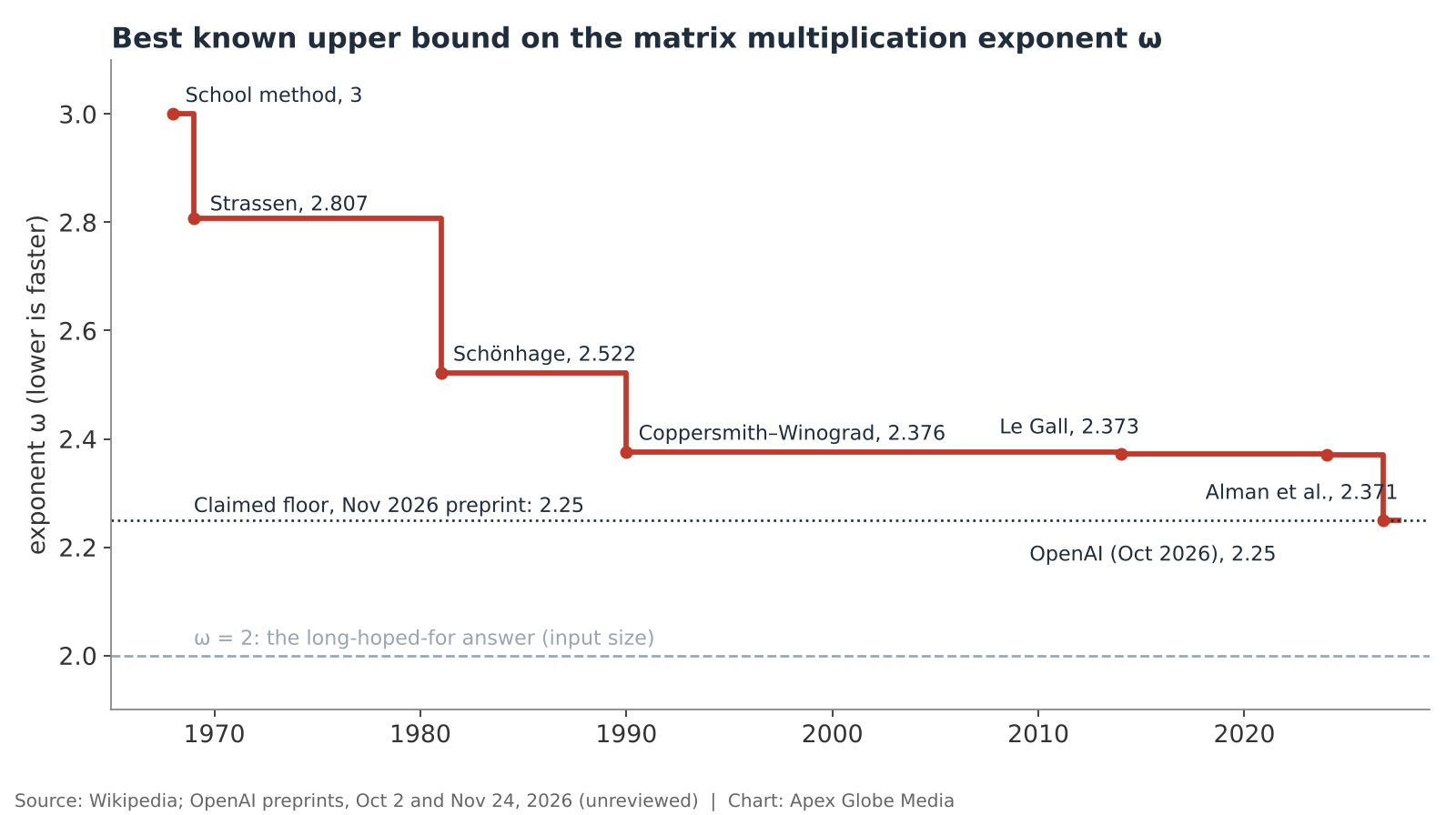
The exponent, written ω (omega), measures the best possible method. In 1969 the German mathematician Volker Strassen showed that the school method is not optimal and brought the exponent down to about 2.81. Over the next five decades, a long line of papers chipped it lower. By 2024 the record stood at about 2.371, after work by Josh Alman, Ran Duan, Virginia Vassilevska Williams and colleagues, according to the standard summary of the field. The obvious lower limit is 2, because any method has to at least read all n2 numbers in the input. Many researchers believed ω = 2 was the real answer and that it was only a matter of finding the right trick.
Step one: the October speed-up
The upper half of the claim is not new this week. On October 2 OpenAI posted a preprint proving ω ≤ 9/4 for matrices over the complex numbers, a drop larger than everything achieved since 1990. That part has had outside eyes on it. The computer scientist Rafael Pass posted an independent, constructive proof on October 20, and a group of researchers including Jeroen Zuiddam extended the bound to every field, Mad Robot reported. Two expository papers have since appeared on arXiv: one by Baitian Li, who describes “the recent preprints from OpenAI that establish the bound ω ≤ 9/4” and argues the core is a new tensor technique, and one by Mahmut Levent Doğan, Vladimir Lysikov, Keiya Sakabe and Michael Walter, who give “an exposition of OpenAI’s recent result” valid over every field.
Step two: the floor nobody expected
The new manuscript goes the other way. It claims that any formal arithmetic circuit (a model of computation built from addition, multiplication and division steps) needs at least n9/4/2 multiplication or division steps, rounded up, to multiply two n-by-n matrices, even if additions are free, Crypto Briefing reported. Put the two halves together and the exponent is pinned at exactly 2.25. That would rule out the long-held hope of ω = 2.
The proof works by contradiction and leans on two companion papers OpenAI posted the same day, one on the geometry of tensors and one on circuit lower bounds for the permanent, a function at the centre of the famous VP versus VNP question, according to Mad Robot. Lower bounds are notoriously hard: for decades the best known floor for matrix multiplication in general models was barely above n2. A clean n2.25 floor would be one of the biggest results in complexity theory in a generation.
The reaction from researchers on social media has been part delight, part disbelief. “Common sense is dead, ω=2.25,” the computer scientist Clément Canonne wrote on Bluesky, as quoted by AI Weekly. As of Wednesday morning, no specialist had published a detailed check of the lower-bound argument.
What the AI did, and what is still unchecked
OpenAI credits the work to “an unnamed internal OpenAI model”, with no human author named on the paper. The repository says the model was given about 4,000 problems and that, “on average, each result used three hours of ChatGPT Pro thinking compute.” The company also says it defers “to the math community completely on matters of credit, precedence, and concurrent work.”
OpenAI is open about the limits. The README calls the manuscripts “best understood as a form of raw research data, rather than polished academic papers” and warns that “some of the unformalized results could have issues.” Part of the new claim has been checked by Lean, a proof assistant that verifies each logical step by computer, but only for circuits that never divide. The full theorem, which allows division, is not machine-checked yet. The paper has not been peer reviewed.
This is the latest in a fast run of AI-assisted maths claims. Last month OpenAI posted proofs on several open problems, and last week an Anthropic mathematician said he and Claude had proved the Riemann hypothesis.
Will it make AI chips faster?
Not directly. Fast matrix methods beyond Strassen’s carry such large hidden overheads that real hardware almost never uses them; GPUs run tuned versions of the school method. All the coverage so far agrees there is no immediate effect on graphics cards or software libraries. The value is in knowledge: engineers would know there is no magic shortcut down to n2 waiting to be found, and theorists would have a powerful new method for proving lower bounds.
Our take
If this survives scrutiny, it is a bigger moment for AI than any benchmark score. A machine did not just find a faster method, it apparently proved that no faster method can exist, which is the kind of result humans have struggled with for half a century. But “if” is doing a lot of work. The easy half is the one that has been verified; the hard, surprising half is the part with division that Lean has not checked, released by a company that benefits from every headline about its models’ reasoning. We would wait for two or three independent complexity theorists to sign off before calling the question closed. Still, even the October half alone rewrote a textbook chapter in a few weeks.