

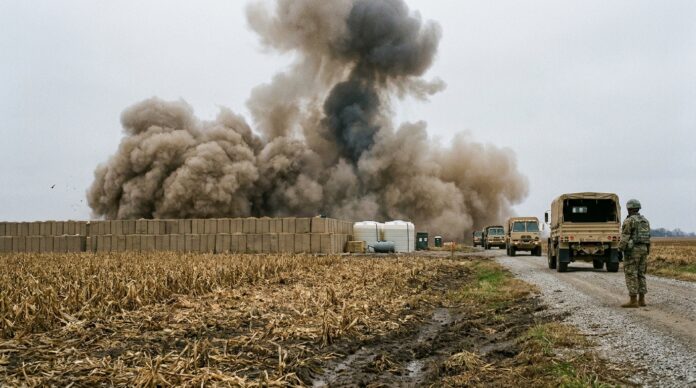

The US Army has blown up the country’s entire stockpile of degraded lead azide at the Iowa Army Ammunition Plant in Middletown, ending a two-week fight over whether it was safe to do so. The Iowa lead azide detonation of 68 drums, holding more than 9,700 pounds of net explosive weight, was set off at 9 a.m. Central time on Wednesday, the day before Thanksgiving, Fox News reported. The two blasts went off as scheduled, and within the first hour officials were calling it a success: the Environmental Protection Agency said its real-time monitors were reporting “zero detection of airborne lead throughout the region,” CBS News reported.
The operation was postponed three times and challenged in court. Its critics were not arguing that the explosives should stay where they were. They were arguing about how a stockpile that was supposed to be kept safe under liquid for decades got so unstable that the only option left was to set it off in the open, sending a plume of lead dust over farmland in Iowa and Missouri.
How the blast went
A few loud pops rang out on livestream footage, followed by a smoke cloud rising over the plant, according to CBS. Acting Army Secretary Adam Telle wrote on X that “the threat of an uncontrolled spontaneous detonation has been eliminated” and that the Army was watching the EPA’s sensor array, with “no readings so far above 0.0.” A senior administration official told CBS the explosion “exceeded all expectations,” and President Trump wrote that the Army’s mitigation efforts “have far exceeded expectations.” Iowa Governor Kim Reynolds called the operation “successful,” and Missouri Governor Mike Kehoe said initial analysis showed “the explosion was well-contained.”
EPA Administrator Lee Zeldin said 300 agency employees and contractors on the ground would take samples of air, land and water “over the course of the upcoming minutes, hours, and days,” after collecting 1,200 baseline samples before the blast, Fox News reported. Air monitors catch dust while it is in the air; what settles on soil and farmland will only show up in those later samples. FEMA told residents within 20 miles who had not evacuated to keep sheltering in place until officials give the all-clear.
Iowa’s Democratic governor-elect, Rob Sand, thanked the crews for making the blast “as safe as possible,” but added: “The lead-up to the detonation should never have been so chaotic and unclear. Iowans across the state are understandably alarmed and scared. There must be immediate transparency to understand how and why this situation became what it did.”
What lead azide is, and why it could not be moved
Lead azide is a primary explosive: a small amount of it sits inside detonators and blasting caps and starts the chain reaction that sets off the main charge. It is extremely sensitive to friction and shock, which is why the plant stored it in drums kept wet with a mix of water and ethanol in concrete-lined, earth-covered underground magazines.
That liquid bath dried out. According to the Environmental Protection Agency, which issued the emergency permit, “recrystallization of the stored lead azide has increased the material’s sensitivity to friction and shock, and disturbing the containers of lead azide could create an unacceptable risk of unintentional detonation,” ABC News reported. The Army’s environmental review said that “movement, physical handling, or off-site transit over public transportation routes presents an unacceptable risk of accidental, catastrophic detonation,” KCCI reported. Officials said crystals had formed on the outside of the barrels and lids.
The Army found the deterioration during a routine inspection on March 11, and an explosive ordnance disposal team later found damage in 58 of the 68 drums, according to court filings summarised in the public record of the case. A sworn Army declaration said the plant’s operator, American Ordnance, had not checked the liquid since September 2025.
The cleaner option the Army dropped
There was another plan. In March the Army hired Georgia-based MuniRem Environmental, for about $120,000, to neutralise the lead azide chemically in place. The Army’s own permit documents said chemical treatment could process up to 10 drums a day, finishing the job in roughly 22 days, and the Army acknowledged it would avoid the lead dust plume of a blast. Two months later the contract was cancelled. The Army said opening and dousing the drums carried its own risk of setting them off, an “unacceptable risk to human safety.” The New York Times reported an email from an Army contracting officer saying the cancellation was unrelated to any shortcomings in MuniRem’s proposal.
The last Army lead azide detonation of this size was in 1977, Col. Aaron Teller, commander of the 71st Explosive Ordnance Disposal Group, told reporters, according to KCCI.
How the Army tried to contain the blast
The mitigation was built like an engineering project. Acting Army Secretary Adam Telle listed earth berms, two-story sand-filled barriers, a “water wall” of more than 100,000 gallons in eight 16,000-gallon tanks, blast-absorbing foam and gel blocks, PFAS-free foams and misters to trap dust, temperature-regulating tarps, drone and satellite monitoring and rapid environmental sampling across the region. C4 and diesel fuel were used to direct the blast downward, which is why residents were told they might see dark smoke. The charge was set off as two rapid detonations, with the blast pointed south and southwest, away from the town of about 360 people.
The timing was driven by weather. Justice Department lawyers told the court that “as the outside temperatures drop the risk of an uncontrolled explosion increases because the formed crystals can break more easily in freezing temperatures.” Telle called a controlled blast “far preferable to an uncontrolled spontaneous detonation of that substance.”
Where the lead goes
Lead is a neurotoxin, and the EPA says no safe blood lead level has been identified for children. The Army’s latest model projected lead dust settling over an area about 25 miles long and 5 miles wide, southwest of the plant into sparsely populated parts of Iowa and north-east Missouri, according to the environmental groups’ court filing reported by ABC. Critics warned that lighter particles could travel up to 100 miles. The US Department of Agriculture estimated that about 350 farms could be affected.
Residents of Middletown were urged to evacuate, with FEMA offering transport and hotel rooms through Friday. People in the plume path were told to stay indoors with windows closed, set heating to recirculate and, after the all-clear, wipe down surfaces children touch with wet cloths. The EPA said anyone in the affected area can ask for their home, property or school to be sampled for lead. “We don’t want to give the public the feeling that there’s absolutely no risk,” Telle said.
The court fight
The Sierra Club’s Iowa chapter and the Iowa Environmental Council sued, arguing that the permit allowed open detonation without a full look at alternatives and that many communities learned of the plan only from social media. The Eighth Circuit Court of Appeals briefly paused the permit, then refused an emergency stay: “we must acknowledge the realities of the situation: The degraded explosives present a risk of an uncontrolled and unplanned explosion.” The Justice Department had already told the court the Army could act without the permit under an emergency exemption.
Our take
The early numbers are good news, and on the day itself blowing up the drums was probably the least bad option; nobody serious argued for leaving a crystallised primary explosive in the ground through an Iowa winter. But that is exactly the problem. This was not an accident, it was a storage job that failed slowly, with warnings dating back to a 2004 environmental assessment, and the bill is being paid in lead on someone else’s farmland. Before the Army awards more contracts at plants like this, Congress should ask a simple question: who was meant to top up those drums, and why did nobody check the liquid after September 2025?