

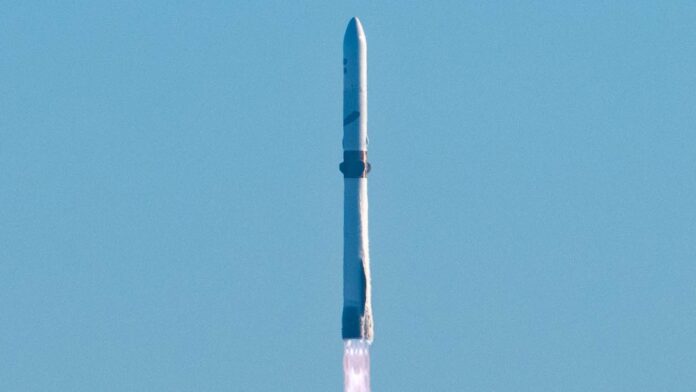

Google has picked Jeff Bezos’s rocket company to carry its first real attempt at a data center in orbit. Blue Origin’s heavy-lift New Glenn rocket will launch several Project Suncatcher satellites, each carrying Google’s own AI chips, into a sun-synchronous orbit in the first quarter of 2029, the companies announced on Thursday. Google calls it “the first heavy-lift launch for Project Suncatcher” and “a crucial milestone on our long-term roadmap.”
The deal is small in dollars, or at least no one has said how big it is: neither company disclosed the price or the exact number of satellites. But it says a lot about where the race to move AI computing off the planet now stands, and about which rocket companies Google is willing to bet on.
What will fly in 2029
Each satellite will carry Google’s Tensor Processing Units (TPUs), the custom chips that train and run its Gemini models, with “roughly the capacity of a data center rack,” according to Google. A rack is the tall cabinet of servers that fills rows inside a normal data center. The satellites will go into a sun-synchronous orbit, a path over the poles that keeps a spacecraft in almost constant sunlight, so its solar panels can feed the chips nearly all the time. Blue Origin said New Glenn was selected for “several” computing satellites, Reuters reported.
Google says the launch “builds on our ongoing work with other satellite and launch partners.” It does not say SpaceX lost any business. Nothing in the announcement suggests Blue Origin will fly every future Suncatcher mission either.
From a haiku to a server rack
Suncatcher started as a research paper in November 2025. Google’s team described constellations of solar-powered TPU satellites flying close together and linked by lasers, and argued that space-based data centers could come close to the energy cost of ground ones if launch prices fall below about $200 per kilogram by the mid-2030s, according to the Google Research blog.
The first hardware went up this October. A prototype built with the satellite company Planet launched on a SpaceX Falcon 9 rideshare, booted its TPUs and used Google’s Gemma 4 model to send a haiku back to Earth, The Verge notes. We wrote at the time that the haiku was a publicity milestone: that fridge-sized satellite carries four TPUs but has power to run only one of them for about 20 minutes at a time. Google’s plan also includes two more satellites in 2027 to test the laser links between spacecraft.
The 2029 mission is a big step up. Going from one chip running for minutes to rack-scale computing in constant sunlight is the difference between a lab demo and something that looks like a small piece of a real data center. It also tests the hardest engineering problems at a meaningful size: cooling chips in a vacuum where heat can only be radiated away, and keeping them working through radiation that can flip bits in memory. Reuters noted that engineers are still testing whether the chips can survive launch forces, radiation and extreme temperatures.
Why Blue Origin is a brave choice
Google is booking a rocket with a short and bumpy record. New Glenn reached orbit on its first flight in January 2025 and launched NASA’s ESCAPADE Mars probes on its second in November 2025, landing its booster. On the third flight, in April 2026, it reused a booster for the first time but left an AST SpaceMobile satellite in an “off-nominal orbit,” Fortune reported.
Then, in May, a New Glenn exploded during a hot-fire test on the ground and badly damaged Blue Origin’s only operational launch pad in Florida, days before it was due to launch 48 satellites for Amazon’s Leo internet service. Blue Origin has since pushed the rocket’s return to flight to January 2027. “Returning New Glenn to flight remains our top priority — it’s worth it,” chief executive Dave Limp wrote to staff, CNBC reported.
American heavy launch is under strain more broadly. Last weekend United Launch Alliance’s Vulcan rocket failed for the first time, destroying 40 Amazon Leo satellites. ULA says the problem lies in the booster’s fuel supply, not in the BE-4 engines that Blue Origin builds for it, but the result is that SpaceX is, for now, the only US company flying big payloads reliably. A 2029 date gives Blue Origin more than two years to prove New Glenn, which is probably why Google is comfortable signing now.
A crowded race, and an awkward rival
Google is not alone. SpaceX and the startup Starcloud are also working on orbital data centers, and SpaceX has said it expects to begin deploying AI computing satellites as early as 2028. That makes SpaceX both Google’s most proven launch provider and a likely competitor in orbit, while Alphabet remains a significant SpaceX shareholder. Booking a dedicated flight with Blue Origin gives Google a second supplier and some independence from a company that may want the same customers.
Bezos has his own reasons to make this work. Amazon, which he founded, runs the largest cloud business in the world, and Blue Origin has said it wants to build orbital data centers too. Flying Google’s chips puts the rocket company close to the most ambitious attempt in the field.
Experts remain cautious about the whole idea. High launch costs, unsolved engineering problems and limited satellite production could leave orbital data centers years from commercial use, Reuters noted. Google’s own project lead, Travis Beals, said in October that he did not expect space computing to be cheaper than ground data centers within five years.
Our take
This is the moment Suncatcher stops being a science project and becomes a schedule. Google is not promising space data centers; it is promising one serious test, on a rocket that has not flown since April and must first fix its pad. That is a reasonable bet, because the alternative is to rely entirely on SpaceX, a company building its own orbital AI business. The thing to watch is not the 2029 date but the next two years: whether New Glenn starts flying regularly in 2027 and whether Google’s 2027 laser-link satellites work. If both happen, a rack of AI chips circling in permanent sunlight will look much less like a moonshot.