

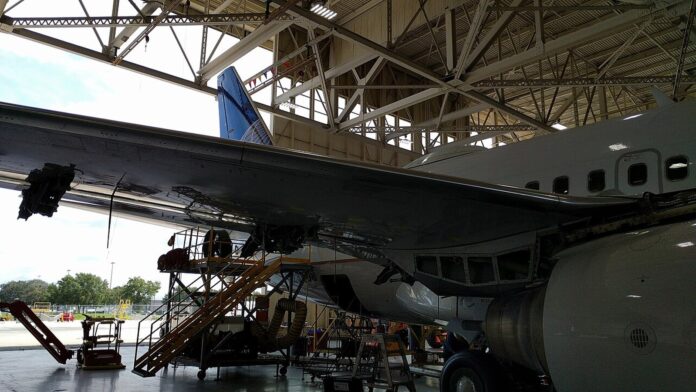

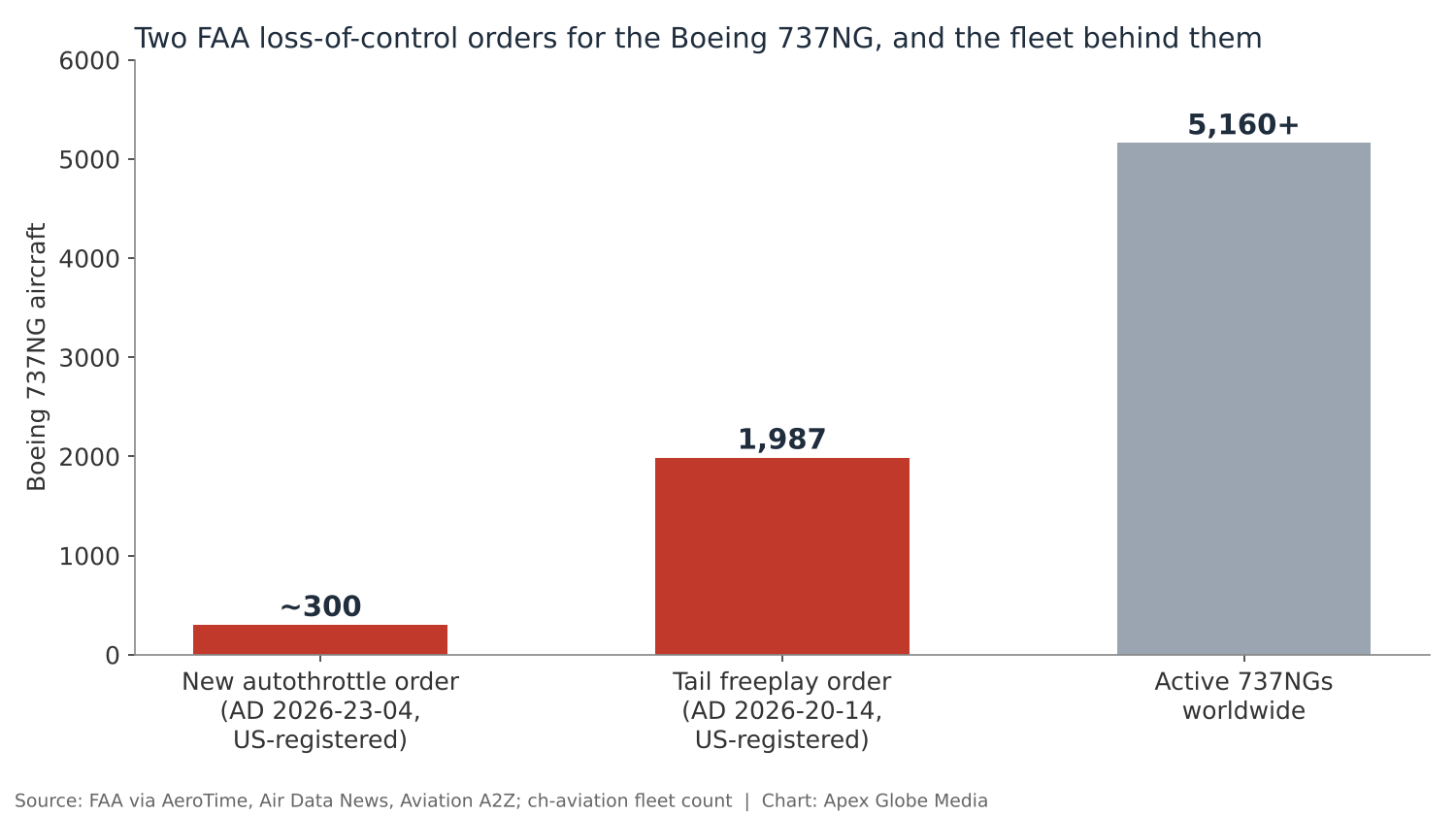
The Federal Aviation Administration has ordered airlines to keep testing the flight controls of about 300 US-registered Boeing 737NG jets, after a review found that bad spoiler sensor data could stop a safety system from reacting when one engine produces much more thrust than the other. According to AeroTime and Air Data News, the FAA warns that the fault could lead to an uncommanded roll and, in the worst case, loss of control of the airplane.
The order, Airworthiness Directive 2026-23-04, is due to be published in the Federal Register on November 20 and takes effect 15 days later. It lands three days before a much larger 737NG directive kicks in: on November 23, operators must start measuring wear in the tail of 1,987 US-registered 737NGs, because loose parts there could cause flutter. Neither order grounds a single plane. But together they put the jet that still flies a large share of America’s domestic routes under two separate loss-of-control warnings in the same week.
What the autothrottle fault actually does
The 737 Next Generation family, which covers the 737-600, -700, -800 and -900, has an autothrottle that sets engine power automatically. Built into it is a safeguard called the cruise thrust split monitor. If one engine is producing much more thrust than the other in cruise, for example because a throttle lever is stuck or an engine control misbehaves, the monitor is supposed to disconnect the autothrottle so the pilots can take over before the imbalance rolls the airplane.
To decide whether something is wrong, the monitor reads several inputs, including the position of the spoilers, the panels on top of the wings that pop up to dump lift. Air Data News reports that the FAA’s review found that missing or incorrect spoiler-position data could keep the safeguard from activating. In that case the autothrottle could stay engaged despite a large thrust imbalance, and the airplane could start to roll without the crew commanding it.
The worrying part is that the fault can hide. The safeguard is only needed in particular conditions, so a broken input may go unnoticed during normal flights. Neither the FAA summary nor the news reports describe an in-service incident on a 737NG caused by this fault. The directive is preventive.
What airlines have to do
The fix is a test, not new hardware. Operators must run repeated aileron built-in test equipment (BITE) checks of the digital flight control system, following Boeing Alert Safety Advisory 737-BSA-22-001, dated October 30, 2026. A BITE check is a self-test the airplane’s computers run on command, so mechanics can see whether a sensor or channel is reporting nonsense. If the test fails, the airline must fix what it finds and repeat the test until it passes.
The FAA estimates each test takes two labor-hours, or about $170 per airplane. Across roughly 300 US jets that is about $51,000 per test cycle, before any repairs. The agency skipped the usual notice-and-comment period because of the safety risk, though it will accept comments for 45 days after publication. The rule covers only the specific aircraft listed in Boeing’s advisory, not the whole NG fleet, and it does not apply to the newer 737 MAX.
A familiar problem from older 737s
This is not the first time spoiler data has caused trouble for the 737’s thrust monitor. In 2022 the FAA ordered repeated tests on the older 737-300, -400 and -500 after an undetected spoiler sensor failure was identified, and in December 2024 it issued another directive on rigging tolerances for the 737-300 and -400.
The background to those orders is grim. On January 9, 2021, Sriwijaya Air Flight 182, a 737-500, crashed into the Java Sea shortly after takeoff from Jakarta, killing all 62 people on board. Indonesia’s accident investigator, the KNKT, found that an underestimated spoiler-position signal delayed the activation of the thrust split monitor while the left engine’s thrust lever kept pulling back. Air Data News is careful to note that the new NG directive does not cite the Sriwijaya accident and does not establish that the affected NG jets have the same defect. Still, the logic is the same: a safety net that only matters on a bad day is only useful if its inputs are right.
The bigger order: 1,987 jets and their tails
The autothrottle checks arrive just before a far larger job. Airworthiness Directive 2026-20-14, published on October 19, applies to 1,987 US-registered 737-600, -700, -700C, -800, -900 and -900ER jets and takes effect on November 23. It targets “freeplay,” the small amount of looseness in the hinges and the jackscrew that move the horizontal stabilizer, the small wing on the tail that controls the airplane’s pitch.
Parts wear, and as they wear, freeplay grows. According to Aerospace Global News, the FAA acted after reports from multiple operators of pitch oscillation events, in which jets pitched up and down in flight, linked to excessive stabilizer freeplay. The agency did not say how many events there were or which airlines reported them. Its warning, quoted by Simple Flying, is blunt: “The unsafe condition, if not addressed, could lead to a flutter event, which can result in loss of control of the airplane.” Flutter is a self-feeding vibration in which aerodynamic forces and a structure’s flexing reinforce each other; in a tail surface it can tear parts apart within seconds.
Mechanics must measure freeplay at the left and right pivot hinges and at the jackscrew, using Boeing Alert Requirements Bulletin 737-55A1104 RB from June 2025. Depending on what they find, they repeat the measurement at set intervals or repair and replace worn parts, and they must confirm the freeplay is back within limits before the jet returns to service. The FAA puts the cost at six work hours, about $510 per airplane, or roughly $1.01 million across the US fleet, not counting parts and repairs. Airlines have 12 months for the first check, and the work can be folded into routine maintenance.
Airlines asked for leeway and did not get it
The tail order was first proposed in January, and airlines pushed back. According to Aviation A2Z, United, which has more than 300 affected jets, asked for longer intervals on aircraft with new hinge bearings and credit for checks it had done under a 2022 Boeing message. Alaska Airlines wanted to skip interim checks and go straight to repairs. Canadian North asked to stretch the first deadline from 12 to 36 months. The FAA said no to all three and adopted the rule essentially as proposed, pointing operators to the alternative-compliance process if they have data to back a different approach.
The exposure is not just American. Ch-aviation counts more than 5,160 active 737NGs worldwide, and big NG operators include Southwest, with several hundred -700s and -800s, and Ryanair, with more than 400. Foreign regulators usually follow FAA directives on US-built aircraft, so the 1,987 figure is a floor, not a ceiling.
Why the 737NG is getting this attention now
The 737NG first flew in the late 1990s, and many of these airframes have been flying for 15 or 20 years. Ageing aircraft produce exactly this kind of finding: hinges that loosen, sensors that drift, software safeguards whose inputs nobody had reason to test until something went wrong elsewhere. The FAA has also had an unusually rough month. As we reported, a single router failure set off the nationwide ground stop in mid-November, and the agency is under pressure to show it is on top of safety beyond its own networks.
For passengers, nothing changes at the gate. No jet is grounded, the checks are cheap, and the inspections can be scheduled into normal maintenance. The point of both directives is to catch problems on the ground that would otherwise show up, rarely but badly, in the air.
Our take
These are sensible, low-cost orders, and the FAA was right to refuse the airlines’ requests to stretch the tail inspections. What bothers us is the pattern: in both cases, the danger comes from something that can sit unnoticed for a long time, a loose hinge that worsens slowly or a sensor input that only matters in an emergency. That is the profile of the Sriwijaya crash, and it is why “no incident yet” is not reassurance. The FAA should publish how many pitch oscillation events led to the tail order. Passengers and pilots deserve to know how close this got.