

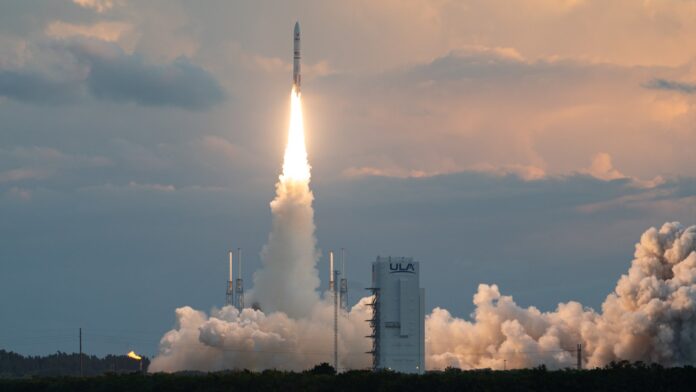

United Launch Alliance lost a rocket for the first time in its 20-year history on Sunday. Its Vulcan rocket failure came about ten minutes after liftoff from Cape Canaveral, and the 40 Amazon Leo internet satellites on board never reached orbit. In a statement issued roughly 50 minutes after launch, ULA said the vehicle “suffered an anomaly 10 minutes into the flight and failed to deliver the Amazon mission to orbit,” CBS News reported. The company, a joint venture of Boeing and Lockheed Martin formed in 2006, had never had an outright launch failure before.
The loss hurts twice. Amazon needs launches badly to build its rival to SpaceX’s Starlink, and Vulcan was supposed to be the workhorse that carried almost half of the network. ULA, for its part, had only just returned Vulcan to flight after a nine-month pause.
What happened during the flight
The 214-foot rocket lifted off from Space Launch Complex 41 at 12:40 p.m. Eastern time on November 15. The countdown had already been difficult. A Friday attempt was scrubbed after a gaseous nitrogen plant that serves several launch companies lost power, and on Saturday a network problem between the rocket and ground equipment caused another delay, according to Via Satellite. On Sunday, controllers called a hold at T-minus 20 seconds for an unexplained technical issue, solved it, and launched near the end of the window.
The six Northrop Grumman solid boosters burned out and dropped away normally at about the 90-second mark. Northrop Grumman later said its preliminary data showed the GEM 63XL boosters “performed as expected” and separated before the anomaly. That matters, because faulty booster nozzles were the reason Vulcan had been on the ground.
The rest of the climb is less clear. CBS News noted that the two methane-fuelled BE-4 engines on the first stage appeared to burn longer than the pre-launch timeline called for, and that separation from the Centaur V upper stage came later than expected. The Centaur’s hydrogen engine was due to fire for 12 minutes and 15 seconds. The telemetry animation showed unusual changes in the stage’s orientation early in that burn. The live broadcast ended about nine and a half minutes into the flight with no sign of trouble, and the planned engine cutoff at around 17 minutes never came.
ULA has not named a cause. “Since the anomaly just occurred, we don’t have any specific data yet,” the company said, according to Anadolu Agency, adding that its standard is mission success and “today, we did not meet that standard.” It promised “full transparency” and said it would work with Amazon and the relevant authorities to find the root cause and return to flight “as quickly as possible.”
A rocket that had just come back
This was only the fifth Vulcan launch since the rocket’s debut in January 2024, and the first in nine months. Two earlier flights, one in October 2024 and one in February 2026, reached orbit despite problems with a solid booster nozzle. After the February incident, the US Space Force paused Vulcan launches of national security satellites while ULA, Northrop Grumman and government engineers investigated. Commercial missions were still allowed.
Before Sunday’s flight, ULA chief executive Mark Peller told Aviation Week that the company had “identified three credible causes” of the nozzle issue and had taken steps against each of them. The boosters did their job this time, so the new failure points somewhere else in the vehicle.
There is also an engine story in the background. The BE-4 is built by Jeff Bezos’s Blue Origin, which also uses seven of them on its New Glenn rocket. New Glenn has been grounded since an explosion on the launch pad in May, traced to a faulty oxygen valve in one of those engines. Blue Origin changed the design, and the Vulcan engines were retrofitted with the fix, CBS News reported. Nothing so far ties Sunday’s failure to the engines, but investigators will look at every stage.
Why this hurts Amazon Leo
Amazon Leo, the satellite broadband network formerly called Project Kuiper, needs more than 3,300 satellites in low Earth orbit to be complete. Sunday’s flight carried 40 of them, the largest single batch so far, and would have brought the number launched to 436. It was also the first of 38 Vulcan launches Amazon has bought, on top of eight Leo missions already flown on ULA’s older Atlas V.
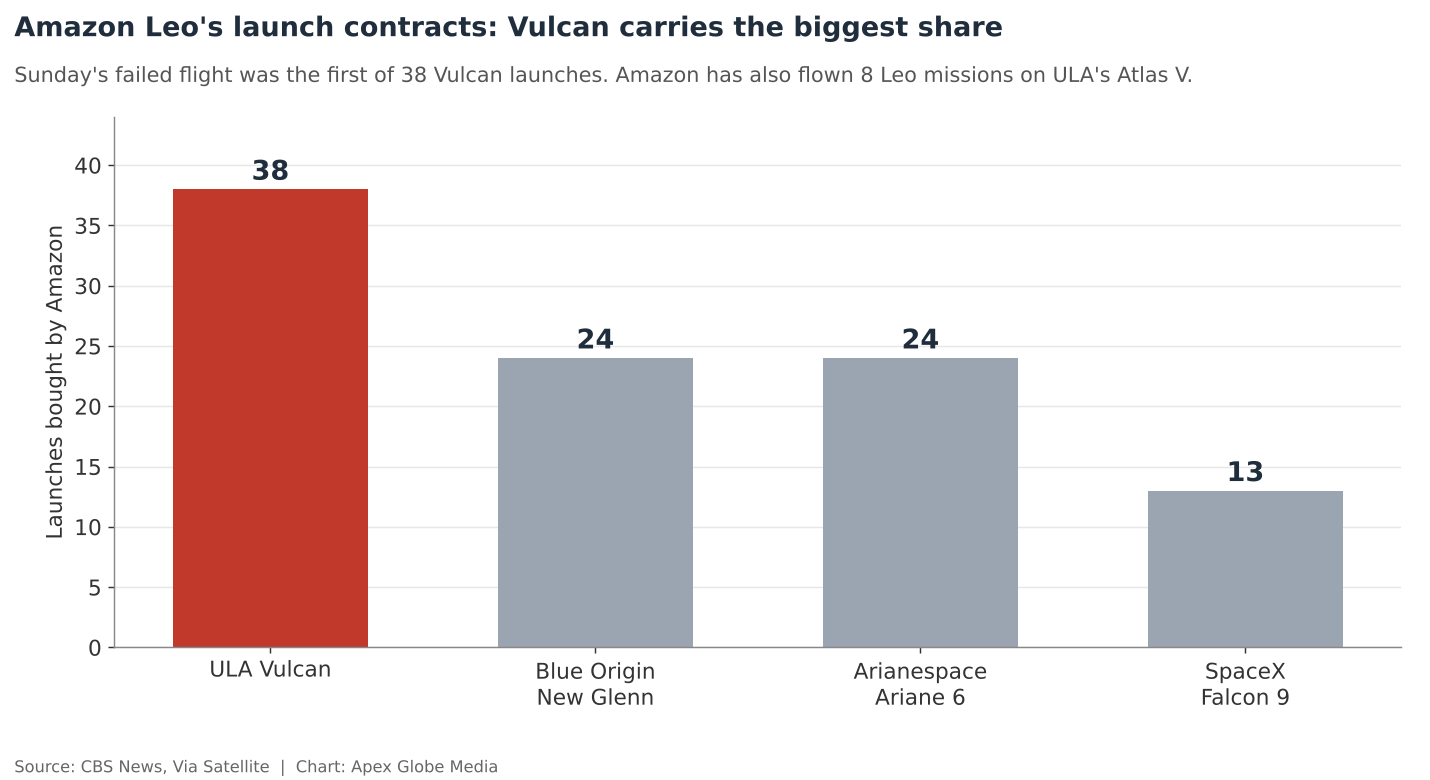
The other rockets on Amazon’s list do not offer a quick way around the problem. New Glenn, with 24 launches booked, is itself grounded. Europe’s Ariane 6 holds another 24, and SpaceX’s Falcon 9, the rocket of Amazon’s direct competitor, has 13. Before the launch, Amazon Leo’s director of launch systems, Melissa Wuerl, called Vulcan a “gamechanger” and a “workhorse” for the project. “We’re launching close to 1,500 satellites on Vulcan, which is nearly half of our constellation,” she said, as quoted by Via Satellite.
Time is the real issue. Amazon’s licence from the US Federal Communications Commission required half the system to be in service by July 30, 2026. Amazon missed that date and, blaming a shortage of available rockets, asked for more time. In June the FCC granted only a limited waiver, with penalties on spectrum priority for satellites launched late, and kept the final deadline of July 30, 2029 for the full network, Broadband Breakfast reported. Every month Vulcan stays on the ground makes that deadline harder to reach.
Publicly, Amazon stayed calm. “There is risk with any launch, and that’s especially true for inaugural missions like LV-01,” Amazon Leo wrote on X. “ULA has been a trusted partner for Amazon, and we believe they’ll learn from this mission and deliver on their long-term plans for Vulcan.”
Bigger stakes for US spaceflight
Vulcan is not only Amazon’s rocket. It is meant to replace ULA’s Atlas V and Delta IV, and it is one of two rockets the Space Force relies on for its most important national security satellites. NASA administrator Jared Isaacman offered NASA’s help with the investigation and wrote: “Artemis, Moon Base, and the nation need ULA.”
The timing makes the contrast with SpaceX sharp. A day earlier, SpaceX caught a Starship upper stage returning from orbit for the first time, as we reported on Saturday, and Falcon 9 flies several times a week. With Vulcan and New Glenn both grounded, the US has one company launching at high rate, and that company also owns the market leader in satellite internet.
Our take
One failure in five flights does not make Vulcan a bad rocket. Plenty of reliable launchers lost a vehicle early in their careers. But this one came at the worst moment, right after a long grounding and on the first flight of a 38-launch contract that Amazon cannot easily replace. If the investigation takes as long as the booster nozzle review did, Amazon Leo will fall further behind Starlink, and SpaceX will gain more control over American access to space. The most useful thing ULA can do now is exactly what it promised: publish what went wrong, quickly and in detail.