

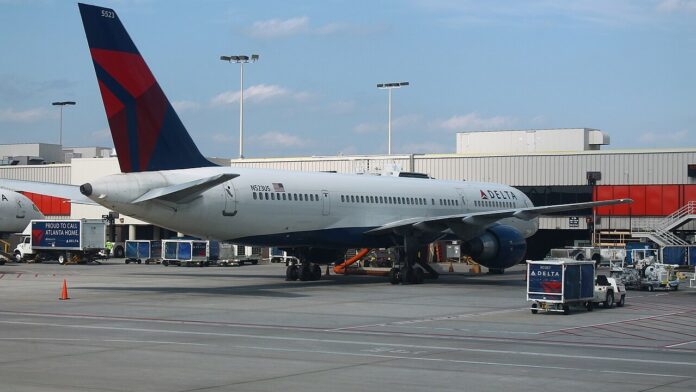

A software failure at Delta Air Lines on Sunday, November 22, left ramp crews across the US counting bags by hand, and it showed how a single back-office system can slow down an entire airline. The Delta outage hit the airline’s automated weight and balance system, which works out how heavy each plane is and where that weight sits before it is allowed to take off. More than 1,600 Delta flights were delayed nationwide, and 49% of all its Sunday flights left more than 15 minutes late, the airline told ABC News. Delta said the system was back to normal by Sunday afternoon and that the outage “was not the result of a computer hack.”
The timing could hardly have been worse. Thanksgiving travel is starting, the busiest airport in the world is Delta’s home hub, and the country has spent the past ten days living through a run of tech failures that has already grounded every flight in the US once this month.
What failed: the system that tells crews how to load a plane
Before any airliner leaves the gate, the airline has to add up the empty aircraft, fuel, passengers, checked bags and cargo, and check that both the total weight and the centre of gravity stay inside approved limits. The result also gives pilots the numbers they need for a safe takeoff. The FAA’s Pilot’s Handbook of Aeronautical Knowledge puts it plainly: “Compliance with the weight and balance limits of any aircraft is critical to flight safety.” It is not a step an airline can skip to save time.
Big carriers do this centrally. According to CNN, Delta plans the loading instructions for its baggage crews at its Operations and Customer Center at the Atlanta headquarters, using a system called ALIS, short for Automated Load Instruction System. The tool also tracks bags and cargo as they go into the hold in real time.
On Sunday morning ALIS went down across the network. A ramp employee in Boston explained the problem to the pilots of Delta flight 2066 to Raleigh-Durham in a radio call captured by air traffic control recordings and quoted by CNN and Men’s Journal: “Right now, it’s a system-wide outage for Delta Air Lines. The ramp isn’t really able to load because there is no ramp worksheet in there, so that’s what we’re doing, we’re manually counting bags and doing a report for you guys.” Then he added: “Kinda like the good old days across here.”
Delta itself did not name the system in its public statements, and it has not said what caused the failure. Its morning message said only that “Delta teams are using manual workarounds this morning to safely get flights departed while work continues to restore automation.”
How a calculation problem became a ground stop in Atlanta
Doing the maths by hand is safe, but it is slow, and slow departures cause a second problem. Planes that cannot leave keep their gates, so arriving flights have nowhere to park. In Atlanta that quickly turned into congestion, and Delta said it was working with air traffic control “to strategically enact programs to protect airport gates and tarmac areas from congestion at our Atlanta hub.”
The FAA started a ground stop at 7:46 a.m. Eastern time for Delta and its regional flights heading to Hartsfield-Jackson Atlanta International Airport from 14 of the 20 air traffic control centres in the lower 48 states, Men’s Journal reported, citing Newsweek. At 8:32 a.m. it was replaced by a ground delay programme, with average holds of 57 minutes and a maximum of 111 minutes. The FAA cancelled the ground delay at around 11:30 a.m., according to CNN.
The airport stressed that this was a Delta problem, not an airport-wide one, and the FAA said on X that “these delays are not related to any FAA air traffic systems.” That matters, because the FAA’s own telecommunications failure on November 13 caused the nationwide ground stop that started this month’s chain of disruptions.
The numbers by Sunday evening
Counts changed through the day. About 700 Delta flights, roughly 20% of the schedule, were delayed by Sunday morning, WABC-TV reported. By the afternoon Delta put the total at more than 1,600. By 7:30 p.m. Eastern, more than half of Delta’s flights had been delayed and 4% cancelled, according to FlightAware data cited by CNN, and Delta said about 70% of Sunday’s schedule changes were caused by the automation issue. More than 60% of all departures from Hartsfield-Jackson were late on Sunday evening, though that figure covers every airline at the airport.
Passengers reported delays at Newark, LaGuardia, Boston, Reagan National, Dulles, Miami and Minneapolis. Weather added to the mess: the FAA was holding flights to LaGuardia and Newark for around two hours on average, and San Francisco also had weather delays.
The airport expects more than 4 million passengers between November 19 and December 1, about 5% more than last year. “Delta teams are focused on completing the remainder of today’s schedule. Cancellations, as always, are a last resort when all other options have been exhausted,” the airline told CNN.
The third airline-system failure in ten days
Sunday’s failure is the latest in a run of outages that has rattled the US since mid-November. On November 13 a fault in FAA telecommunications equipment grounded all flights nationwide. On November 16 United Airlines had a brief system outage that affected fewer than 150 flights. In between, Microsoft 365, Apple services and the online banking of JPMorgan Chase, Bank of America and Wells Fargo all went down at different points. We have collected every estimate of what that outage week cost.
Officials keep saying the failures are not a coordinated cyberattack. On the same Sunday as the Delta outage, Director of National Intelligence Jay Clayton went further and told Americans to expect more of them. “The American people should be prepared for a great deal of investment in upgrading our systems,” he told CNN’s Dana Bash, as reported by The Hill. “They should be prepared for investment in cybersecurity, and they should be prepared that any time there is a step change in technology, a step change in both compute and applications, there will be bumps in the road.” He compared it with renovating a house, where there are “going to be things that you do not expect.”
Nobody has linked the Delta failure to that upgrade wave, and Delta has not said whether ALIS was being patched or changed. United’s weight and balance system failed in a similar way in 2025, causing more than 1,000 delays, CNN noted, so this type of outage was not new even before November.
Delta also has history here. In July 2024 a faulty CrowdStrike update crashed Windows machines around the world, and Delta took far longer than other airlines to recover. It later sued CrowdStrike, blaming the outage for a hit of roughly $500 million.
What Delta passengers are owed
Delta said it is “rebooking customers to the next best itinerary and providing meals and hotel rooms where necessary,” and that “for customers facing a canceled flight and don’t wish to travel, refunds are being given.” Under US Department of Transportation rules, travellers who decide not to fly get a full cash refund when a flight is cancelled or significantly changed, which includes an arrival delay of at least three hours on a domestic flight or six hours on an international one. Our guide to getting your money back after an outage explains how to claim. Anyone connecting through Atlanta this week should check the Fly Delta app before leaving for the airport.
Our take
The most telling detail of Sunday is the ramp worker’s joke about “the good old days.” Airlines have spent decades turning load planning into a central, automated service, and that makes them efficient on normal days and fragile on bad ones: when one system in Atlanta stops, every station in the country falls back to pencil and paper at the same moment. Delta deserves credit for keeping flights moving safely rather than cancelling wholesale, but after the CrowdStrike meltdown in 2024 it should be able to say quickly what failed and why, and it has not. And when the country’s intelligence chief tells people to expect “bumps in the road,” airlines heading into Thanksgiving should treat that as a reason to test their manual backups this week, not after the next outage.