

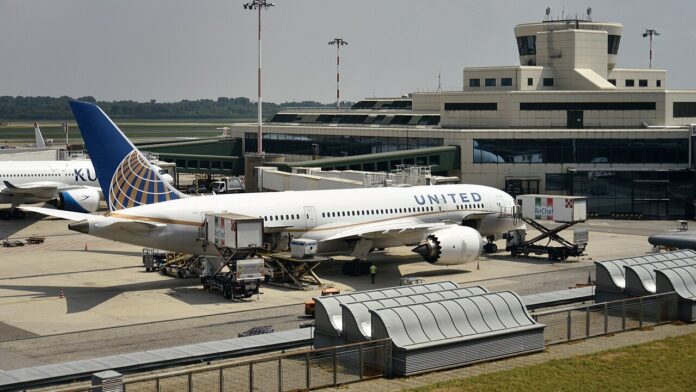

Your AI assistant can still find you a United flight. It just can’t buy it anymore. United Airlines said on Wednesday that it is changing its booking, ticketing and distribution policies to stop “unauthorized, third-party personal AI agents or assistants” from using its website and app, and from booking through travel agencies and fare aggregators. United’s AI agent ban makes it the first major U.S. airline to publicly push back against so-called agentic commerce, according to the Wall Street Journal’s reporting as summarized by investingLive.
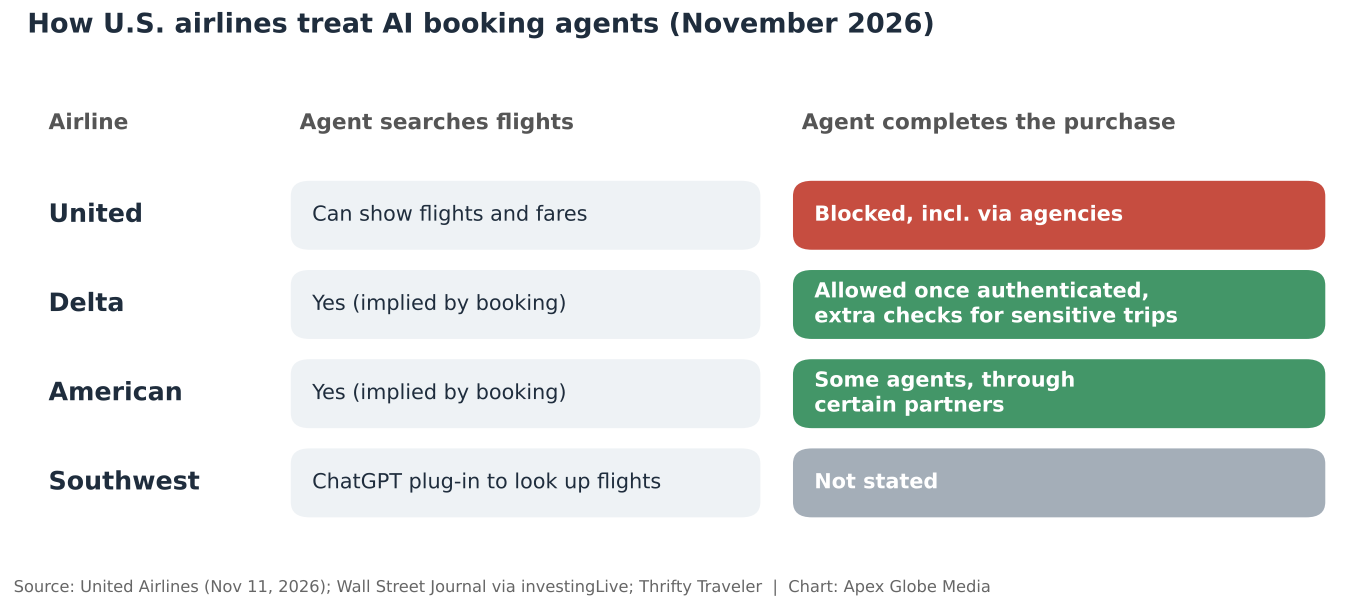
An AI agent is a chatbot that does more than answer questions: it opens websites, fills in forms and pays on your behalf. Coverage of United’s move names Meta’s Muse, OpenAI’s Dots and xAI’s Grok as the kind of assistants it has in mind. Under the new rules they can still show United’s flights and fares, but the purchase has to be made by a person.
United’s three reasons
The airline’s statement gives three arguments. The first is security. “Sharing account credentials with personal, third-party, AI assistants can expose sensitive information,” it says, “and actions taken by these tools may result in unintended purchases, account changes, or use of MileagePlus miles.” MileagePlus is United’s frequent-flyer program, and miles in it are effectively money.
The second is regulation. United says automated actions “have the potential to violate FAA and DOT regulations,” and gives one example: “flight check-in requires human acknowledgment that bags do not contain banned substances like explosives.” An agent can click that box, but it cannot honestly know what is in your suitcase.
The third is that others have already done it. “Corporate leaders in the banking and retail industries have taken similar actions regarding AI agents,” United says. Engadget points to JPMorgan Chase and Amazon, which has barred Meta’s Muse from shopping on its site. Amazon also sued Perplexity in November 2025 over its Comet browser agent buying on Amazon and later won a court order that temporarily blocked it.
United promises to update its Digital Trust Center page to explain the new limits and “where to get help if an agent takes an unintended action.”
“I don’t want to create another middleman”
There is a fourth reason the statement leaves out. A day before the announcement, at an event in Chicago, chief executive Scott Kirby said of AI agents: “To be honest, I don’t want to create another middleman,” Thrifty Traveler reports.
Airlines spent years fighting online travel agencies over how their fares are displayed and sold, and pushing customers to book directly, where the airline controls upsells and keeps the customer relationship. An agent that searches every carrier, picks the cheapest fare and books it turns the airline back into a supplier on someone else’s shelf. Jackson Newman of Thrifty Traveler argues that AI rebooking may worry United even more: since most change fees disappeared in 2020, a bot could watch a booked fare and rebook every time the price drops, leaving the difference as credit.
Other airlines are taking the opposite path
United is not speaking for the industry. Delta lets authenticated AI assistants complete bookings, with extra safeguards for sensitive trips such as those involving unaccompanied minors, and American says some agents can buy tickets through certain partners, according to the Journal’s reporting. Southwest went further in the other direction this year with a ChatGPT plug-in that lets travelers look up its flights inside the chatbot.
For now the practical effect is small. United says it is not seeing many bookings made by agents. Uber’s numbers show how early this market is: during Halloween week, AI agents accounted for four ride bookings and 500 Uber Eats orders out of about 320 million trips, according to the same report.
The AI companies are betting that this will change. OpenAI bought the travel-booking startup Odessia this week, and Meta says travel planning is one of the top uses of Muse. Both need sellers to let their agents finish the job. Anthropic is pushing in the same direction with assistants that act on their own, as we described in our piece on Claude Duet.
Enforcement is the open question. United can block suspicious traffic on its own site, but it is harder to tell whether a booking that arrives through Expedia was made by a person or by a bot acting for one. The airline says it will keep evaluating “how these tools interact with our services.”
Our take
United’s security worries are real. Agents with saved logins and payment cards are an easy target, and we have already seen what happens when AI tools ship with the wrong defaults, from 35,000 exposed Grok Build apps to Meta’s Muse reportedly leaking a user’s address. But Kirby’s “middleman” remark shows the commercial motive behind the policy. The cleaner answer is Delta’s: let verified agents book, with limits, and require a human for the steps the law reserves for one. If more big sellers copy United instead, AI agents will stay stuck at the browsing stage, and the business case for agentic shopping that the AI labs are selling investors gets a lot weaker.