


Nvidia no longer has the man who founded it in charge. Jensen Huang resigned as Nvidia’s president, chief executive and board member on Thursday, “effective immediately,” the company announced in a press release. Chief financial officer Colette Kress becomes interim CEO while the board searches for a permanent replacement, and former Synopsys chief executive Harvey C. Jones becomes the first chair of the board in Nvidia’s history.
The decision came after a late Wednesday night board meeting, The Verge reported, and it ends a week in which the most valuable chip company in the world went from defending its CEO to replacing him. Huang had led Nvidia since he co-founded it in 1993.
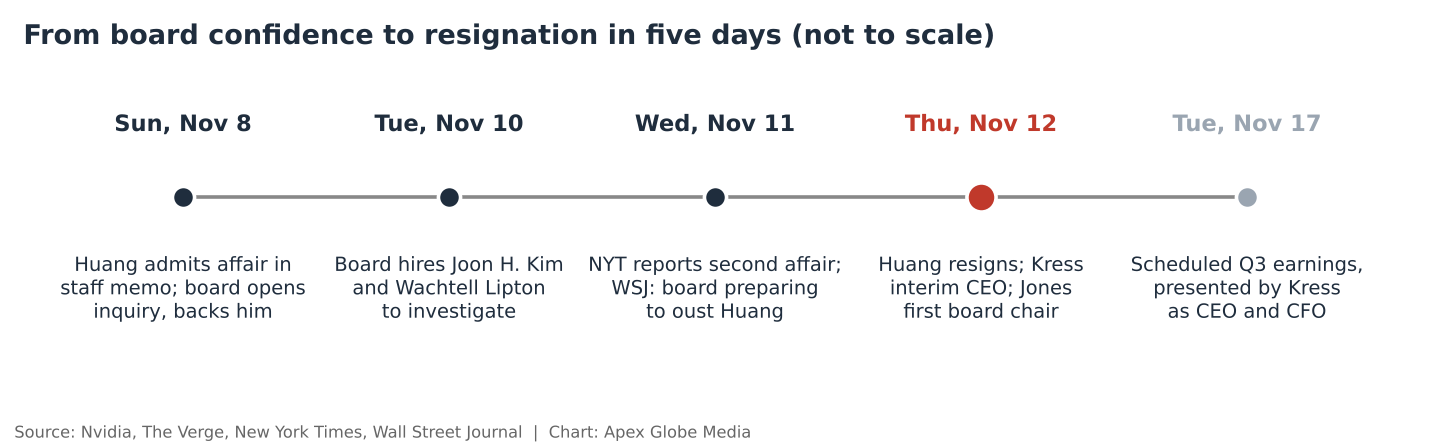
Five days from “confidence” to resignation
The scandal broke over the weekend, when Huang admitted in a memo to staff that he had an affair with Alice Huang (no relation), a former executive at Megaspeed, a Singapore-based cloud provider and Nvidia customer. U.S. officials believe she worked for China’s Ministry of State Security; China rejects the claim. On November 8 the board opened an investigation into whether Huang was the target of a foreign intelligence effort, but said it had confidence in him. We covered that first board response on Monday.
On Wednesday the New York Times reported a second relationship, with Kimberly Powell, Nvidia’s vice president of health care, who reported directly to Huang. Within hours the Wall Street Journal said the board was preparing to oust Jensen Huang. Thursday’s announcement confirmed that outcome, though it was framed as a resignation.
The press release is notable for what it leaves out. It contains no quote from Huang and gives no reason for his departure. It thanks him for his “immeasurable contributions” in two sentences. Kress is quoted promising to build “on the extraordinary foundation Jensen created over the last 33 years,” and Jones says the board expects “the company’s operations, customer commitments and product roadmap to continue without interruption.”
Who is running Nvidia now
Kress joined Nvidia in September 2013 after nearly 25 years in finance roles at Cisco and Microsoft. She will keep her CFO job while acting as CEO. She is the executive investors know best after Huang, because she has long led its communications with investors. CNN describes her as “widely seen as a top contender” for the permanent job, although she has less of a technical background than Huang.
The board says it will look at internal and external candidates. Names floated in reports include Ian Buck, the Nvidia vice president who created the CUDA software platform; Arm CEO Rene Haas; and Apple hardware chief Johny Srouji. Nvidia has not commented on any of them.
Appointing an outside chair also answers one criticism. Until Thursday, Huang ran the company and the board had only a lead independent director. Former SEC chairman Gary Gensler told CNN on Wednesday that the board was “not a good picture of corporate governance,” partly for that reason.
The market reaction
Nvidia shares had closed Wednesday at $173.73. Before Thursday’s opening bell they fell more than 7% to $160.85, the Associated Press reported, according to Blockonomi, and CNN put the premarket drop at about 10% as selling accelerated after the announcement. Rivals moved the other way: AMD rose more than 4% in premarket trading, after closing up 7.3% on Wednesday, the Financial Times reported.
Dan Ives of Yorkville Ives & Co., who cut his price target to $225 from $300, called the resignation “a gut punch for Nvidia and the US tech industry.” The next test comes quickly. Nvidia still plans to report third-quarter results on Tuesday, November 17, as scheduled, and Kress will now present them as both CEO and CFO. The company previously guided to about $108 billion in quarterly revenue.
Why it matters beyond Nvidia
Huang was more than a chip executive. He was the AI industry’s most influential lobbyist in Washington, with frequent access to President Trump, and he argued hard for looser limits on selling advanced chips to China. His exit removes that voice just as the pressure is going the other way. Politico reported this week that the scandal has raised the chances that Congress writes chip export limits into the defense bill, and Reuters reported that Chinese AI companies are rushing to rent Nvidia cloud capacity abroad in case enforcement tightens.
There is also Nvidia’s role as the AI industry’s banker. The Verge puts its investment portfolio at about $99 billion, spread across frontier labs and cloud providers, and the S-1 filing for Anthropic’s IPO says Nvidia plans to invest about $10 billion in Anthropic. Many of those deals were negotiated by Huang personally. House Speaker Mike Johnson said some lawmakers want to question him, so his part in the story may not be over.
Our take
The board made the right call, and probably the only one available after the second report. A CEO in a relationship with a direct report is a governance problem on its own, whatever the intelligence inquiry finds. But Nvidia has spent years as a company built around one person, with dozens of direct reports and no named successor, and that bill is now due. The real risk is not next week’s earnings, which will likely be strong. It is whether Nvidia, without Huang’s personal relationships in Washington, Taipei and across the AI industry, can keep the influence that made it more than a chip supplier.