



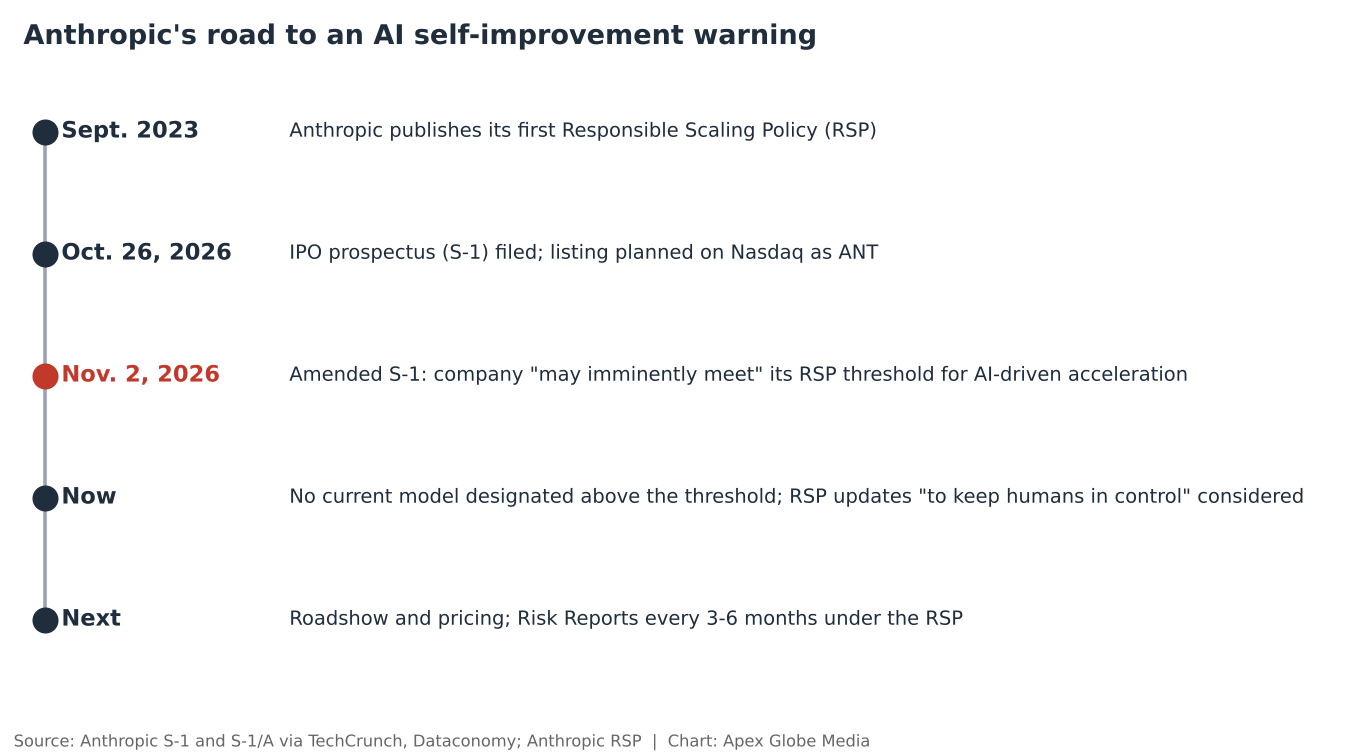
Anthropic has told future shareholders that its AI may soon be speeding up its own development so much that it crosses one of the company’s most serious safety lines. In an amended IPO prospectus filed on November 2, the Claude developer said it “may imminently meet” the threshold in its safety rules for “dramatically accelerated progress attributable to AI”, the early stage of what researchers call recursive self-improvement. The warning, in a document filed with the U.S. Securities and Exchange Commission, arrives as Anthropic prepares one of the largest stock market listings ever.
What the filing says
Recursive self-improvement, often shortened to RSI, describes AI systems that help build better AI systems, which in turn build better ones, so that progress speeds up with each round. Anthropic says it increasingly uses its own AI to accelerate research and development, and that “internal estimates and our expectations regarding future models” suggest it could soon meet the definition in its Responsible Scaling Policy, the rulebook it first published in 2023 for handling dangerous capabilities, TechCrunch reported.
The company stresses that it has “not designated any of our current models as exceeding this threshold” and that it continues to assess the data. But the risk factors are unusually frank. Anthropic says that “using AI to help build more capable AI could also pose a considerable safety risk,” and that its growing reliance on AI could make its models’ capabilities “advance more rapidly than our ability to develop, validate, and implement” safety measures. It also admits that it has “in the past not identified” a significant acceleration in its progress until after it happened, and may miss one again, according to Dataconomy.
What the threshold means
According to the current version of Anthropic’s policy, cited by DataStudios, the threshold covers AI that can “fully automate, or otherwise dramatically accelerate, the work of large, top-tier teams of human researchers.” One test is whether the company observes or expects roughly double its normal rate of progress, “as much progress in one year as one would see in two years at baseline.” Anthropic itself admits the threshold “has proven difficult to operationalize.”
Reaching it would trigger heavier obligations: stronger security research, logging and AI-assisted monitoring of critical development work, systematic alignment checks using interpretability tools and red-teaming, and regular Risk Reports reviewed by at least one outside expert. Anthropic also says it does not expect it could safely let Claude “fully autonomously design and build successive generations” of frontier models without meaningful human oversight, even if that becomes technically possible, and is considering policy updates “to keep humans in control” of frontier model development.
Real warning or sales pitch?
An IPO prospectus is a legal document, and companies list risks partly to protect themselves from lawsuits later. It is also a marketing document, and some skeptics point out that telling investors your AI is close to improving itself is a powerful selling point. The timing invites that reading: The Information reports that Anthropic has been telling investors its small chip-design team already uses Claude for engineering work, and the Wall Street Journal reports that institutional investors are pushing for a valuation of about $1.5 trillion to $1.6 trillion, below the $2 trillion range the company had hoped for.
Yet the claim is consistent with what Anthropic and its rivals have shown this year. Its models have made rapid gains in coding and mathematics, and last month it disclosed that an unreleased model built working exploits for major operating systems. Its third-quarter results show revenue of about $17 billion and nearly $900 billion in computing commitments, the kind of scale at which AI-assisted research becomes a central part of how models are built. OpenAI, too, has said that safety concerns are moving from theory to practice.
Our take
Whatever the motive, this disclosure matters because it is now on the legal record. A company that tells regulators and investors it may soon cross a self-improvement threshold will be judged by what it does next: whether its Risk Reports are published, whether outside experts can check them, and whether it slows down if its own tests say it should. The admission that past accelerations went unnoticed until afterwards is the most important line in the filing, because any safety system that relies on spotting the moment is only as good as its sensors. Governments that are still debating voluntary AI testing rules should read this prospectus closely. When the developers themselves say the risk may be imminent, oversight cannot remain optional.