

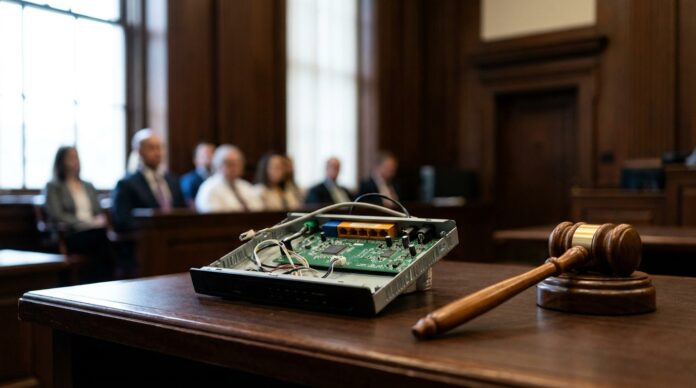

A federal jury in Brooklyn has found Huawei guilty of stealing American technology and lying to banks about its business in Iran, closing a case that Washington opened in 2019 and that shaped the global fight over 5G networks. In the Huawei trade secrets verdict delivered on Tuesday, jurors convicted the Chinese company on 10 of the 12 counts it faced, including conspiracy to steal trade secrets, bank fraud and conspiracy to defraud the United States, the Associated Press reported. They acquitted it of the most serious charge, racketeering conspiracy, and of conspiracy to obstruct justice.
Huawei says it will appeal. The company could face “billions of dollars in penalties” when it is sentenced next September, according to the AP. No person stood trial: the defendants were Huawei and three of its subsidiaries, and none of its executives or employees was in the dock.
What the jury heard
The trial began in September and lasted about three months, AFP reported. Prosecutors described a long pattern of copying rivals’ technology. According to the AP account of the evidence, Huawei sold internet routers “containing source code copied from a competitor”. A person working for Huawei went into a competitor’s booth at a trade show in Chicago to photograph the circuits inside a networking device. In another episode, a Huawei worker removed a robotic arm from a competitor’s lab so it could be photographed and measured. That last episode appears to match the well-known “Tappy” dispute, in which T-Mobile accused Huawei of copying its phone-testing robot more than a decade ago.
Court records name the victims as Cisco Systems, Motorola Solutions, T-Mobile, Quintel USA and Fujitsu. The Justice Department said the stolen material included “source code and user manuals for internet routers, antenna technology, and robot testing technology”, AFP reported. Prosecutors also said Huawei tried to recruit staff from US telecom companies to get technical information and ran an internal bonus scheme that rewarded employees for collecting competitors’ secrets.
“The tone was set at the top by Huawei leaders and executives who themselves engaged in criminal conduct,” prosecutor Meredith Arfa told the jury, according to the AP.
Iran, North Korea and the banks
The second half of the case was about sanctions. The jury found that Huawei did business in countries under US sanctions, including Iran and North Korea, and made false statements to US officials and to banks to hide it. “Huawei repeatedly lied about the nature of its business in Iran, falsely telling banks, journalists, and the US government that it did not assist Iran’s government, military, or intelligence community,” the Justice Department said in a statement quoted by AFP.
This is the part of the case that once made world headlines. Huawei’s chief financial officer, Meng Wanzhou, the daughter of founder Ren Zhengfei, was arrested in Canada in 2018 on US charges that she misled HSBC about the company’s dealings in Iran. She was allowed to return to China in 2021 in a deal that also freed two Canadians held by Beijing, and the US dropped its case against her, the AP noted. The charges against the company itself stayed alive, and they are the ones decided this week.
Both sides claim a win
Washington treated the verdict as a landmark. “Few crimes are as serious as Huawei’s decades-long pattern of endangering U.S. national security,” said Joseph Nocella Jr., the US Attorney in Brooklyn. Attorney General Todd Blanche said: “No person or company is above the law.” Assistant Attorney General Tysen A. Duva said the verdict “sends an unmistakable message”.
Huawei focused on what the jury rejected. Racketeering is a charge normally used against organised crime, and prosecutors had used it to tie all the allegations together into one story of a company built on theft. Huawei’s lawyer Brian Heberlig called the acquittal on that count a “profound rejection” of the government’s narrative and “a vindication of the company and its good-faith compliance culture”. In court he had argued that “you can’t steal a secret that isn’t a secret”, and said Huawei has paid “billions of dollars in licensing fees”, 75% of it to US companies.
In a statement, quoted by Engadget, Huawei said the racketeering charge lacked a “factual basis” and added: “We believe the government’s remaining charges are equally without legal or factual merit.” It said no court had ever found it liable for wilful misappropriation of intellectual property, and that the five trade secret disputes cited by prosecutors were settled in civil cases over two decades. Chinese officials have accused the US of “economic bullying” and of using national security as a pretext to attack Chinese companies, the AP reported.
What changes for Huawei’s business
Very little, in the short term. Huawei has been on the US Commerce Department’s Entity List since 2019, which cuts it off from American chips and software without a licence. It is on the Federal Communications Commission’s list of equipment considered a national security risk, cannot sell to US carriers, and has been pushed out of 5G networks in Britain and Canada. Engadget notes that the FCC opened an investigation in 2025 into whether Huawei, ZTE and China Telecom were getting around those restrictions.
Meanwhile the company has rebuilt itself around the Chinese market. It makes its own phone chips again, has launched a desktop operating system with no American code, which we covered earlier this month, and its Ascend AI processors have become the main home-grown alternative to Nvidia in China, the AP noted. Each new round of US export controls, including the licence rules that stopped some TSMC and Samsung shipments to China last week, makes Huawei more important to Beijing, not less.
The real impact is outside both countries. Telecom operators in Europe, the Gulf, Africa and Latin America still buy Huawei radio equipment because it is cheaper. A criminal conviction for stealing source code from Cisco and antenna technology from US firms gives governments that want to remove that equipment a stronger argument than “the Americans say so”. It also gives Huawei a reason to fight the verdict for years: an appeal keeps the question open.
Our take
This verdict is mostly about symbols. Huawei has had no American market to lose since 2019, and a fine paid by a company with more than 200,000 employees and a home market protected by Beijing will not change its course. The racketeering acquittal matters more than it looks: jurors accepted that Huawei broke the law in specific cases but did not buy the idea of a company run as a criminal enterprise, and that is exactly the line Huawei will repeat to every foreign government it sells to. In our view, the most useful thing the US got out of this case is not the conviction but the record: a public court file showing how the copying worked. Whether that record persuades Europe to finally rip out Huawei gear will matter far more than the size of the penalty next September.