

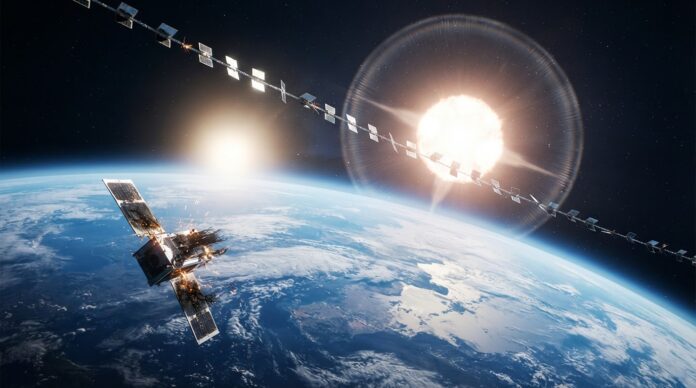

Western intelligence services believe Russia is preparing to put a nuclear weapon into orbit within weeks. A joint investigation by German public broadcasters NDR and WDR and the newspaper Süddeutsche Zeitung reported on Monday, November 23, that intelligence shared among several NATO countries shows a Russian nuclear-armed satellite, called Sputnik-S, has been built and is being kept in the Moscow region, ready for a launch this year, Reuters reported. The Kremlin says the story is not worth taking seriously. Berlin, notably, has not denied it.
If the reports are right, this is not a weapon aimed at a city. It is a weapon aimed at the satellites that carry the internet, GPS, weather data and military communications, including SpaceX’s Starlink network that Ukrainian troops rely on every day.
What the German reports say
According to the reporting, the satellite was assembled several years ago. Intelligence warnings that circulated in early November said it could be launched within 60 days, and Germany’s Space Command reportedly assesses that a launch could come within weeks, AeroTime summarised. The reports say the satellite could become operational soon after reaching orbit. The sources are unnamed officials from the German military and the BND, Germany’s foreign intelligence service.
The reports do not say what kind of nuclear device the satellite would carry, how powerful it is, or which orbit it would use. Those gaps matter. Defence minister Boris Pistorius said it was “too early to speculate publicly”, in particular because “the nature of these nuclear weapons is not clear,” AFP reported. “We are consulting internally and taking the measures that need to be taken,” he added.
How Berlin, NATO and Moscow responded
The German government chose its words carefully. Chancellor Friedrich Merz, whose office oversees the BND, did not confirm or deny the story but said: “Reports that Russia is planning to introduce nuclear weaponry into space are not new, yet they remain no less shocking. They reveal the level of escalation Russia is evidently prepared to pursue.” Government spokesman Stefan Kornelius said the government “takes the reports very seriously,” Newsweek reported, while also warning, according to AFP, against “excessive nervousness regarding hypothetical dangers.” The BND and Space Command said they do not comment on intelligence matters.
NATO Secretary General Mark Rutte, speaking in Berlin next to Merz, said: “We will always make sure that we defend every inch of NATO territory, and that includes making sure that we are safe when it comes to the space element.”
Moscow dismissed the story. “There are so many ‘alleged’ and ‘possible’ claims in it, attributed to who knows whom, that it’s certainly hardly worth taking them seriously,” Kremlin spokesman Dmitry Peskov told reporters. The Russian embassy in Berlin said it “firmly” rejected “unfounded allegations regarding the Russian Federation’s space activities” and, according to the German outlets, called the reports part of a propaganda campaign.
The news lands in a tense week. NATO is sending an AWACS surveillance aircraft to Poland after Russian cruise missiles came down on Polish territory on Friday, the latest in a series of incidents that began with the Kh-101 crash after Swedish Gripens failed to identify it.
Why a nuclear blast in orbit is so dangerous
A nuclear explosion in space would not need to hit anything. The blast releases a burst of radiation and charged particles that Earth’s magnetic field traps, creating artificial radiation belts. Satellites that fly through them for weeks or months slowly have their electronics and solar panels fried. The damage is indiscriminate: it hits military, civilian and commercial spacecraft alike, whichever country owns them.
There is a historical example. On July 9, 1962, the United States detonated a 1.4-megaton warhead about 400 kilometres above the Pacific in a test called Starfish Prime. The flash was seen from Hawaii, where streetlights failed, and the radiation belts it created went on to damage or disable several satellites in the following months, including Telstar 1, the world’s first commercial communications satellite. In 1962 only a few dozen satellites were in orbit. Today there are more than ten thousand, most of them in low Earth orbit, the same region Starfish Prime polluted.
US Space Command chief General Stephen Whiting has estimated that about one-third of satellites in low Earth orbit could fail within hours or days of such a detonation, with more failures in the months after. That is where Starlink, Amazon’s Leo network and most Earth-observation satellites operate. Losing them would hit far more than soldiers: rural broadband, airline and ship connectivity, disaster response, weather forecasting and, through ground networks that depend on satellite timing, parts of finance and power grids.
The European Space Agency’s head, Josef Aschbacher, called the presence of nuclear weapons in space “the ultimate nightmare scenario” in comments to the Handelsblatt newspaper.
Not the first warning
The claim has been building for nearly three years. In early 2024 the White House said it had intelligence that Moscow was developing an anti-satellite capability. “Russia’s pursuit of this particular capability is troubling,” national security spokesman John Kirby said at the time, and US officials described the planned weapon as nuclear. Russia denied it. In April 2024, Russia vetoed a UN Security Council resolution drafted by the United States and Japan that called on all countries not to develop nuclear weapons for orbit.
In June this year, Major General Michael Traut, head of Germany’s Space Command, told Politico: “At the very top end of escalation, there is the suspicion that Russia may be working on technology to place a nuclear explosive device in orbit.” And a US Defense Intelligence Agency report published in October says Russia is developing a satellite designed to carry a nuclear weapon for use against other satellites.
What is new is the timeline. Earlier warnings described a programme. The German reports describe a finished spacecraft waiting for a launch slot.
The treaty problem
Putting a nuclear weapon in orbit would break the 1967 Outer Space Treaty, which bans weapons of mass destruction in space, and Russia is a party to it. Nuclear test explosions in space were already banned four years earlier, by the 1963 Partial Test Ban Treaty, which Moscow also signed. Neither treaty has a way to inspect what is inside a satellite before launch, which is why the West has to rely on intelligence it cannot fully publish.
There is also a reason why such a weapon makes little military sense if used. William Alberque, a former head of NATO’s nuclear non-proliferation centre now at the Pacific Forum, told Newsweek that a detonation would not only destroy its target but would likely take out Russia’s own satellite constellations too, along with those of its allies, including China. A radiation belt does not check flags.
What to watch
- Launch notices. Russia publishes airspace and maritime warnings before launches from Plesetsk and Baikonur. Any unusual military launch in the coming weeks will be read in this light.
- Official confirmation. So far no government has put its name to the claim. A public statement from Washington, which made the 2024 accusation, would change the story’s weight.
- Satellite operators. SpaceX, Amazon and insurers have the most to lose. Watch for any change in how they talk about orbital risk, or in the cost of insuring satellites.
Our take
We cannot verify the reports, and neither can anyone outside a handful of intelligence agencies. But the most important part of this story may be the leak itself. Intelligence of this kind does not reach three major German newsrooms at once by accident, and Berlin’s refusal to deny it is a message in its own right: to Moscow that it has been seen, and to German voters that space defence needs money.
As for Russia, a weapon that would blind its own satellites and China’s is hard to use, which is exactly why it is useful as a threat. Its real target is not one satellite but the confidence of every company that runs a network in orbit. In our view, Sputnik-S, if it exists, is a hostage-taking device for the commercial internet in space, and the worst outcome is not a detonation but a world where operators, insurers and governments quietly start pricing it in.