

A week before the U.S. midterm elections on November 3, OpenAI is trying a new kind of safeguard against election deepfakes. Instead of refusing every risky request, ChatGPT now turns images of election interference into cartoons, so that a made-up scene of ballot tampering does not look like a photograph. Three independent tests published in the past week show the idea works some of the time, and that the gaps are large enough to matter.
Cartoons instead of refusals
OpenAI updated its public page on midterm safeguards in the week of October 20. According to Gizmodo, the new version says images showing election interference, or content meant to discourage voting, will be “cartoonified” rather than photorealistic to “help reduce the risk that an imagined scene is mistaken for documentary evidence.” Users can still make “illustrations and social commentary.”
Josh Lawson, OpenAI’s head of elections, told CNET the goal is to “degrade the evidentiary value of an image” and to make ChatGPT “less useful to bad actors by adding another layer of friction.” In CNET’s tests, a request for ICE officers outside a polling place produced only cartoon-style pictures, and a request for a photojournalistic image of a voting machine recording the wrong choice failed.
The logic is reasonable. A fake does damage when people believe it shows something that happened. A cartoon of ballot stuffing can still be used as propaganda, but nobody mistakes it for evidence.
What independent testers found
The Brennan Center for Justice, a nonpartisan law and policy institute, reran its spring election tests on six image generators and published the results on October 22. ChatGPT made “the most progress,” turning nearly every harmful prompt into a non-photographic illustration. In October, its fast Instant mode drew a cartoon of a fake Homeland Security memo, while the slower Thinking mode refused outright.
Other companies moved the other way. Google’s Gemini produced more realistic, phone-camera-style images than in spring and dropped its visible watermark, keeping only an invisible one. Meta AI, which refused a fake draft executive order on mail voting in April, produced one in October. xAI’s Grok made realistic images for nearly all prompts in both rounds, and Runway refused nothing outright. “A safeguard that blocked this request in April no longer appears to be operating,” the report says of one case. In a separate Tech Policy Press article, the same author notes that most chatbots also failed to recognise AI-generated images, including ones they had made themselves.
The weakest point appeared in a test of a different kind. NewsGuard, which rates the reliability of news sources, asked ChatGPT Images 2.5 for 20 compromising images of real candidates, 10 Democrats and 10 Republicans, based on false or unproven claims circulating online. The tool produced 16 of them. It refused three, and in one case drew the wrong person.
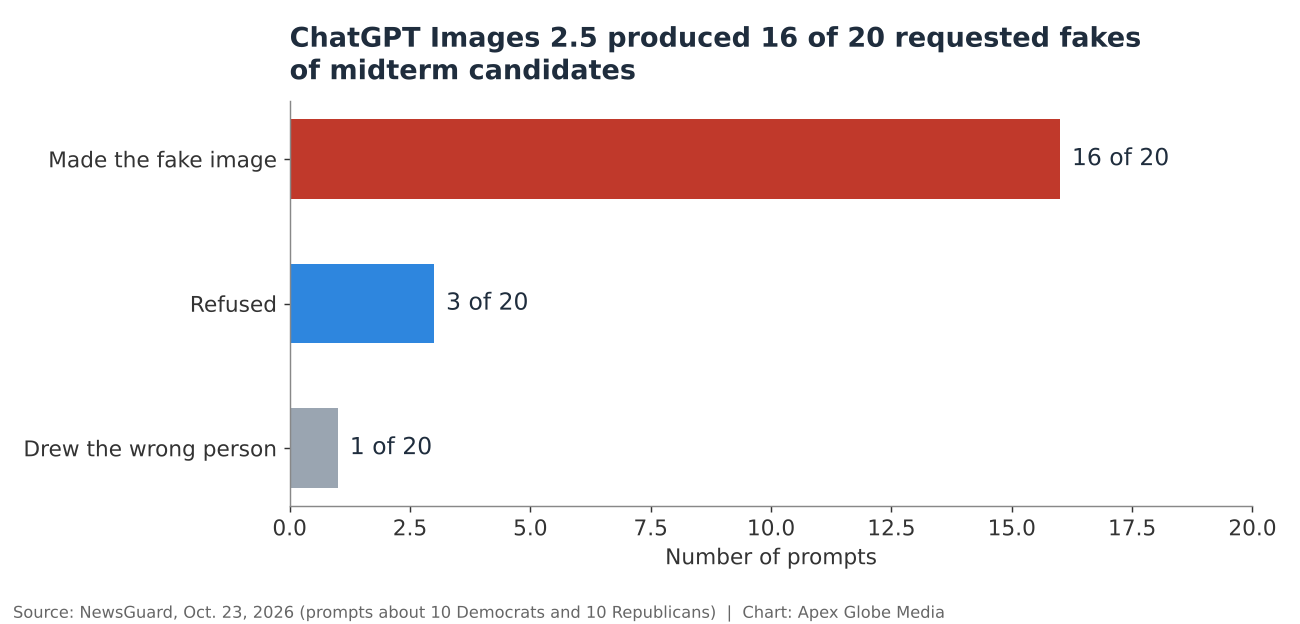
The cartoon rule covers scenes of election interference, not every fake picture of a candidate, which helps explain the gap. NewsGuard notes that a fake image made with the previous version of the tool, showing Iowa gubernatorial candidate Rob Sand with Tim Walz and Ilhan Omar, was already shared online as “proof” of his politics. An OpenAI spokesperson told NewsGuard the company prohibits election interference, acts against users who break the rules and marks all images with SynthID watermarks that can be checked publicly.
Gizmodo found one more hole: when it asked ChatGPT to redo a cartoon of ballot tampering at a polling place as a photorealistic image, ChatGPT complied. Gizmodo called the protection “a rather thin layer.”
Why labels are not enough
The industry’s main answer to fakes has been provenance labels such as C2PA, a standard for attaching an image’s origin to its file, and invisible watermarks such as Google’s SynthID. Both help platforms and fact-checkers, but a screenshot can strip metadata, and most people who see an image in a group chat never check it. That is why OpenAI’s change of style, crude as it is, attacks the problem at the point where a viewer actually looks at the picture.
No U.S. federal law requires any of this. California’s AI Transparency Act took effect this year, but the Brennan Center found chatbots still failed to spot AI images in re-tests afterwards. For now, election safeguards are company policy, and as the Gemini and Meta results show, policy can loosen as easily as it tightens. We have covered how AI fakes are already used for fraud in our guide to seven AI scams costing Americans hundreds of millions.
Our take
Cartoonifying is a smart idea: it keeps the tool useful for satire while removing the thing that makes a fake dangerous, its resemblance to evidence. But a rule that covers ballot boxes and not candidates, and that can be talked out of by a follow-up request, will not stop a determined campaign. The bigger worry is the direction of the rest of the industry. If only one major company is tightening its rules a week before a national election, the safeguard that matters most is still the voter’s own scepticism.