



US prosecutors have charged three men with running a scheme that used AI voice cloning to impersonate company chief executives and lawyers at major international law firms, tricking businesses into wiring away more than $129 million. The indictment, filed in the Southern District of New York, is a stark example of AI voice cloning fraud at industrial scale. Victims included hospital systems, banks and an investment bank, and the case shows how cheap voice cloning has turned an old corporate scam into a far more convincing one.
How the scheme worked
According to the US Attorney’s Office and reporting by NBC News, the scheme ran from July 2024 to February 2026 and followed a script:
- An employee, usually in the accounting department, got a call from someone who sounded exactly like the company’s CEO. The voice was generated with AI. The “CEO” said the company was working on a confidential financial transaction and needed help.
- The employee was told to contact lawyers at a large international law firm who were supposedly handling the deal. Those “lawyers” were part of the scheme.
- The fake lawyers instructed the employee to wire large sums to bank accounts around the world.
- The money was then converted into cryptocurrency to hide its origin and split among the conspirators.
The fake legal step made the scam especially convincing. Employees trained to be suspicious of an unusual request from the boss were reassured when a polished “attorney” from a well-known firm walked them through the paperwork. Prosecutors say one defendant used a script titled “Lawyer Call” to sound like a real lawyer.
Who is charged
The three defendants were arrested in Europe this year. Jacob Soall, who prosecutors say used the aliases “Rocky Balboa” and “Seba Clarke,” allegedly impersonated UK lawyers and was arrested in Spain in June. Sharon Hazan, accused of laundering the proceeds, was arrested in Spain in August. Prosecutors say he boasted of laundering more than $400 million in three years, and he was convicted of bank fraud conspiracy in the same court in 2008. Guy Sheetrit, also accused of laundering money, was arrested in the UK in September.
All three face seven counts, including wire fraud, aggravated identity theft and money laundering. The charges are allegations, and the defendants are presumed innocent unless proven guilty.
The victims
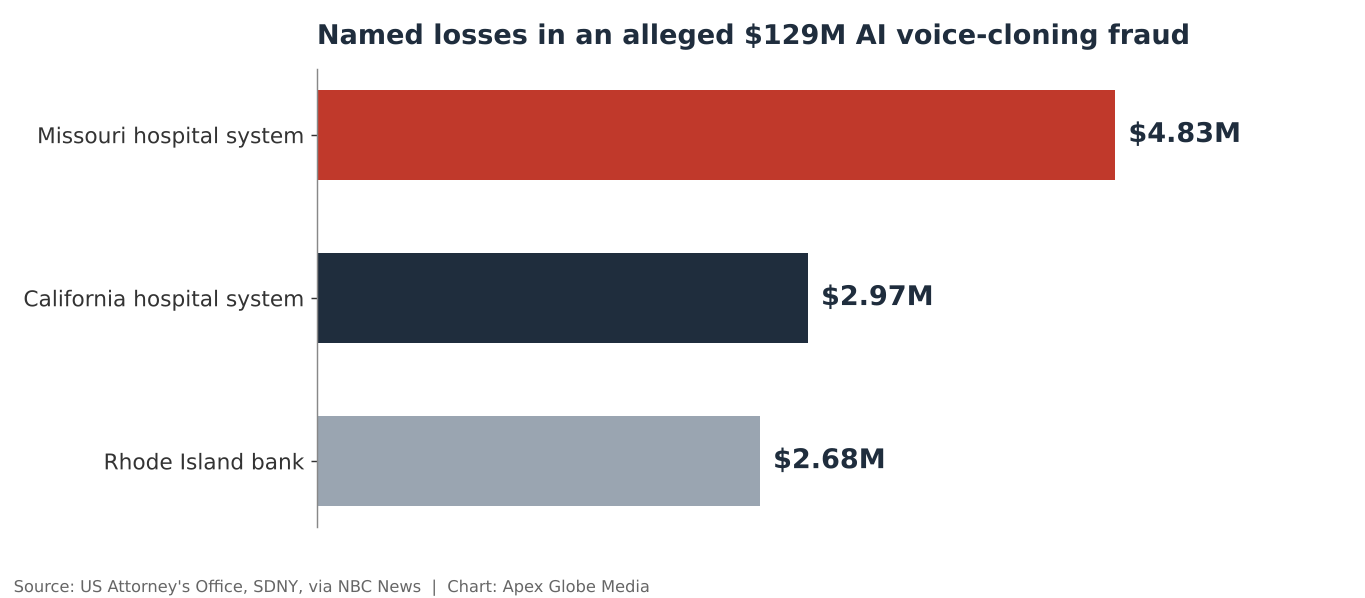
Prosecutors listed victims including an investment bank in New York, a hospital system in Missouri that lost about $4.83 million, a California hospital system that lost about $2.97 million, a Rhode Island bank that lost about $2.68 million, a UK fintech company, a Massachusetts mutual fund company and a Florida pet food company. The range shows that no sector is safe. Any organisation where a finance employee can send a large wire transfer is a potential target.
The US Attorney’s Office used an unusual term in its announcement, describing the tools as “super intelligence,” or SI. “SI technology offers tremendous potential,” US Attorney Jamie McDonald said, warning that some people “seek to use this emerging technology to pursue criminal goals.” He urged companies and individuals to think about how to protect themselves.
Why voice cloning changes the game
CEO fraud, also called business email compromise, is not new. For years criminals have sent fake emails from executives asking for urgent payments. What has changed is that a few minutes of audio, often taken from earnings calls, conference talks or YouTube interviews, is now enough to clone a person’s voice convincingly. A phone call in the boss’s own voice is far harder to doubt than an email from a strange address.
We have covered the rise of these tricks in our guide to AI scams costing Americans hundreds of millions, and AI fakes have also spread into elections. This case shows the same tools being used by organised groups against companies at scale.
Our take
The lesson for businesses is that a voice is no longer proof of identity. Companies should treat any request for an urgent or confidential payment as suspicious, however senior the caller sounds. The best defences are simple and old-fashioned: call the executive back on a known number, require two people to approve large transfers, and agree on internal code words for sensitive deals. Banks can help by slowing down unusual international wires to first-time recipients.
The case is also a test for law enforcement. Arresting suspects in Spain and the UK took international cooperation, and following money that was turned into cryptocurrency is hard. A conviction would send a strong signal. But as voice and video cloning tools get cheaper and better, prevention inside companies will matter more than prosecutions after the money is gone.