



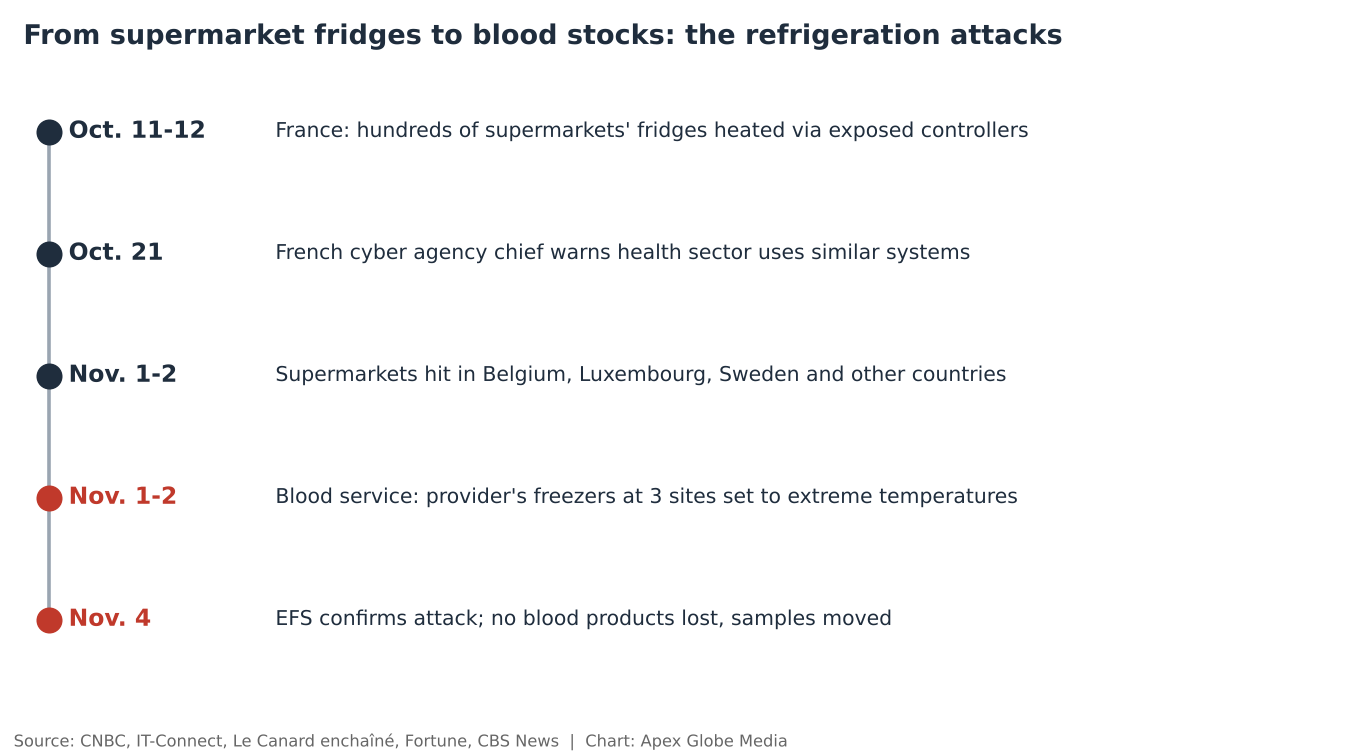
The wave of attacks on refrigeration systems in Europe has reached France’s blood supply. The French Blood Establishment (EFS), the national agency that collects and distributes blood for transfusions, confirmed on November 4 that cold storage units run by an outside provider at three of its sites were hacked on the same night that supermarkets across Europe saw their freezers heat up. No blood products were lost, but the blood bank cyberattack shows that the attackers, whoever they are, are now reaching systems where the stakes are measured in patients’ lives rather than spoiled groceries.
What happened
According to CNBC, the EFS said it was not the direct target. Equipment operated by external providers was compromised, and “temperature and defrost thresholds were set to excessively high levels.” The units held blood products waiting to be delivered to hospitals, samples kept in EFS biobanks, and frozen plasma used for transfusions and to make medicines.
The French investigative weekly Le Canard enchaîné first revealed the incident on November 3. French tech site IT-Connect reported that the provider is Coolworld, a refrigeration and maintenance company that works mainly for the medical sector, and that freezers normally kept at around -30°C were reprogrammed to a setpoint of 110°C. That figure is the target that was set, not a temperature the plasma actually reached: changing the setpoint stops the cooling or switches on heating elements such as defrost heaters, so temperatures rise gradually. An on-call technician reportedly noticed the abnormal rise during the night, and the affected sites are reported to be in the Bourgogne-Franche-Comté region.
The EFS said its monitoring systems reacted quickly. Equipment was either brought back under control without any impact on products or samples, or taken offline, and samples were moved to other facilities. The French Health Ministry said the situation was under control and that blood supply safety had been preserved thanks to monitoring, alarms and precautionary measures. The EFS is working with ANSSI, France’s national cybersecurity agency.
A warning that came true
The incident was foreseen. After the first wave of attacks on hundreds of French supermarkets on the night of October 11 to 12, a CERT-FR security alert identified the weak points: internet-exposed remote controllers for refrigeration, including Danfoss AK-SM and AK-SC units and Copeland and Dixell xweb supervisors, running outdated firmware. On October 21, ANSSI’s director general Vincent Strubel told the French Senate that those attacks exploited basic security failures such as exposed equipment and weak passwords, and warned that the health sector uses similar systems “to store vaccines or dangerous things,” IT-Connect reported.
It is not known whether Coolworld’s equipment is the same type, how the attackers got in, or whether the same group is behind every incident. But the timing matches the second wave, which on the night of November 1 to 2 hit supermarkets in Belgium, Luxembourg and Sweden, with reports from Finland, Ireland and Estonia. No one has claimed responsibility. The same night, hackers also hijacked emergency alert apps in Ukraine and Russia, a reminder of how many connected systems with real-world effects are now in attackers’ sights.
Why blood is different
Spoiled food is an expensive loss. Spoiled blood products can be a medical emergency. Fresh frozen plasma generally has to be stored at -25°C or colder, and units that warm up for too long must be removed from the transfusion chain. Blood stocks are often tight, especially for rare groups, and some biobank samples cannot be replaced at all. Unlike a supermarket, a blood service cannot simply restock from a supplier the next morning.
The good news is that monitoring worked. Independent temperature alarms, staff on call at night and the ability to move stock quickly turned a potential disaster into a near miss. That is a lesson for every hospital, pharmacy and vaccine store that relies on remotely managed refrigeration.
Our take
Three weeks after France’s cyber agency publicly warned that health facilities use the same kind of vulnerable equipment as supermarkets, attackers reached the national blood supply through a contractor. That gap is the real story. Hospitals and blood services can harden their own networks, but much of their critical equipment is installed and maintained by outside firms that may connect it to the internet for convenience. Regulators should treat medical cold storage as critical infrastructure, require contractors to keep such controllers off the open internet, and make independent alarms mandatory. This time, a technician on night duty caught it in time. The system should not depend on that.