


Late on Sunday, November 1, millions of people in Ukraine received a push notification warning of a radiation hazard, a chemical threat and street fighting in Kyiv. A few hours later, users of Russia’s official emergency app were told that “nuclear warheads” had been launched at their country. Neither warning was real. Both came from hacked emergency alert apps, and the twin incidents show how the phone apps that governments now rely on to warn citizens have become a target in their own right.
What happened in Ukraine
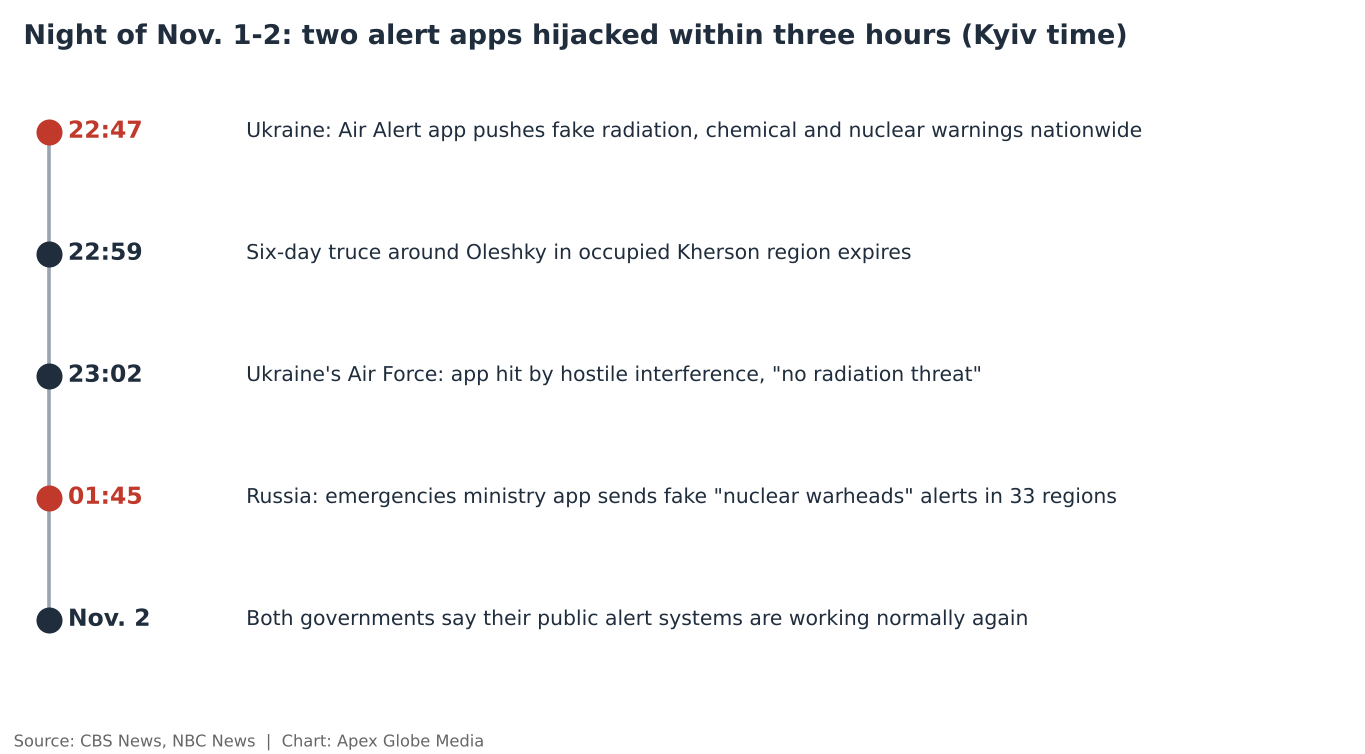
At about 10:47 p.m. Kyiv time, Ukraine’s Air Alert app, developed by the companies Ajax Systems and Stfalcon with support from the Ministry of Digital Transformation, began sending false warnings across the country, CBS News reported. One Russian-language message said all of Ukraine was under nuclear alert, told readers not to worry, and added that “Oreshnik is in action”, a reference to Russia’s nuclear-capable hypersonic missile. In the western Lviv region, some sirens and loudspeakers also broadcast a “radiation hazard” signal, according to NBC News.
About fifteen minutes later, Ukraine’s Air Force posted on several platforms: “The Air Alert app appears to have been subjected to hostile interference. There is no radiation threat!” The developers first said “unauthorized third parties” had interfered with the app and temporarily switched off its push notifications, then called it a cyberattack and said they were restoring service with extra protection. Air Force spokesman Yurii Ihnat said the hack had no effect on Ukraine’s defence, because the app is not connected to military command systems.
The message itself mentioned a Telegram channel called Hitcorecorp, and the pro-Kremlin Telegram channel Mash said it had spoken to the group, which claimed responsibility. NBC News could not verify the group or its role. Ukraine’s Center for Strategic Communications blamed Russia.
Then Russia’s app was hit
At about 2:45 a.m. Moscow time, Russia’s Emergencies Ministry said its own mobile app had suffered a “massive cyberattack” that let attackers send “fake information to the public.” Russian state media said the false alerts reached users in 33 regions. Screenshots showed a casually worded message warning of “nuclear warheads” launched across the country and telling people to stock up on food for three weeks and shelter in basements. The ministry said the attackers exploited a vulnerability in the app’s administrative panel, the back-end system staff use to write and send alerts, and that the affected services were disconnected and isolated. It did not name a culprit and called the app “an additional, supplementary information service.”
By Monday both governments said their public alert systems were working normally, RTÉ reported. It is not clear whether the two attacks were linked. They came on the night a six-day truce around the occupied town of Oleshky in the Kherson region, the biggest de-escalation of the war so far, expired.
Why alert apps are such a tempting target
For an attacker, an emergency app is unusually valuable. It already has permission to push loud, urgent notifications to millions of phones, and people are trained to trust it without question. Breaking into the system that sends alerts, rather than into each phone, gives instant national reach. The Russian ministry’s own explanation points to the weakest link: not encryption or the phones themselves, but the web dashboard where operators compose messages. If that panel is reachable from the internet and protected only by a password or an unpatched flaw, one intrusion is enough.
The incidents fit a wider pattern of attacks that use connected systems to cause physical or psychological effects. On the same day, supermarkets in several European countries reported refrigeration systems hacked to 50°C, and last week CrowdStrike described a China-linked group using AI agents to probe hundreds of organizations. Fake alerts are not new in this war: in 2023, hacked Russian radio and TV stations broadcast false air raid warnings. What has changed is that warnings now travel through apps on personal phones, which reach far more people at once.
The human cost is real even when the hoax is quickly exposed. A Kyiv researcher told NBC News that the seconds before she checked the news were “absolutely terrifying.” Many Ukrainians, used to Russian disinformation, quickly spotted the fake and shared memes about it. That resilience is earned, but every false alarm also risks making people slower to react to a real one.
Our take
An emergency alert system is only useful if people believe it, which makes its credibility a piece of critical infrastructure. Both apps recovered within hours, and Ukraine’s quick, clear denial limited the damage. But the attack shows what every government running alert services needs to fix: admin panels should never be exposed to the open internet, sending a nationwide alert should require more than one person and more than one login, and messages should carry checks that apps can verify before they ring. Wireless emergency alerts sent through mobile networks are harder to hijack than a single app back end, and countries that rely mainly on apps should treat this weekend as a warning, not a curiosity.