

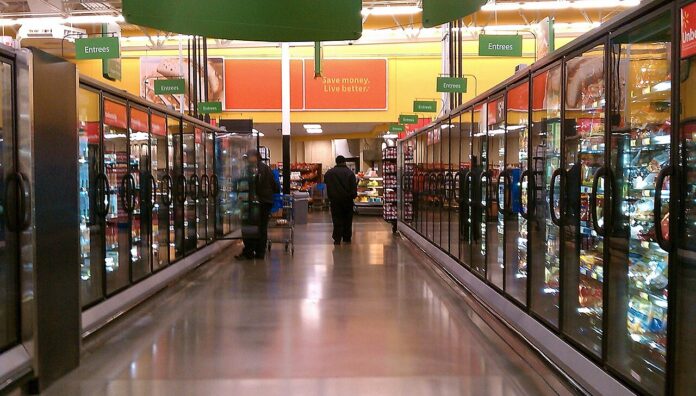

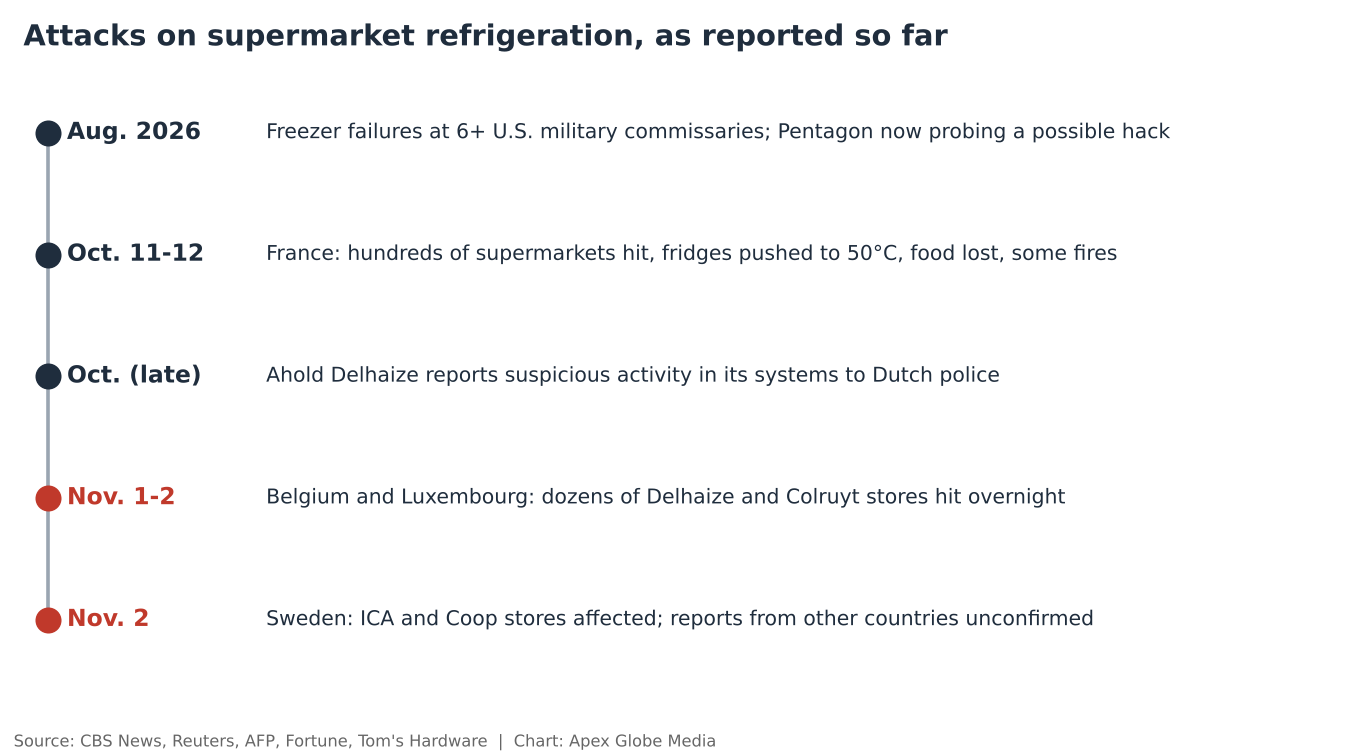
For the second time in less than a month, hackers appear to have taken control of supermarket refrigeration systems in Europe and turned freezers into ovens. Overnight into Monday, November 2, fridges and freezers at dozens of stores in Belgium and Luxembourg and at several supermarkets in Sweden heated up to about 50°C (122°F), forcing staff to throw out trolleys full of spoiled food. The new wave of supermarket freezer hacks follows a larger attack on hundreds of French stores in October, and it comes as the Pentagon investigates whether U.S. military grocery stores were hit the same way.
What happened overnight
Netherlands-based Ahold Delhaize and Belgium’s Colruyt both said an IT incident had sent temperatures soaring in fridges and freezers in dozens of their stores in Belgium and Luxembourg, CBS News reported, citing Reuters and AFP. Ahold had already reported suspicious activity in its infrastructure to Dutch police in October, according to Reuters. The trouble started around midnight on Sunday, and Belgian media also named Carrefour and Spar stores among those affected, Tom’s Hardware reported.
Stephan Moelans, chief executive of the Belgian refrigeration company Sabcobel, which services the systems used by Delhaize and other chains, told the Belga news agency that a cyberattack was to blame. The attackers switched the units’ evaporators into defrost mode, the setting used to melt ice build-up, and overrode its temperature and time limits. “We began mobilizing technicians at 1 a.m. to get the situation under control,” he said. “We’ve been working all night and morning to disconnect the affected units from the network.”
In Sweden, the ICA and Coop chains reported similar failures. An ICA store in Sjöbo, in the south of the country, wrote on Facebook that its fridges and freezers had “been hacked and they set the temperature at 50 degrees.” Coop said six of its roughly 800 stores had to throw out food, but both chains told AFP they had no confirmation yet of a cyberattack. Tom’s Hardware reported unconfirmed accounts of problems in Ireland, Estonia and the Netherlands.
The same weak spot as in France
The method matches the attack on French retailers on the night of October 11 to 12, when E.Leclerc, Intermarché, Monoprix and Coopérative U stores lost refrigeration and some reported fires. The Paris prosecutor’s office called it a “large-scale” attack. According to an alert published by French authorities and cited by Fortune, the attackers got in through remote controllers for refrigeration systems made by Denmark’s Danfoss, its AK-SM and AK-SC series, as well as Copeland and Dixell xweb controllers. The affected units were reachable from the internet and ran outdated firmware.
These controllers exist for good reasons. A large supermarket can run dozens of refrigerated cases, and remote monitoring lets technicians spot failures, adjust settings and save energy without driving to the store. But a device built to be managed remotely is also a device that can be attacked remotely if it is left on the open internet with old software. Sabcobel said many units need physical modifications to be fully protected, “and that requires investment.” In the meantime, the simplest fix is to move them onto a secure, private connection, which most of its customers did after the French attack.
The Pentagon is asking questions too
Fortune reports that the Defense Criminal Investigative Service is leading a joint investigation into freezer failures at more than half a dozen U.S. military commissaries in August, including at Fort Irwin in California, Holloman Air Force Base in New Mexico and Naval Station Newport in Rhode Island, and is treating them as a possible cyberattack. U.S. investigators are also working with French authorities. There is no evidence yet that the incidents are connected, or that the commissary failures were a hack at all.
The financial damage is easy to see and impossible to reverse. Two French chains alone put their stock losses at about €270,000. “Refrigerators give an attacker a weirdly direct route… to financial loss that’s, with cyber, unusually irreversible,” Christopher Whyte of Virginia Commonwealth University told Fortune. “You can’t unspoil food.” No group has claimed responsibility for any of the attacks, and their motive, whether criminal, political or simply to cause chaos, is unknown.
The attacks fit a wider trend of hackers reaching into the physical world as more equipment is connected to the internet and AI tools make it cheaper to scan for and exploit weak devices. CrowdStrike’s recent report on a China-linked group using AI agents against hundreds of targets showed how quickly forgotten, unpatched systems can be found at scale.
Our take
The lesson from these attacks is not that supermarket refrigeration should go back to dials and thermostats, but that equipment able to change physical conditions should never accept commands straight from the open internet. Remote controllers for fridges, heating and pumps belong behind a private network, with updated firmware, unique passwords and alarms that warn staff when settings change at midnight. The fact that the same weakness worked again three weeks after France, despite public warnings, shows how slowly fixes reach the field when they cost money. Food retailers now have a clear choice: pay for the upgrade, or keep paying for spoiled stock. For regulators, the episode is a reminder that “critical infrastructure” includes the cold chain that keeps food on the shelves, and defenders building tools such as AI models for security teams should treat it that way.