


A decade-old bug in OpenSSH lets attackers log in to locked Linux accounts by typing a very long password. The OpenSSH flaw, nicknamed “*sshole” by the researcher who found it, affects systems built on the musl C library, such as Alpine Linux, which is widely used in containers and cloud images. A fix arrived on November 5 in OpenSSH 10.6p2.
The bug only works under a specific set of settings, and there is no sign that anyone has used it in attacks. But it hits an account type that administrators trust the most: accounts that are not supposed to accept a password at all.
How a long password opens a locked door
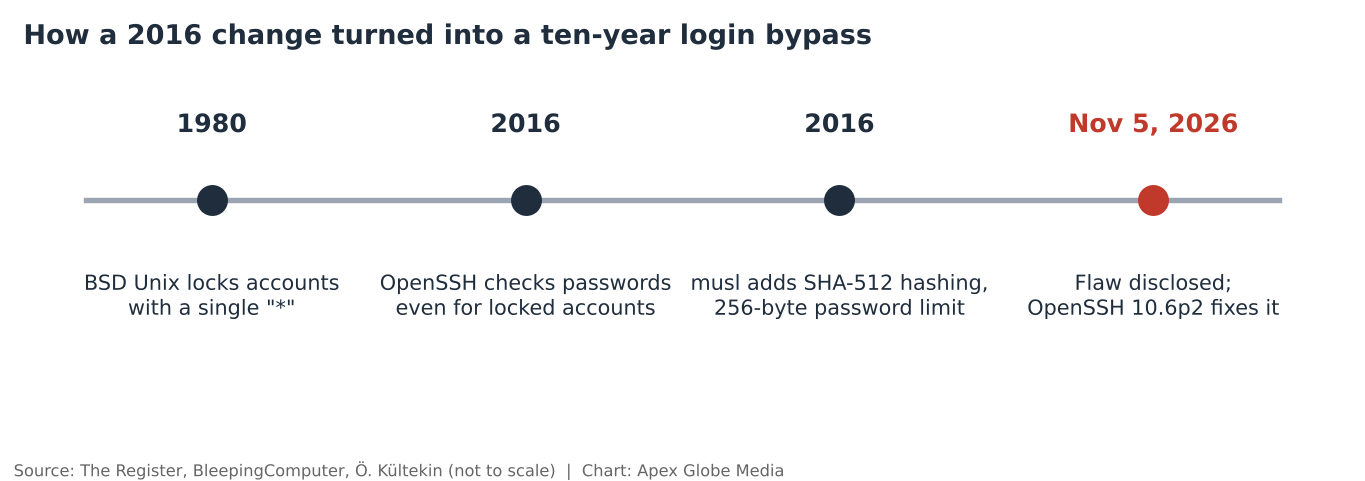
On Linux, an account can be closed to password logins by putting a single asterisk (*) in place of its password hash in the /etc/shadow file. The trick goes back to BSD Unix around 1980. Root accounts, deployment users that log in only with SSH keys, and many service accounts are set up this way.
In 2016, OpenSSH changed how it handles failed logins. To stop attackers from guessing which usernames exist by timing the server’s answers, it began running the full password check even for accounts without a usable hash. Around the same time, musl added SHA-512 password hashing with a 256-byte limit on password length.
Researcher Özgün Kültekin found that the two changes clash. When a password is longer than 256 bytes, musl’s crypt() function fails and returns a single asterisk instead of a hash. OpenSSH compares that asterisk with the asterisk stored for the locked account, sees a match and lets the attacker in. According to The Register, passwords between 257 and 1,024 characters work. Accounts with a real password hash are not affected.
Kültekin told BleepingComputer that he found the problem with the help of AI agents, which ran about 17,600 login tests across OpenSSH settings, broken hashes and oversized passwords. That fits a wider trend we have been following: AI tools are now finding old bugs at scale, as in our reports on OpenAI’s 948 Linux root exploits and Anthropic’s exploit chains.
Who is at risk
All of these conditions must be true for an attack to work:
- OpenSSH runs on a musl-based system: Alpine Linux, Buildroot, Yocto, or OpenWrt with OpenSSH installed instead of its default Dropbear server.
- PAM authentication is turned off. This is the default in Alpine’s openssh-server package.
- Password logins over SSH are turned on.
- At least one account is locked with an asterisk, and at least one other account has a real password.
Systems based on glibc, such as Debian, Ubuntu and Fedora, are not affected, and neither are servers that use PAM. The most serious case involves Alpine’s official images for AWS and Azure. BleepingComputer reports that they include a default “alpine” account with passwordless doas rights, so a login to that account could lead straight to root.
Alpine is small, fast and popular in Docker containers and embedded devices, so the total number of exposed machines is hard to estimate. Most containers do not run an SSH server at all, which limits the risk. Routers, industrial boxes and cloud virtual machines built on Alpine are the likelier targets. Sources also disagree on the CVE number, and at least one security firm said none had been assigned when it published.
What administrators should do
- Update to OpenSSH 10.6p2. On Alpine, run
apk upgrade openssh. - If you cannot update yet, set
PasswordAuthentication noin the SSH server settings and restart sshd. Key-only servers should have this set anyway. - Check logs for password logins to accounts that should never accept them. On Alpine,
grep "Accepted password" /var/log/messagesis a good start.
Old firmware is the hard part. Embedded devices often ship with an SSH server and are rarely updated, as we saw with the Broadcom router bug that went 16 years without a fix.
Our take
This is not a mass-exploitation bug. The settings it needs are narrow, and a single line in a config file blocks it. Its lesson is bigger than its reach. Both changes from 2016 were sensible on their own: one hid usernames from attackers, the other added stronger hashing. Nobody tested what happens when a hashing function fails silently and returns a symbol that also means “locked”. AI agents found that gap by trying thousands of odd inputs that no human tester would bother with. Expect many more finds like this as defenders and attackers point the same tools at old, trusted code. For administrators, the safe default stays the same: turn off SSH passwords and use keys.