

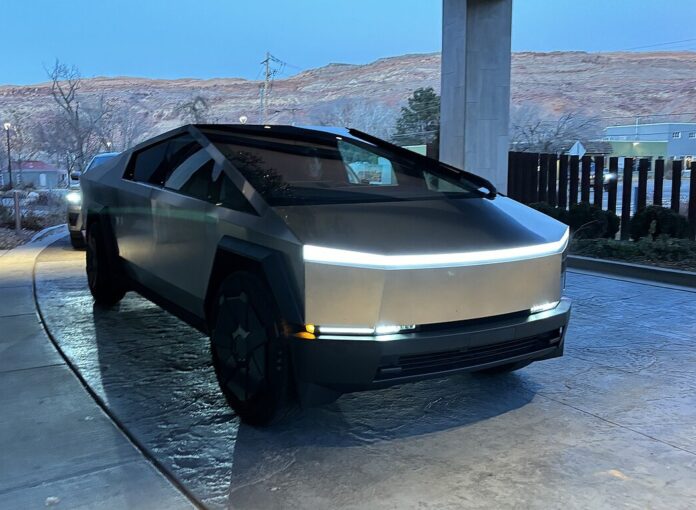

Tesla is ending Cybertruck production at its Texas factory. Elon Musk said on X on November 6 that the company will be “winding down production of the Cybertruck at Gigafactory Texas around the middle of next year” to make room for more Cybercab robotaxis. Three and a half years after the first deliveries, the stainless-steel pickup that once drew more than a million reservations is giving up its floor space to a car with no steering wheel.
Musk gave no end date, no volumes and no word on whether the truck will be built anywhere else. Tesla has not published a separate statement. Cybertruck lead engineer Wes Morrill later said that trucks already on the road will keep getting parts and service, according to TechRadar.
A truck built for 250,000 a year
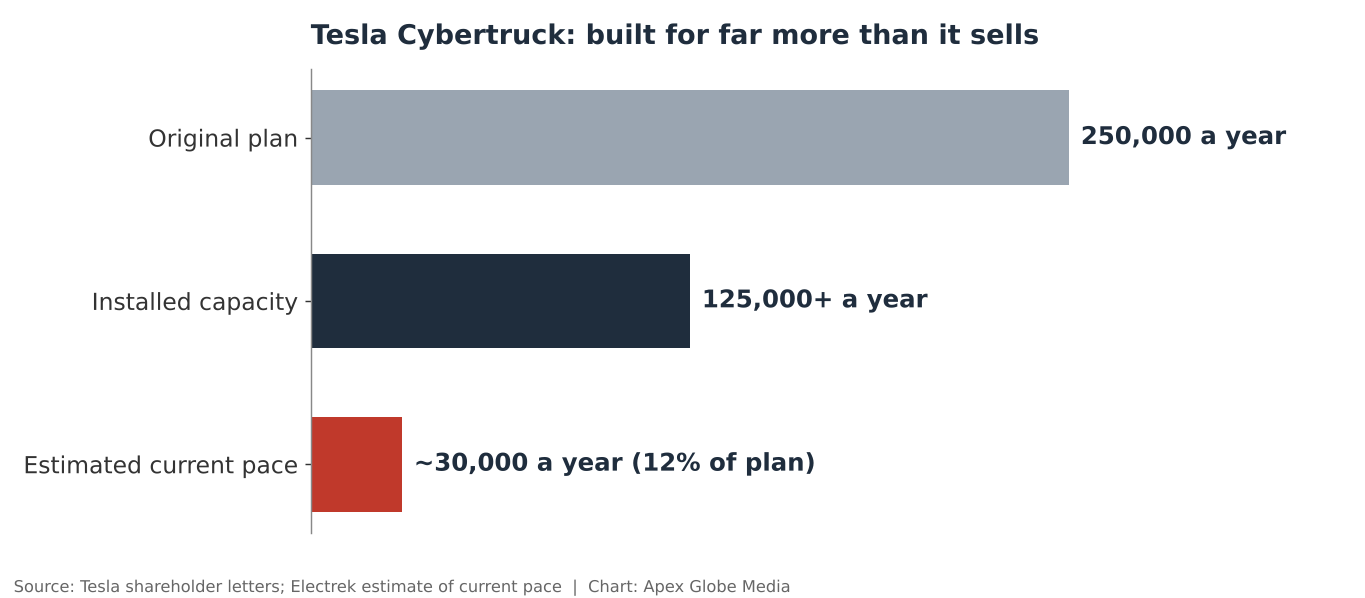
The official reason is space. The numbers suggest demand is the real story. Tesla designed the Cybertruck line for 250,000 trucks a year, and its latest shareholder letter still lists more than 125,000 units of installed capacity. Tesla does not report Cybertruck deliveries on their own, but Electrek estimates the current pace at about 30,000 a year, roughly 12% of the original plan and a quarter of what the line can already build.
Cox Automotive estimates tell the same story. About 14,400 Cybertrucks were sold in the US in the third quarter of 2024, the truck’s best period. In the first two quarters of 2026, sales were about 3,500 and 3,700. In Tesla’s own reports, the “Other Models” group, which held the Cybertruck, Model S, Model X and Semi, delivered 8,295 vehicles in the third quarter of 2026. That is 48% less than a year earlier and the lowest figure since 2021. Model S and X production already ended in April.
Tesla tried to fix demand with price. It launched a cheaper rear-wheel-drive version in 2025 and pulled it months later. This summer it added a cheaper dual-motor trim, then raised prices by $5,000 in August, so the dual-motor truck now starts at $74,990. About two weeks ago Tesla also cancelled sales in Australia and New Zealand. The truck still cannot be sold in Europe.
Even the buyers were partly in the family. S&P Global Mobility data cited by Electrek shows that SpaceX bought 1,279 Cybertrucks in the fourth quarter of 2025. Together, Musk’s companies took about 19% of US Cybertruck registrations that quarter.
Why the Cybercab gets the space
The Cybercab is Tesla’s two-seat robotaxi with no pedals and no steering wheel. Tesla unveiled it in October 2024, started production in February 2026 and began paid public rides in Austin in September. As of late October, Texas had 463 registered Cybercabs, according to Electrek. Tesla built them on a separate line that uses its new “unboxed” method, where large sections of the car are assembled in parallel and joined at the end.
For Musk, the trade is simple. Tesla’s valuation rests on autonomy and robots, not on pickup trucks. Earlier this year Tesla ended the Model S and X to free up its Fremont plant for the Optimus humanoid robot. Now the Cybertruck makes way for the robotaxi. We covered the Cybercab’s road to launch, including its federal safety audit, and the wider ties between Musk’s companies in our story on Tesla-SpaceX merger talks.
Not everyone accepts the floor-space explanation. Tesla says Giga Texas has more than 10 million square feet of factory floor, and the Cybertruck line already runs far below its capacity. Electrek argues that Tesla probably lost billions on the program and never made positive cash flow from it. Tesla has not published Cybertruck profit figures, so that claim cannot be checked.
What it means for owners and for Tesla
About 70,000 Cybertrucks have been delivered in three years, by Electrek’s estimate. Owners will keep service support, but resale prices for a discontinued model usually fall, and the long-promised cheaper versions are unlikely to return. Musk also has a history of changing plans, so “wind down” may not mean “end” until Tesla says so in a filing.
The decision also says something about the robotaxi bet. Tesla is moving a real factory line to a car that so far exists in the hundreds, not the hundreds of thousands. If the Cybercab scales, the move will look smart. If regulators or riders slow it down, Tesla will have fewer products to sell in the meantime. Rivals such as Waymo already run large paid fleets, and Chinese firms are pushing hard, as we noted in our story on Pony.ai’s move into Europe.
Our take
The Cybertruck was designed as a statement, and it made one. It also showed the limits of building a car around shock value. A $75,000 pickup that cannot be sold in Europe and sells a tenth of its plan was always going to lose a fight for factory space. The more important question is what Tesla gets in return. Musk is betting that robotaxis will make the lost truck sales look small. Until the Cybercab runs at scale in many cities, that bet is still a promise. Watch Tesla’s next shareholder letter for a firm end date and for Cybercab production numbers. Those two figures will show whether this is a clean pivot or a quiet retreat.