



The tablet market is shrinking fast. Global tablet shipments fell 23% year on year to 32 million units in the third quarter of 2026, the lowest level in nearly three years, research firm Omdia said on November 5. Apple’s iPad shipments dropped 28%, and Omdia does not expect a real recovery before 2028. The tablet shipments decline is a direct side effect of the AI boom: the components that tablets need are being pulled into AI data centers.
Almost every big brand is shipping less
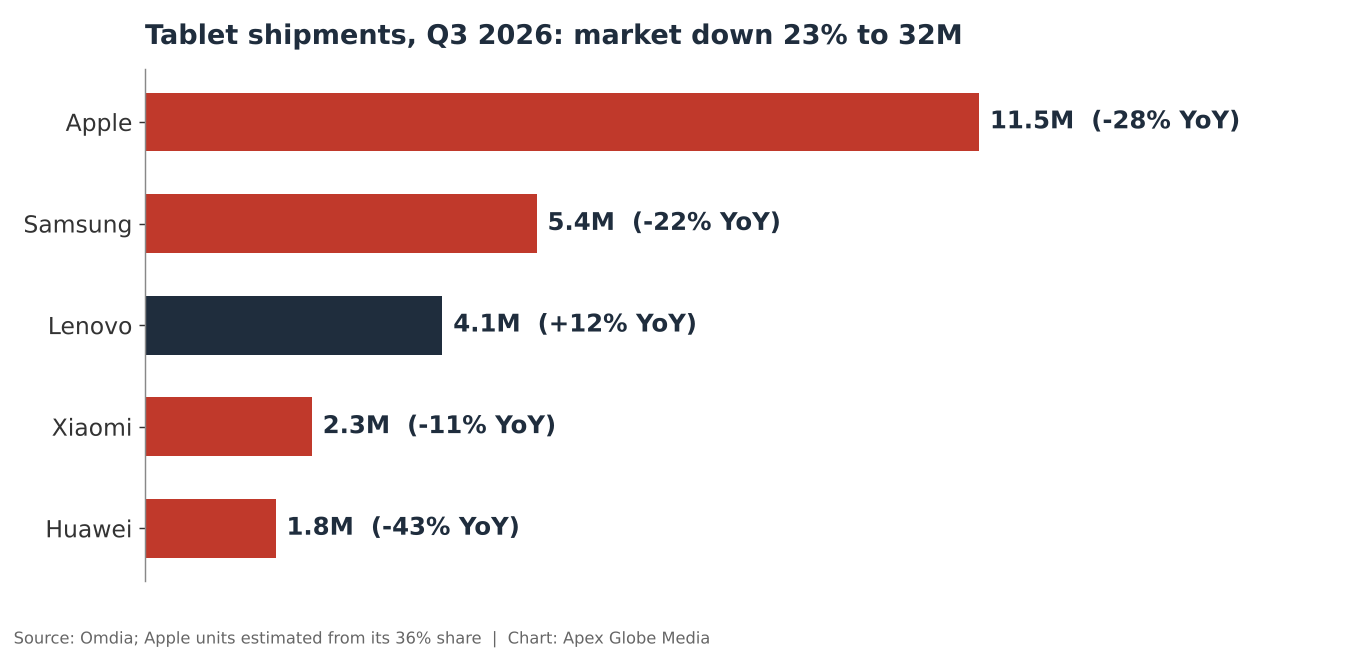
Apple kept first place but shipped about 11.5 million iPads, down 28% from a year earlier, and its market share slipped to 36% from 38.2%. Samsung was second with 5.4 million tablets, down 22%. Xiaomi shipped 2.3 million, down 11%, and Huawei fell hardest among the top five, down 43% to 1.8 million, even though it grew in Central and Eastern Europe and Asia-Pacific.
Lenovo was the only major brand to grow. Its shipments rose 12% to 4.1 million and its share jumped to 12.7% from 8.7%, helped by cheaper slate tablets and stronger sales in most regions. The Middle East, China and Western Europe were the hardest-hit regions overall.
Why it is happening
Omdia blames supply first and demand second. “Following a 10% decline last quarter, the tablet market recorded another double-digit contraction in Q3,” said Himani Mukka, research manager at Omdia. She said supply and component constraints are pushing tablets down device makers’ list of priorities and limiting meaningful upgrades, while recent launches have done little to tempt buyers.
Omdia did not name specific parts, but the biggest constraint across consumer electronics this year has been memory. AI data centers need enormous amounts of high-bandwidth memory and server DRAM, and chipmakers such as Samsung, SK Hynix and Micron have shifted production towards those far more profitable products. That has left less memory for phones, PCs and tablets, and pushed up prices, as we explained in our story on how the memory shortage is raising gadget prices. Apple itself warned about rising memory costs in its latest earnings. When memory is scarce, companies put it into their most profitable devices, usually smartphones, and tablets lose out.
Demand is weak too. Many people bought tablets during the pandemic and see little reason to upgrade. New models have brought small changes, and with prices rising, buyers are waiting. Mukka expects supply to get even tighter in 2027 and consumers to keep delaying purchases until products offer bigger improvements.
The squeeze is also visible in the numbers of the companies that make the chips. Memory makers have reported record profits from AI, while device makers, from Nintendo to Apple, have warned that component costs are eating into margins. Tablets sit at the wrong end of that trade: they use a lot of memory for a device that sells at modest prices and is replaced only every few years.
Apple’s iPad problem
For Apple, the decline comes as attention shifts to other devices. The company has just launched the foldable iPhone Duo, which offers a large screen that partly overlaps with what an iPad does, and new MacBook Pro models with touchscreens. If a foldable phone and a touchscreen laptop cover most of what people used a tablet for, the iPad’s role becomes less clear. Apple says more than 100,000 apps have already been built for the iPhone Duo.
Our take
The tablet slump is one of the first clear examples of the AI boom crowding out consumer electronics. The same memory chips that power AI models are being taken away from everyday devices, and tablets, a product category that most people do not urgently need, are the easiest to cut. The result is fewer tablets, higher prices and fewer upgrades.
There is an irony here. This week investors worried that the AI build-out will slow after the US midterm elections. If that happens, more memory could flow back to consumer devices, and tablet makers would be among the winners. Until then, expect the market to keep shrinking, with Lenovo’s cheap tablets and Apple’s loyal customers holding up best. For anyone thinking of buying a tablet, prices are unlikely to fall soon.