

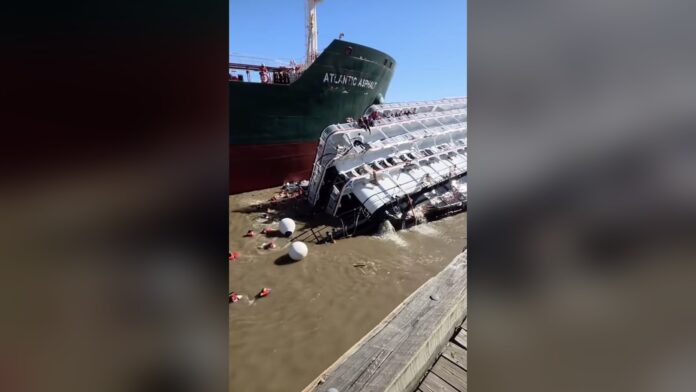

A 160-meter asphalt tanker lost control on the Mississippi River in New Orleans on Friday and slammed into a docked paddlewheel cruise ship, rolling it onto its side as passengers were getting off. The New Orleans riverboat crash involved the Marshall Islands-flagged tanker Atlantic Asphalt and the American Heritage, an 81-meter river cruise vessel operated by American Cruise Lines. Everyone aboard survived. Mayor Helena Moreno called it “a miracle on the Mississippi,” NBC News reported.
The collision happened at about 12:30 p.m. on November 13, just below the Crescent City Connection bridge, near the French Quarter. Within a day the Port of New Orleans had sued the tanker’s owners, federal marshals had been ordered to seize the ship, and investigators from the National Transportation Safety Board (NTSB) were on their way. The first clue to the cause points to the tanker’s steering.
What happened
The American Heritage had arrived from Natchez, Mississippi, and had been tied up at the port’s Thalia Street terminal for about two hours. Passengers were starting to disembark ahead of a new seven-day cruise up the river to Baton Rouge, St. Francisville, Natchez and Vicksburg, WDSU reported.
According to court documents filed by the port, the Atlantic Asphalt appeared to lose control as it passed beneath the bridge, veered to the right and hit the riverboat. It struck the American Heritage on its port side, according to gCaptain. The smaller ship took on water, rolled over and partly sank alongside the dock. Video posted by Axios New Orleans shows the tanker’s bow pressed against the tilted decks of the paddlewheeler, with passengers crowded on the upper deck above the water.
Accounts of how many people were aboard vary. The port first said about 129 passengers plus crew; later reports put the number at 191 or 192 people. NBC News said about 100 people were pulled from the river. Harbor Police Chief Melody Montroll said officers got more than 80 people off the boat before it capsized, and a local barge company’s boat pulled more than a dozen from the water. The riverboat’s captain was injured and was the last person off.
Thirty-two people were taken to hospitals on Friday, including two first responders. As of Saturday, eight remained hospitalized, two of them in serious condition, according to deputy mayor Jen Avegno. One passenger, Rhonda Akers, told NBC she had to climb over the railing to escape after the boat flipped; her husband was hospitalized with a head injury.
A steering problem, and a lawsuit within hours
Coast Guard Captain Melanie Burnham said initial reports pointed to a steering problem aboard the tanker, NBC reported. Officials have not said whether the ship also lost engine power, and the cause remains under investigation by the Coast Guard and the NTSB. The NTSB’s team arrived on Saturday after being delayed by Friday’s nationwide FAA ground stop, which halted every departing flight in the US.
The Port of New Orleans did not wait for the investigation. On Friday it filed a $1 million federal lawsuit in the Eastern District of Louisiana against the Atlantic Asphalt, its registered owner Nave Shipping SA, a Liberia-registered company, and Thome Ship Management, a Singapore firm described as the ship’s safety manager, WITN reported. The suit blames the crash on the “negligence, gross negligence, fault or carelessness” of the tanker and says damage to the terminal is expected to exceed $1 million. A warrant directs federal marshals to arrest the 525-foot ship, a standard step in US maritime law that keeps a vessel in port as security for a claim.
The tanker has since been towed away from the wreck. Removing the American Heritage could take weeks. The Coast Guard closed about three miles of the river, between mile markers 93 and 96, then reopened it to one-way traffic late Friday and limited two-way traffic in the main channel on Saturday.
Why big ships lose control in ports
The lower Mississippi is one of the hardest stretches of water in the world to navigate. Around New Orleans the river bends sharply, the current is strong, and ocean-going ships share a narrow channel with barge tows, ferries and cruise vessels tied up along busy waterfronts. Foreign-flagged ships on this part of the river must carry a state-licensed river pilot, a local expert who guides the vessel through the bends. Officials have not yet said who was steering the Atlantic Asphalt or what the pilot and crew did when the trouble began.
In such conditions, a ship has very little room to recover from a failure. A large vessel steers by moving water past its rudder; if the rudder jams or the steering gear fails, or if the engine stops and water no longer flows past it, the ship keeps moving with its own weight and the current and can only slow down slowly. Dropping anchors and calling tugboats takes minutes that a ship passing a dock does not have.
The closest recent comparison is the container ship Dali, which lost electrical power and propulsion in March 2024 and struck the Francis Scott Key Bridge in Baltimore, collapsing it and killing six road workers. That disaster led to a wave of questions about the reliability of shipboard electrical and steering systems, about how ports protect bridges and docks, and about whether large ships should be escorted by tugs in tight waterways. The Atlantic Asphalt crash raises the same questions in a different setting: this time the target was not a bridge pier but a passenger ship full of people.
What investigators will look for
The NTSB investigates major marine accidents in the United States and usually publishes a preliminary report within weeks and a final report, with a probable cause, a year or more later. In this case it is likely to focus on a few things:
- The steering system. Whether the rudder or its hydraulic steering gear failed, and if so, why, including maintenance records.
- Power and propulsion. Whether the engine or electrical supply dropped out at the same moment, as happened on the Dali.
- The bridge team. Who was in command, what the pilot ordered, how quickly the crew reacted and whether anchors were dropped.
- The ship’s data recorder. Commercial ships carry a voyage data recorder, similar to an aircraft’s black box, that logs position, speed, rudder angle, engine orders and bridge audio.
- The dock. Whether a moored passenger ship at that spot, just below a bridge and on a river bend, was exposed to an avoidable risk.
The voyage also adds a regulatory wrinkle. According to gCaptain, the tanker had partly discharged a foreign-loaded cargo in New Jersey and was continuing an international voyage, so it was not operating under the Jones Act waiver that currently lets foreign ships carry some cargo between US ports.
Our take
Nobody died, and that is mostly thanks to fast work by harbor police, the riverboat’s crew and nearby boats. But the near-disaster shows how thin the safety margin is on a busy river where ocean tankers pass a few meters from docked passenger ships. If the steering failure is confirmed, the important questions are not about one bad day but about the system: how well foreign-owned ships are maintained, whether a single failure should be enough to send a tanker into a dock, and whether ports should require tug escorts or keep passenger berths away from the most dangerous bends. After Baltimore, regulators promised to take ship failures near critical infrastructure more seriously. New Orleans is a reminder that a cruise ship full of tourists is critical infrastructure too.