

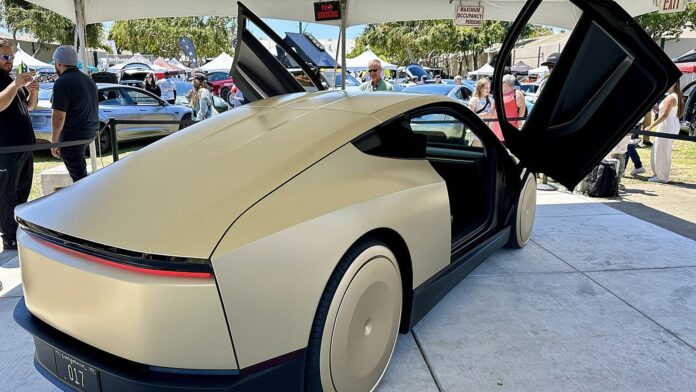

On paper, Tesla’s offer makes little sense. For $29,990 plus a mandatory $299 a month, a private buyer gets a two-seat car with no steering wheel and no pedals that only works inside a few city zones, cannot leave them, cannot be rented out without Tesla’s written permission and stops moving the day the subscription lapses. For the same money, Americans are used to buying a car they can drive across the state. So who is the Tesla Cybercab really for, and why is Tesla selling it to individuals at all?
The short answer is that the Cybercab is not designed as a consumer car. It is designed as a cheap unit of a taxi network, and the personal sale is a side door into that network. Whether it works depends less on the car than on two things Tesla has not delivered yet: robotaxi software that runs without supervision at scale, and a way for private owners to earn money from their cars. This analysis looks at both, and at the uncomfortable comparison with the Cybertruck.
The offer, in brief
As we reported earlier today, Tesla has started inviting “select customers” to buy the Cybercab “for personal use.” The price is $29,990 before taxes with a $1,000 non-refundable deposit, and first deliveries are planned for December in Austin, Texas. The $299-a-month Autonomy Subscription is required: “Your Cybercab will not operate without an active Autonomy Subscription,” the agreement says, according to Electrek.
The car works only inside Tesla’s Robotaxi zones, which Tesla can change at any time. Using it for ride-hailing, delivery or rentals requires Tesla’s written authorization, and reselling it requires permission too, with damages of at least $50,000 for an unauthorized sale, according to Teslarati. Over five years, the car plus subscription costs about $47,600 before insurance, charging and taxes.
Even Elon Musk seems uneasy with the price. Replying to YouTuber Marques Brownlee on X, he wrote that “the monthly fee is too high” and “should match the cost of Tesla FSD and connectivity for other models, which is more like ~$115/month.” That is an opinion, not an announced price cut: the order page still shows $299.
Why it looks like a bad deal for a private buyer
As a personal vehicle, the Cybercab fails the basic tests people apply to a car. It cannot take its owner out of town, because it only operates inside geofences, the mapped zones where Tesla’s driverless service already runs. Today those zones exist in eight cities, five in Texas and three in Florida, and even inside them Tesla serves only part of the advertised area: an analysis cited by Electrek found pickups and drop-offs accepted in 59% to 78% of the zones in the six cities checked. There is no Robotaxi service in California at all, so a buyer in Los Angeles, a city where most people need a car to live, could not use one.
It cannot carry a family, because it has two seats. It cannot be driven by hand if the software has a bad day: the touchscreen lets the owner move it about 2 mph for short distances, not drive it on public roads. And because the owner cannot put it to work as a taxi, the car earns nothing while it sits in the garage, which is most of the day.
Seen this way, the private Cybercab is a niche product for enthusiasts who live inside a robotaxi zone and want to be among the first to own a driverless car. That is a small market.
The Cybertruck warning
Tesla has been here before. The Cybertruck was launched with enormous hype and a line built for 250,000 trucks a year. Sales never came close. Tesla does not report Cybertruck numbers separately, but Electrek estimates it was selling about 30,000 a year before Musk announced on November 6 that production would “wind down” at Gigafactory Texas around mid-2027. He has since moved the end date to the end of summer 2027. The official reason is to free space for more Cybercab production; Electrek points out that the factory has more than 10 million square feet of floor space.
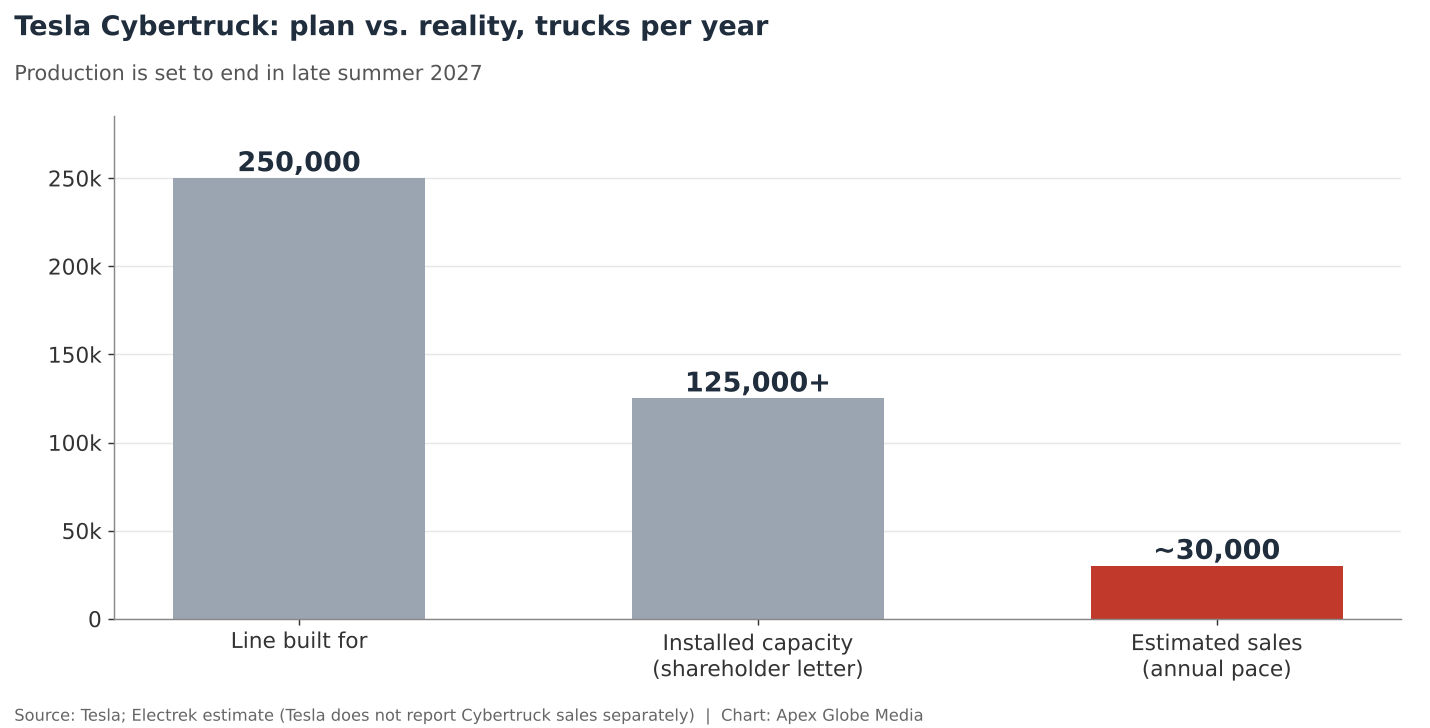
The lesson is that bold design and loud promises do not create steady mass demand. If the Cybercab were meant to win private buyers the way a normal car does, it would be heading for the same fate. But Tesla does not seem to be betting on that.
What the Cybercab is really for: cheap rides
The real target of the Cybercab is the cost of a taxi ride. Today a ride-hailing trip is expensive mostly because of the driver’s pay and the cost of a regular car built for a human to drive. Remove the driver, and the vehicle becomes the main cost. That is why the Cybercab has no steering wheel, no pedals and only two seats: Tesla argues that most city taxi rides carry one or two people, so a smaller, simpler car with fewer parts can be built and run more cheaply. Tesla has said it will make the car with a new “unboxed” assembly process, in which sections of the car are built in parallel and joined at the end, to cut costs further.
Musk has said the “vast majority” of Cybercabs will be owned by Tesla and used in its own Robotaxi fleet. Texas had 463 registered Cybercabs as of late October, according to Electrek. In other words, the private sale is a sideshow to the main plan: a large company-owned fleet of cheap, small, driverless taxis.
The Tesla Network: Uber plus Airbnb
The private sale makes more sense if it is the first step toward an idea Musk has promoted since 2016 and described in detail in 2019: a shared robotaxi network in which private owners add their cars when they are not using them. In this model, an owner taps a button in the Tesla app, the car leaves the driveway, picks up paying passengers through the Tesla Robotaxi app, and comes back when the owner needs it. Tesla keeps a cut of each fare, which Musk put at around 25% to 30% in 2019, and the rest goes to the owner. It works like a combination of Uber, where drivers bring their own cars, and Airbnb, where owners rent out an asset they already have.
For Tesla, the appeal is financial. A company running its own robotaxi fleet, as Alphabet’s Waymo does, has to buy every vehicle, build depots, and pay staff to charge, clean and repair cars. Waymo has grown to about 500,000 paid rides a week, according to InsideEVs, but every car in that fleet sits on Waymo’s own balance sheet. A shared network lets private buyers pay for the cars, the electricity and the cleaning, while Tesla takes a percentage of every ride. It is a way to scale a fleet with other people’s money.
Tesla has now put a date on it. On its October 21 earnings call, Ashok Elluswamy, Tesla’s head of autonomous driving, said some customer-owned Model Y cars could join the Robotaxi fleet around the second quarter of 2027, using software that will be released to customers as part of FSD version 15, TechSpot reported. Owner cars would run only inside existing Robotaxi zones. Tesla has not said how revenue sharing, charging or cleaning would work.
The current Cybercab agreement hints at how it might. It already reserves ride-hailing and Robotaxi network use for cases with Tesla’s written authorization, which suggests the door is being kept open rather than shut. The subscription already covers some wear items, such as tires, windshields and camera cleaning. Insurance, charging, parking and cleaning stay with the owner.
Why sell it now?
Tesla has not explained its reasons beyond the order page, but the timing fits several goals. Deliveries in Austin in December let Tesla show, as Electrek put it, that it can deliver an “unsupervised” vehicle to customers in 2026. Private sales bring in cash and real-world driving data while the factory ramps up. And starting with personal use only avoids, for now, the legal problems of private cars carrying paying strangers.
The real obstacles: law and insurance
The hardest problems are not technical. In most places, individuals cannot legally run their own self-driving cars as driverless taxis. Each city or state that allows Tesla’s network would need to issue permits for unsupervised ride-hailing, and insurers would need to price a risk they have never covered: a privately owned car with no driver carrying passengers for money.
The biggest unanswered question is liability. If a privately owned Cybercab crashes or breaks a traffic law, is the owner responsible, or Tesla as the maker of the software that was driving? The subscription agreement already gives Tesla the right to locate, restrict or remotely control the car and to suspend autonomy after repeated “strikeouts” for unsafe use, which shows how much control Tesla keeps over a car the customer has paid for. Federal safety regulators have also not ruled on whether a car with no brake pedal meets standards written for cars that have one.
Musk’s track record adds a final layer of doubt. He has promised owner-run robotaxis repeatedly since 2016, and many of his autonomy deadlines have slipped by years.
Our take
As a private car, the Cybercab is very likely to disappoint, and the Cybertruck shows what happens when Tesla’s hype meets ordinary buyers. But judging the Cybercab as a car misses the point. It is a bet that in a few years many city dwellers will not want to own a car at all, and that cheap two-seat robotaxis can undercut Uber and personal driving on price. That bet could pay off in dense city centers such as Austin, Miami or San Francisco, and is much harder to win in sprawling places like Los Angeles, where people need long trips, more seats and the freedom to leave the zone. For now, anyone paying the $1,000 deposit is not buying a car. They are buying an early ticket to a network that does not exist yet, on terms Tesla can change.