



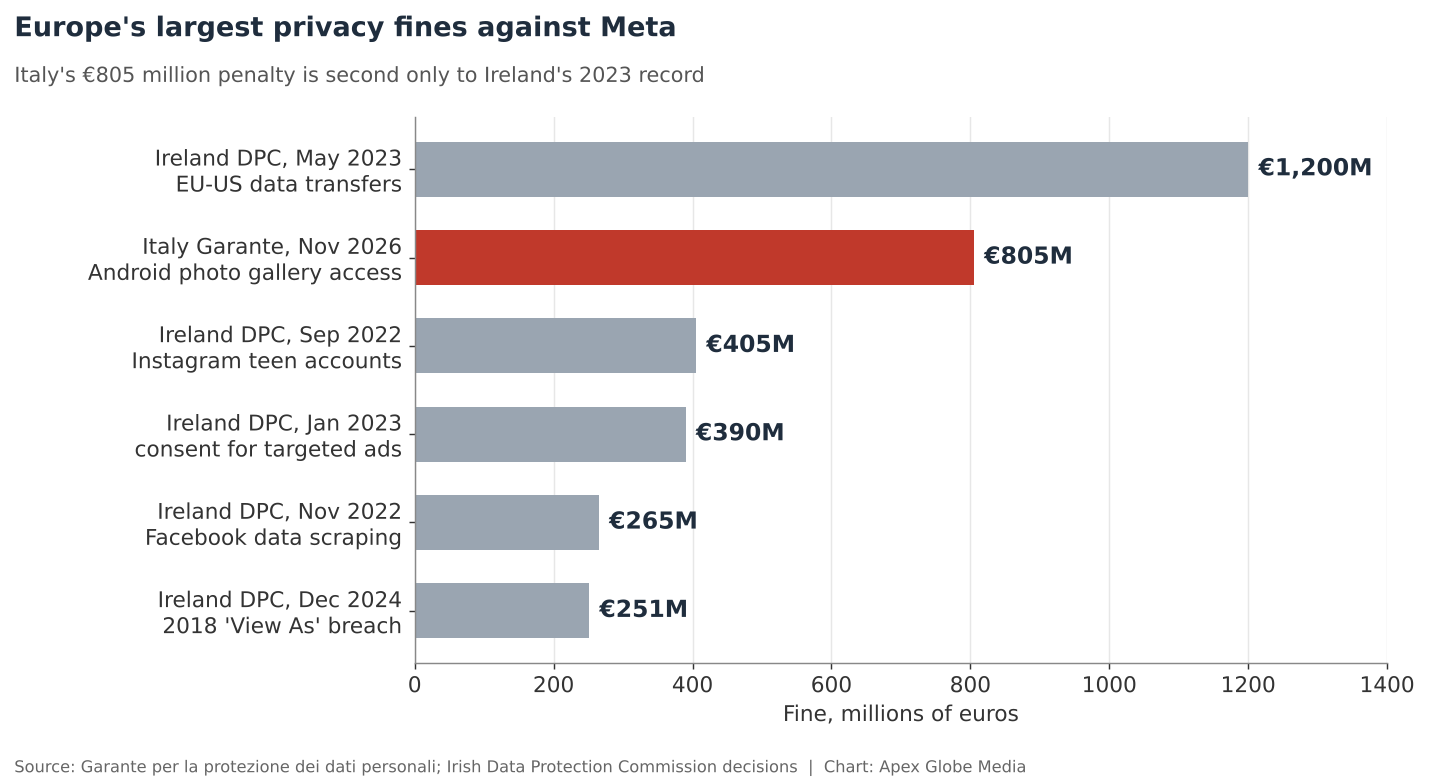
Italy’s data protection authority has hit Meta with an €805 million fine over the Facebook app for Android, which read photos and videos stored on people’s phones without asking for specific consent. In a statement issued in Rome on November 14, the regulator, known as the Garante, said the company accessed “photos, videos, and related metadata stored on Italian users’ smartphones without obtaining specific consent and without properly informing them.” The penalty, about $887 million, is second among Europe’s privacy fines against Meta only to the €1.2 billion Ireland imposed in 2023 over data transfers to the US.
The case is not about a data breach or a hack. It is about a convenience feature that most Facebook users have probably never noticed, and about a simple principle: what is on your phone belongs to you, and an app needs your clear permission to look at it.
The feature at the centre of the case
The decision concerns a Facebook setting the Garante calls “Get tips from your gallery while browsing Facebook.” Available since 2023, it shows users photos and videos from their phone’s gallery while they scroll, as ideas for posts. It sounds harmless, a little like the “memories” prompts many apps offer. The problem, according to the regulator, is how Facebook got access to the gallery in the first place.
The Garante’s technical analysis found three things. First, Facebook asked for gallery access with a single permission that covered the whole app and several different functions. Second, that request came after a generic prompt to “enable other features,” which, in the regulator’s words, “doesn’t allow the user to understand that they are also authorizing gallery suggestions.” Third, the suggestions feature was switched on by default.
Put together, that meant a user who tapped “allow” once, perhaps to upload a single picture, could be giving the app ongoing access to their entire photo library. “If fully granted, this kind of authorization allows the app to read the entire photo archive on the device, usually permanently, without the user or the Authority being able to verify what information is actually being used,” the Garante said.
Metadata matters here as much as the pictures themselves. Photo files often carry the date and time they were taken, the phone model and, if location services were on, the GPS coordinates. A full gallery is a detailed record of where someone has been and who they spend time with.
Why Italy, and not Ireland, made the call
Meta’s European operations are run from Dublin, and under the EU’s General Data Protection Regulation (GDPR) most privacy cases against the company go to Ireland’s Data Protection Commission. This is the “one-stop shop” system, which lets a company deal with one lead regulator for the whole bloc. Meta argued that the Italian authority had no jurisdiction for exactly that reason.
The Garante rejected the argument, and the legal basis it chose explains why. Instead of the GDPR, it relied on Article 122 of Italy’s Privacy Code, which puts the EU’s older ePrivacy Directive into national law. That directive, best known as the source of cookie consent banners, protects the information stored on a user’s device. The Garante said the rule treats “the smartphone as part of a person’s private sphere,” so any access requires “free and informed consent, regardless of data transmission or the existence of harm.” Crucially, “the ePrivacy rules do not provide for the ‘one-stop shop’ mechanism,” so each national regulator can enforce them directly.
That distinction is the most important part of the decision for the wider tech industry. Italy has lost one-stop-shop fights before: in March 2026, a Rome court annulled the Garante’s €15 million GDPR fine against OpenAI because Ireland had become OpenAI’s lead authority, PPC Land noted. By framing app access to a phone as an ePrivacy issue, national regulators across the EU have a route to act on their own, without waiting for Dublin.
What Meta has to change, and by when
The fine comes with orders. Within 60 days, Meta must ask for consent through a “separate and specific request” for the gallery feature, and explain clearly what it does, that it involves gallery access and how to turn it off. The feature must stay off by default, the Garante said, “even for those who have already given consent.” If Meta has not complied by the deadline, the feature cannot be switched on for anyone in Italy who has not given valid consent. The company must report what it has started within 30 days and what it has done within 90.
The regulator said Meta did change the permission flow after the complaint was filed, and counted that in the company’s favour. But it judged the changes “late” and limited to people who update the app. For everyone still on an older version, and for those who had already granted the system permission, the Italian text of the decision says the violation is still going on.
The size of the fine reflects several aggravating factors listed by the Garante: roughly 20 million Android users in Italy, a breach that is still continuing for some of them, a previous 2019 decision against the company, and what the regulator called “limited cooperation” during the investigation. The amount equals about 0.47% of the group’s worldwide turnover. Meta did not immediately comment, the Associated Press reported, and it can challenge the decision in Italian courts.
The question the Garante left open: AI
Two things are explicitly outside this decision. The investigation “did not concern the potential use of content to train artificial intelligence, which Meta denies,” the Garante said. And it reserved the right to examine separately “the new feature, launched in 2026, that allows cloud processing of gallery content.”
That second line is the one to watch. The regulator did not name the product, but in October 2025 Meta introduced opt-in camera roll suggestions in the US and Canada that upload photos to Meta’s cloud on an ongoing basis to create AI edits and collages, according to PPC Land, which said it is not confirmed that the two are the same. Reading a gallery on the phone is one thing. Copying it to a company’s servers to run AI models on it raises far bigger questions about storage, reuse and training, the very issues Europe’s regulators have been fighting Meta over since it started training its AI on public posts. We wrote recently about the push to let people opt out of AI data collection, and this case shows why the fight is moving from websites onto the phone itself.
The ruling is also part of a broader European squeeze on how social apps are designed, alongside the EU’s case over TikTok’s “rabbit hole” feed under the Digital Services Act.
What Android users can do now
Anyone uneasy about this does not need to wait for Meta. On Android, open Settings, then Apps, then Facebook, then Permissions, and set “Photos and videos” to “Allow limited access” or “Don’t allow.” Newer versions of Android let you pick only the specific pictures an app can see. iPhone users have similar controls under Settings, Privacy and Security, Photos.
Our take
The money is less important than the method. €805 million is small change for a company that reported $196.2 billion in advertising revenue in 2025, but by using the ePrivacy rules, Italy has shown that any EU country can police what apps do on a phone without going through Ireland. That should worry every app maker that bundles permissions and switches features on by default. The real test comes next, when the Garante looks at gallery photos being processed in Meta’s cloud, where AI is no longer a side issue. If one tap of “allow” can open your whole photo library to a company’s servers, the consent was never really yours.