


The FAA ground stop ordered on Friday, November 13, halted every departing flight in the United States for the first time since January 2023. Shortly before 4 p.m. Eastern, the Federal Aviation Administration stopped departures nationwide “for reasons of safety” after what Transportation Secretary Sean Duffy called “a communication issue impacting all Air Route Traffic Control Centers,” CBS News reported. Multiple sources told CBS that the trigger was not an attack but a routine change: an update to the private network that links the air traffic control system caused it to reboot and crash.
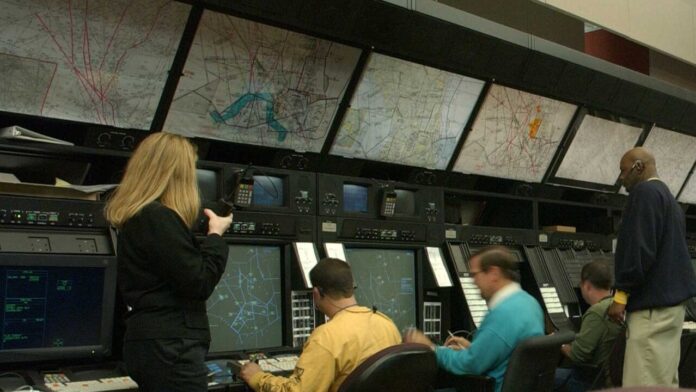
Air Route Traffic Control Centers are about 20 large regional facilities that guide planes between airports, at cruising altitude. If controllers there cannot reliably talk to pilots or see their data, the safest move is to stop putting new planes in the sky.
How the day unfolded
The trouble started in Chicago. O’Hare and Midway airports were put on a ground stop for an “equipment outage” shortly before the national order, according to CBS. Within minutes the FAA widened it to the whole country. In a post on X, the agency described a “temporary telecommunications outage” and said it had halted flights out of an “abundance of caution,” CNBC reported.
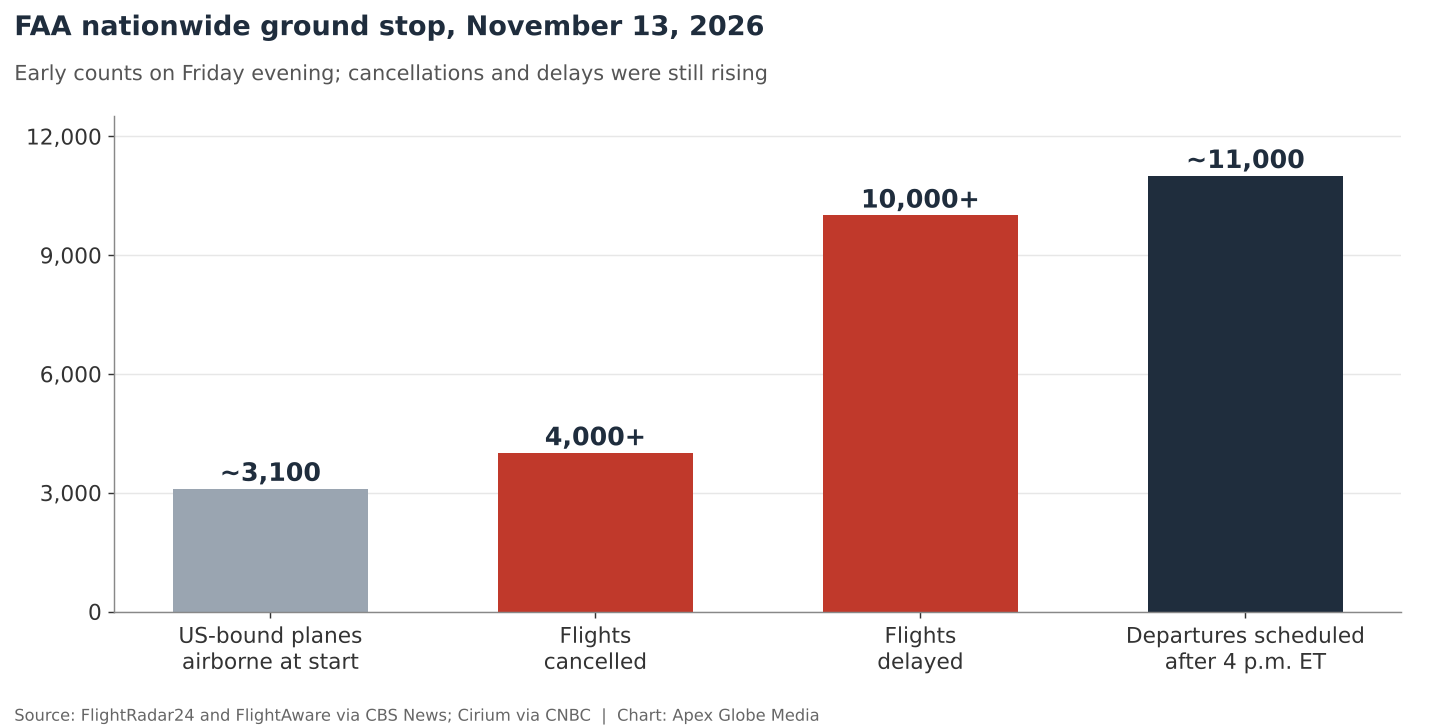
About 3,100 aircraft bound for US airports were already in the air when the stop began, according to FlightRadar24 data cited by CBS. They were allowed to keep flying and land. Inbound international flights were to be handled “case by case.” FlightAware soon listed more than 10,000 delays and over 4,000 cancellations, and the aviation data firm Cirium counted about 11,000 flights scheduled to leave US airports after 4 p.m. Eastern that day.
Around 6 p.m. Eastern, the FAA said departures could resume gradually as en route centers recovered, “through coordination with the air traffic control system.” Some flights to Europe left Boston, and by early evening planes were taking off from the West Coast for Hawaii and Asia. But FAA administrator Bryan Bedford told airline chief executives at about the same time that it was unclear when the problem would be fixed, according to people familiar with the call cited by CNBC. JetBlue told staff it would cancel the rest of Friday’s flights, except to Europe, plus its flights on Saturday, so planes and crews could be repositioned.
A network update, not a hacker
Homeland Security Secretary Markwayne Mullin said at the White House there was “no indication, as of yet, that this was a nefarious act against us.” According to Bloomberg, the FBI is examining whether a software update caused the failure and does not believe it was a cyberattack. CBS said the communications network is operated by the defense contractor L3Harris, which did not immediately comment.
The accounts of what broke still differ. CBS sources describe an update that made the network reboot and crash. An airline source told CNN the FAA blamed a problem with network routers that cascaded across the country. Neither version has been confirmed by the FAA, whose technicians are still investigating.
The timing also drew attention to a new AI system. On November 10 the FAA said it had expanded SMART, a tool that advises controllers on managing congestion, across the US. Its developer, ASI, said Friday’s outage “is not based on or a result of the SMART system, any product of ASI, or our integration with FAA and ATC.” Nothing published so far links the two.
The second big outage in two days
Friday’s ground stop came while Microsoft 365 was still recovering from a separate outage that began on Thursday and hit Outlook and Teams for governments, hospitals and businesses. Microsoft apologized and blamed a “network capacity upgrade,” saying the incident was “not related to cyber or AI/agents.” Mullin said the two events were not connected.
They do share a pattern: in both cases, a planned change to network infrastructure, not an outside attacker, appears to have taken down a system millions of people rely on. Air travel has seen this before. The January 2023 nationwide stop was caused by the failure of the FAA’s pilot alert system, known as NOTAM, and in September 2026 hundreds of flights into Newark and Philadelphia were disrupted after a Verizon fiber cable was cut by accident, CNBC noted. Before 2023, the last nationwide halt was after the September 11, 2001 attacks. Former NTSB chair Robert Sumwalt told CBS the new event was “absolutely unprecedented.”
Airlines already struggle with automation of their own. Earlier this week United Airlines said it would ban AI agents from buying its tickets, showing how quickly software questions have become operational ones for carriers. Friday showed the opposite risk: the weak point was not new AI, but the old plumbing that connects controllers to pilots.
What travelers should expect
Even once the network is stable, recovery takes longer than the outage. Planes and crews ended Friday in the wrong cities, crews can run into legal duty-time limits, and Saturday schedules were already being cut. Travelers should check their airline app before going to the airport and look for fee-free rebooking offers, which carriers usually issue after disruptions of this size. The FAA’s national airspace status page shows which airports are still restricted.
Our take
A system that, by the FAA’s own count, handles about 45,000 flights a day should not be grounded by one network update. If the CBS account holds, the real failure is change management: an update to a safety-critical network went out without a tested way back, and there was no independent backup path for controller communications. The FAA is spending billions to modernize air traffic control and is adding AI tools on top. Friday is a reminder that those tools are only as reliable as the decades-old links underneath them, and Congress should ask L3Harris and the FAA to publish a full timeline of what changed and why it could not be rolled back.