

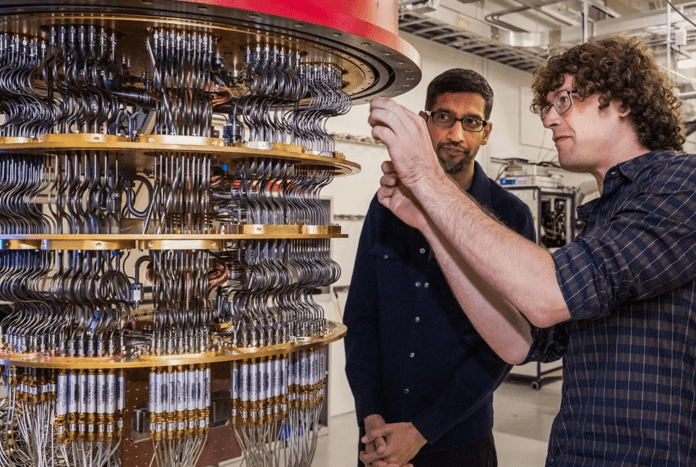

Quantum computing has spent years sounding like something that exists mostly in press releases and physics departments — fascinating in theory, but nowhere you could actually touch it. That changed a little over a week ago in, of all places, Chattanooga, Tennessee. The city’s public power utility, EPB, switched on a real, working quantum computer that local businesses and universities can now rent time on — making it the first place in the US where commercial quantum computing and quantum networking exist under one roof.
Here’s what that actually means
The machine is called an IonQ Forte Enterprise, built by a company called IonQ that makes quantum computers using trapped ions — individual charged atoms held in place and manipulated to perform calculations in ways ordinary computer chips can’t. Unlike the regular computers everyone’s familiar with, which process information as simple on-or-off switches, this system works with “qubits” that can represent many possible states at once, which in theory lets it tackle certain types of extremely complex math dramatically faster.
The University of Tennessee at Chattanooga is the first outside customer, with Vanderbilt University also lined up; commercial access for other businesses opened in early October. IonQ is putting $15 million into the project and expects it to create around two dozen specialized jobs, while local officials project the broader quantum push could generate up to $1.1 billion for the Chattanooga economy over the next decade.
The more interesting detail, though, is what this machine — and others like it — are already being used for, because it’s a useful antidote to the usual quantum-computing hype. Just days before the Chattanooga launch, IonQ and the engineering software company Synopsys published results showing that plugging quantum algorithms into standard industrial design software sped up complex simulations — the kind used to crash-test car frames and model jet engines — by up to 14.6%.
To put that in perspective: a seven-day supercomputer simulation finished roughly a day faster. It’s not a miracle, and it’s not quantum computers replacing regular ones; it’s quantum hardware handling one specific, narrow part of a much larger calculation — sorting and organizing massive systems of equations — faster than classical chips can. The research, tested on models with up to 35 million data points, won a best-paper award at a major quantum computing conference, and investors reacted immediately: IonQ’s stock jumped about 9.5% the day it was announced.
That stock reaction is worth pausing on, because it captures where quantum computing genuinely stands right now. IonQ is the most commercially active pure-play quantum company around, but it’s still not profitable, and results like the Synopsys partnership are best described as solid, incremental progress rather than the long-promised “quantum supremacy” moment where quantum computers definitively outperform classical ones at something broadly useful.
What’s actually happening in Chattanooga and in these engineering simulations is called hybrid computing — a quantum processor working alongside ordinary supercomputers, each handling the part it’s good at, rather than quantum computers doing everything on their own. EPB itself is using exactly this hybrid approach: alongside the new quantum machine, it’s installed a classical supercomputer built with Oak Ridge National Laboratory and NVIDIA, aiming to optimize its own electrical grid — a real-world application a public utility can actually use today, not a speculative future one.
That distinction matters for how to read quantum computing news generally. For years, the field has alternated between genuine incremental progress and announcements that sound bigger than they are. A 14.6% speedup on one kind of engineering calculation is real and useful to the automotive and aerospace companies who’d use it, but it’s a long way from the room-temperature, general-purpose quantum computer that could, say, break modern encryption or simulate complex chemistry from scratch — the kind of breakthrough still widely expected to be years, not months, away.
What Chattanooga represents is something more modest but arguably more important: quantum computing quietly becoming infrastructure that ordinary businesses and universities can rent and experiment with, the same unglamorous way cloud computing became normal over the past fifteen years, rather than a one-off lab demonstration that never leaves the physics building.