

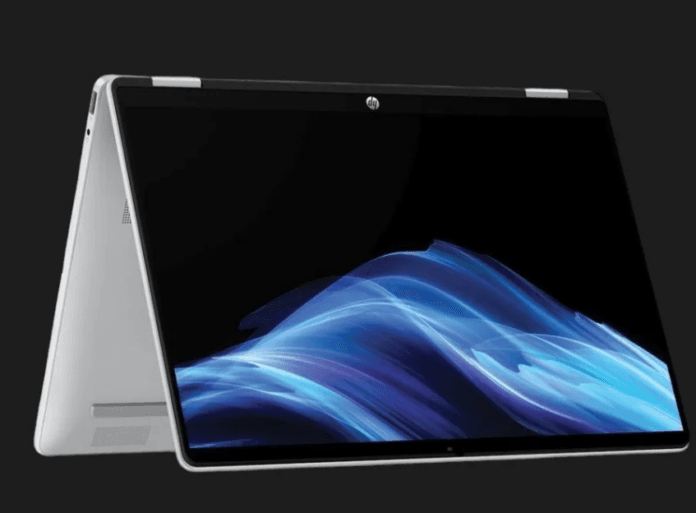

Apple’s cheapest MacBook has started something. Dell, Asus and Acer have all answered it with cheap, thin laptops, and now HP has joined in with the OmniBook 5 14, a machine that copies the Neo’s recipe almost line by line, down to the colors.
What HP is selling
The OmniBook 5 14 starts at $699.99 and launches in October. The base model has an Intel Core 5 315 “Wildcat Lake” processor, 8GB of RAM and a 256GB SSD, which mirrors what Apple and Dell sell at this price. It comes in silver, pink, blue and green. You can configure it up to a Core 7 350 chip, 16GB of RAM and a 1TB drive. Every model has a 1080p webcam, dual speakers, an HDMI port, a headphone jack and two 10Gbps USB-C ports.
HP’s main selling point is the screen. Every configuration uses an OLED panel, which is rare at this price. It weighs 2.56 pounds and is 0.46 inches thick, slightly lighter and thinner than the Neo’s 2.7 pounds and 0.5 inches. HP also gave it the sleeker lid logo that is normally reserved for pricier models.
The catch with the screen
The OLED is also where HP made its compromises. The base panel is a non-touch 1920 x 1200 display with 300 nits of maximum brightness, which is modest. A touchscreen version arrives in October, but the sharper 2560 x 1600 OLED with 400 nits won’t ship until March 2027. For comparison, the Neo’s LCD screen runs at 2408 x 1506. So HP wins on contrast and color, and loses on resolution and brightness for now.
Performance looks like a similar story. Performance looks like a similar story. Going by reviews of other Wildcat Lake laptops, the OmniBook is unlikely to match the Neo’s processing power. Battery life should be good, but it hasn’t been tested yet.
One price, many laptops
The $699 price point has become a magnet. Apple launched the Neo in March at $599, and has since raised the starting price to $699, though students still pay $599. One report links the increase to the memory shortage, but Apple hasn’t given a public explanation. Dell’s XPS 13 followed at $699 with a 120Hz touchscreen and a 512GB drive, also with $599 student pricing. HP’s $699.99 puts it in the same lane.
When so many laptops share the same price and the same 8GB and 256GB starting specs, the differences come down to screen, ports and storage. That is where companies are now competing: HP with OLED, Dell with touch and a faster display, and Apple with macOS and its own chip. Whoever picks the right trade-off on the screen and the battery will win this tier, and so far none of the rivals has beaten the Neo on every count.
A business model too
HP is also announcing the ProBook 4 G2iS, which it calls its thinnest business notebook at 0.47 inches. It will use the same Wildcat Lake chips, 8GB of RAM and a 256GB SSD, and launches in December. There is no price yet. The arrival of a business version suggests PC makers see the Neo-style template as more than a consumer play.