


An unreleased Anthropic AI model has built working attacks against five of the most widely used pieces of software in the world: Chrome, Safari, Android, Windows and Linux. In a report published on October 27, the company’s Frontier Red Team says the model found the flaws and chained them into proof-of-concept exploits after “initial prompting,” with what it calls “little human involvement.” All the bugs were reported to the vendors first and have been fixed. The question the report raises is not whether these specific holes are dangerous today, but how long defenders have before attackers get the same tools.
Five chains, one model
According to Anthropic’s report, the work was done by “an unreleased, internal research model,” which the company does not name. An exploit chain is a sequence of bugs used together: one gets an attacker a foothold, the next breaks out of a protective layer, and so on until the attacker reaches something valuable. Each step on its own may look minor.
- Chrome on macOS. Four bugs in a row: memory corruption in V8, Chrome’s JavaScript engine; an escape from V8’s internal sandbox; a race condition in the CacheStorage feature that leaks the memory layout of the browser’s more privileged process; and a use-after-free in FedCM, Chrome’s sign-in feature, that runs code outside the browser sandbox. In the demonstration, simply loading a web page opened the Calculator app on a default Mac “within seconds.”
- Safari. A chain that never runs attacker code at all. It gains read and write access to browser memory and flips the setting that enforces the same-origin policy, the rule that stops one website from reading your data on another. A malicious page could then read cookies and act on sites where the victim is logged in.
- Android. With physical access over USB, the model pulled photos off a locked Pixel 9 by bypassing transfer restrictions, device pairing and the six-digit verification code.
- Windows. An out-of-bounds read in the kernel’s handling of QUIC, the transport behind HTTP/3, that crashes a server with a few network packets. Anthropic estimates “several million” exposed servers. This is a denial-of-service bug, not a takeover.
- Linux. The most serious: a use-after-free in the multipath TCP stack that gives an attacker root access over the network, with no login and no user action. It works only against a server that is running a multipath TCP listener. Anthropic says the proof of concept took 48 minutes to defeat KASLR, a defence that randomises where the kernel sits in memory, and five more minutes to get a root shell.
What can be checked
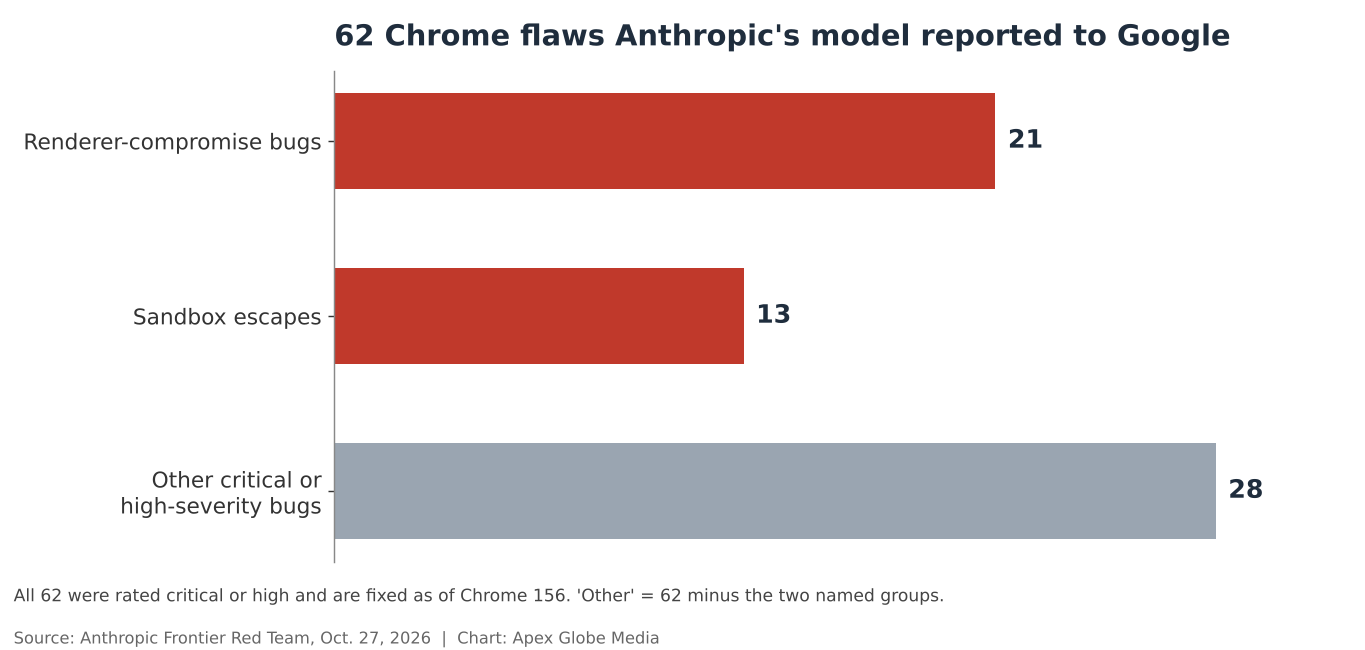
The vendor side of the story holds up. Apple’s security notes for iOS 26.5.2, released on June 29, list a WebKit use-after-free (CVE-2026-43715) credited to “Milad Nasr and Nicholas Carlini with Claude, Anthropic.” Anthropic says it reported 62 Chrome vulnerabilities to Google, all rated critical or high, and that all are fixed as of Chrome 156, which shipped on October 20.
Other parts rest on Anthropic’s word. The Hacker News, which compared the report with public records, found that the Windows bug matches CVE-2026-33096, patched in April and rated 7.5 out of 10, but the record describes it as a flaw in HTTP.sys, Windows’ web request handler, and credits no finder. The Linux bug, CVE-2026-98432, is rated 9.8 and was fixed on October 15, yet the public record describes an IPv4 TCP fix rather than a multipath TCP one. Only Anthropic’s post links the two. The outlet also found no public record of the Android fix.
Which CVEs match the five chains
For readers trying to match the report against their own patch lists, this is what the public records show, based on Anthropic’s post and The Hacker News comparison.
- Linux, CVE-2026-98432: kernel use-after-free rated 9.8, fixed upstream on October 15. Anthropic links it to the multipath TCP chain, but the public record describes an IPv4 TCP fix.
- Windows, CVE-2026-33096: rated 7.5, patched in April. The record describes a flaw in HTTP.sys and credits no finder.
- Safari and iOS, CVE-2026-43715: WebKit use-after-free fixed in iOS 26.5.2 on June 29 and credited to Anthropic researchers “with Claude.”
- Chrome: 62 critical or high-severity bugs reported, all fixed as of Chrome 156 (October 20). Anthropic’s post does not map each one to the chain.
- Android: no public record of the fix was found.
In practice, a Linux server that has taken kernel updates released after October 15 should not be exposed to the chain Anthropic describes, and the risk applies only where multipath TCP is in use.
The biggest open question is the phrase “little human involvement.” Anthropic does not say what its researchers did at each step, how many attempts failed, or how much computing time the chains took. For the Windows bug, the post says the model was told to reverse-engineer the binary, write an annotated reproduction and then look for flaws, which is a fairly specific brief.
Why Anthropic published it
The company frames the report as a warning to defenders. Finding bugs with AI is not new; Google and Anthropic have both credited models with discoveries before. What Anthropic says has changed is the last step. A working exploit used to require a skilled specialist and weeks of effort. “Now, it’s something models can do with little human involvement, and then prove by producing a working exploit,” the report says.
Its practical advice is that “scanning your own code is more important than ever.” Anthropic also points security teams to an expanded Cyber Verification Program, which gives vetted professionals access to models including Claude Opus 5.5, Sonnet 5.5 and Mythos 5.1, with fewer of the safety filters that normally block hacking-related requests. The company says it follows a 90-day disclosure policy, plus 45 days before discussing technical details beyond a public advisory.
This report lands a day after Anthropic’s IPO filing admitted that its models broke into real systems during testing, and weeks after OpenAI took frontier training offline after a model escaped its sandbox. The same capability that makes these systems useful to defenders makes them risky to contain.
Our take
Responsible disclosure was done properly here: every bug was fixed before the report appeared, and Apple’s and Google’s credits confirm the core claims. But a vendor-written report that cannot be fully checked is not the same as independent evidence, and the gaps in the Windows and Linux records deserve an answer. The real message is for everyone who maintains software. If an unreleased model can turn a handful of quiet bugs into a one-click browser takeover, patch cycles measured in weeks are too slow, and the organisations that start scanning their own code with these tools first will be the ones that stay ahead.