



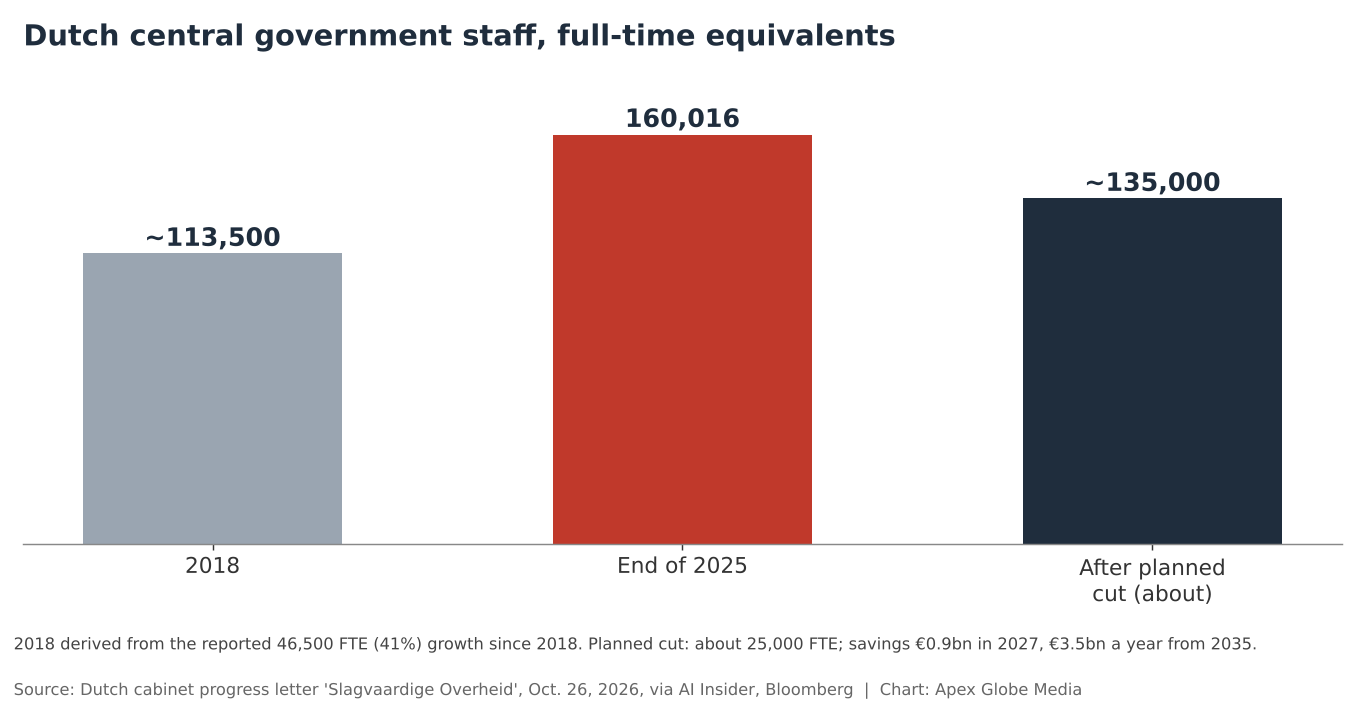
The Netherlands wants to cut about 25,000 central government jobs, roughly one in six, and is counting on AI to make it possible. The plan, sent to parliament on October 26, is one of the first times a European government has tied a large staff reduction directly to artificial intelligence. It also contains an unusual warning from the cabinet to itself: “Do not overestimate the workforce effects of digitalisation and AI.”
What the cabinet is proposing
State Secretary Eric van der Burg, who is responsible for the civil service and for coordinating AI across government, set out the plan in a progress letter titled “Slagvaardige Overheid” (roughly, “an effective government”). According to Bloomberg’s report, the cuts are meant to save €900 million in 2027, rising to €3.5 billion a year from 2035. Police and defence are exempt. Van der Burg said the government must become “simpler, smarter, and smaller,” adding: “We cannot keep doing what we have been doing.”
The starting point explains the political pressure. The central government employed a record of about 160,000 full-time equivalents at the end of 2025, up 41% since 2018, despite repeated promises to shrink it. AI Insider, which went through the letter itself, reports that a typical organisation faces a cut of about 20%, some about 45% and a few about 60%, partly because temporary budgets are expiring.
Where AI comes in
The technology is supposed to do the work that departing civil servants did. According to the Dutch IT publication Computable, the plan foresees AI and chatbots handling administrative tasks and contact with citizens at scale, including round-the-clock service, and explicitly aims to reduce the number of policy and implementation staff. Around it sits a broader IT overhaul: ministries’ separate systems are to be replaced by shared, standardised infrastructure and open standards, procurement will be centralised, and the government wants to cut the number of its websites, currently close to 1,700.
The cabinet also wants to work mainly with Dutch and European suppliers to avoid depending on non-European technology. That is a significant condition. Most of the leading AI models and cloud platforms are American, and Europe’s alternatives are smaller. Whether a government can automate thousands of jobs while staying within European suppliers is one of the plan’s biggest untested assumptions. The concrete AI goals and savings estimates will only be presented in the first quarter of 2027.
The cabinet’s own doubts
What makes the letter unusual is how cautious it is about its own central tool. It notes that earlier waves of digitalisation promised lower costs and fewer staff but instead produced new tasks, more capacity and more external hiring. The cabinet assumes general efficiency gains of at most 0.5% a year, the figure the Dutch Bureau for Economic Policy Analysis (CPB) considers realistic. By AI Insider’s reading, that covers only about a third of the target. The remaining two-thirds will have to come from the government doing less, or stopping some tasks altogether.
Outside experts share the caution. Bart Custers, a professor of law and data science at Leiden University, told NRC in September that the government should not assume AI will deliver savings within four years or so. “With AI, the costs come before the benefits,” he said, because the state first has to hire people who understand the technology. He also warned that AI is “a black box,” which sits uneasily with a government’s duty to explain its decisions to citizens.
The Netherlands has particular reason to be careful. Its childcare benefits scandal, in which a risk-scoring system wrongly flagged thousands of families as fraudsters, led the government to resign in 2021, and Amnesty International later documented how the algorithm discriminated against people with dual nationality.
Not only a Dutch experiment
The Netherlands is not alone. Semafor notes that New Zealand is weighing a similar proportional reduction with what a senior official called an aggressive approach to AI, and the United Arab Emirates wants to become the first “AI-native” government. Across Europe, governments are also using AI in public decisions, sometimes with poor results: this week an investigation suggested that the EU’s record Russia sanctions list may have been drafted with AI, errors included.
Our take
The Dutch plan deserves credit for honesty: few governments put “do not overestimate AI” into the same document that relies on it. But that honesty exposes the weak point. The jobs target and the savings are fixed now, while the AI plans that are supposed to deliver them come next year and the cabinet’s own numbers say efficiency covers only a third. The risk is that AI becomes the label on cuts that are really about doing less, and that citizens discover which services were dropped only when a chatbot cannot answer them. Parliament should insist on seeing the AI plan, with its costs, before the job cuts are locked in.