



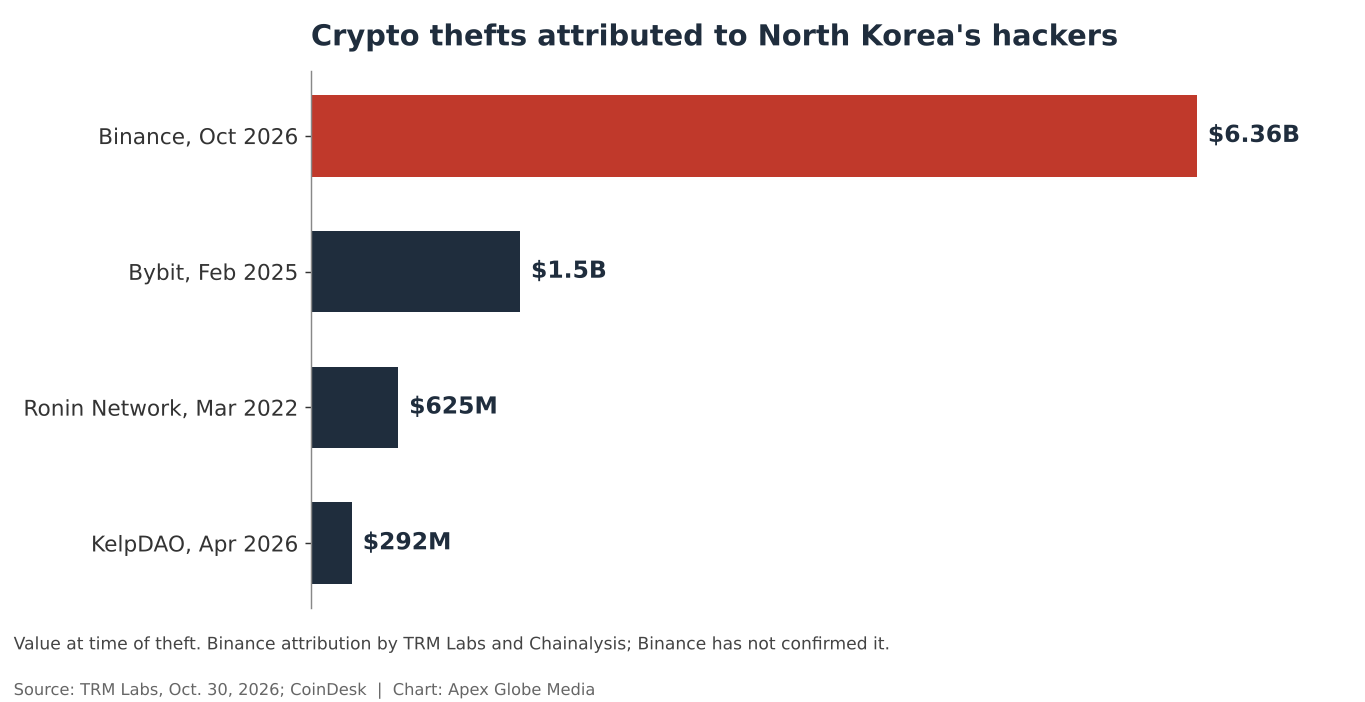
Hackers took about $6.36 billion from Binance, the world’s largest cryptocurrency exchange, on October 29, in what the blockchain analytics firm TRM Labs calls the largest crypto theft on record. Most of it left the exchange’s wallets on ten different blockchains in about 20 minutes. TRM and Chainalysis both attribute the Binance hack to TraderTraitor, a North Korean state hacking unit, though Binance itself has not confirmed who was behind it.
Twenty minutes, ten blockchains
TRM’s reconstruction shows a carefully rehearsed operation. The attackers’ wallet received small withdrawals from Tornado Cash, a service that hides the origin of crypto funds, on the morning of October 28. Early on October 29 they deployed and tested their attack code on two wallets, ran a final rehearsal on a third, and about four hours later installed the code on a Binance “hot wallet”, the kind exchanges keep online to process withdrawals.
The theft started at 20:05 UTC, when five Binance wallets on the XRP Ledger sent 233 million XRP to one address. Within minutes, funds left Binance wallets on Solana, Optimism, Bitcoin and Tron. The largest single blow was on Ethereum: the attackers had prepared 50 signed authorizations in advance, and when one matched, the entire Ethereum hot wallet was swept in about three and a half minutes, including 167,464 ETH and 1.6 billion of the stablecoin USDT. In total, about $3.79 billion was taken on Ethereum and 18,270 bitcoin, worth about $1.47 billion, on the Bitcoin network.
How the attackers got in
The technical root cause is still unclear, and the accounts differ. Binance said in a late update on October 29 that it had traced the attack to a compromised laptop belonging to a DevOps engineer, an employee who manages the company’s infrastructure, and that it “found no evidence of any wallet private key leak,” CNBC reported. TRM’s assessment is that the attackers gained the ability to make Binance’s signing system approve transactions across all ten chains. On Ethereum, they abused EIP-7702, a feature introduced in the network’s May 2025 upgrade that lets an ordinary wallet temporarily run smart-contract code, to hand control of the hot wallet to their own sweeping contract.
The pattern matches earlier North Korean operations, TRM says: small Tornado Cash deposits, staging well before the theft and signatures obtained in advance, as in the $1.5 billion Bybit hack of February 2025, which the FBI linked to the same group. Chainalysis chief executive Jony Levin also pointed to TraderTraitor, and investigator ZachXBT said the attacker was “likely Lazarus,” the wider North Korean hacking organisation, CoinDesk reported. One investigator cautioned that the hackers moved the money more slowly than Lazarus usually does, and Binance said only that it is working with law enforcement to identify those responsible.
What was frozen, and what was not
Stablecoins turned out to be the weak spot for the thieves. Because companies like Tether and Circle can freeze their tokens, about $2.7 billion had been frozen by early October 30, according to TRM, including about 1.77 billion USDT and 825 million USDC. The Arbitrum network’s security council froze about $30 million more. Binance says it will cover all customer losses; deposits continued, while withdrawals were suspended for a day or two.
The rest is harder to recover. The attackers still control more than 420,000 ETH and 18,270 bitcoin, worth about $2.4 billion, which no issuer can freeze. They have already sold some stolen USDT to market makers at a discount of more than 10% to swap it for ether, and TRM expects the next stage of laundering to run through cross-chain bridges, swap services and over-the-counter brokers. For North Korea, crypto theft is a major source of foreign currency under international sanctions, and U.S. and UN officials have linked it to funding the country’s weapons programmes.
The attack also fits a broader month of heavy, increasingly automated cyberattacks, including AI-built exploit chains against major operating systems, and the earlier eMudhra certificate failure.
Our take
The Binance hack shows that the weakest point of a crypto exchange is no longer the cryptography but the people and machines that hold the signing keys. A single compromised work laptop appears to have been enough to drain hot wallets on ten blockchains in minutes, which means exchanges keep too much money online and too few independent approvals between an engineer’s computer and a multi-billion-dollar transfer. The freezes also expose an uncomfortable fact for crypto purists: the funds that were saved were mostly in centrally controlled stablecoins. Regulators will now ask whether exchanges of Binance’s size should face the same custody rules as banks.