



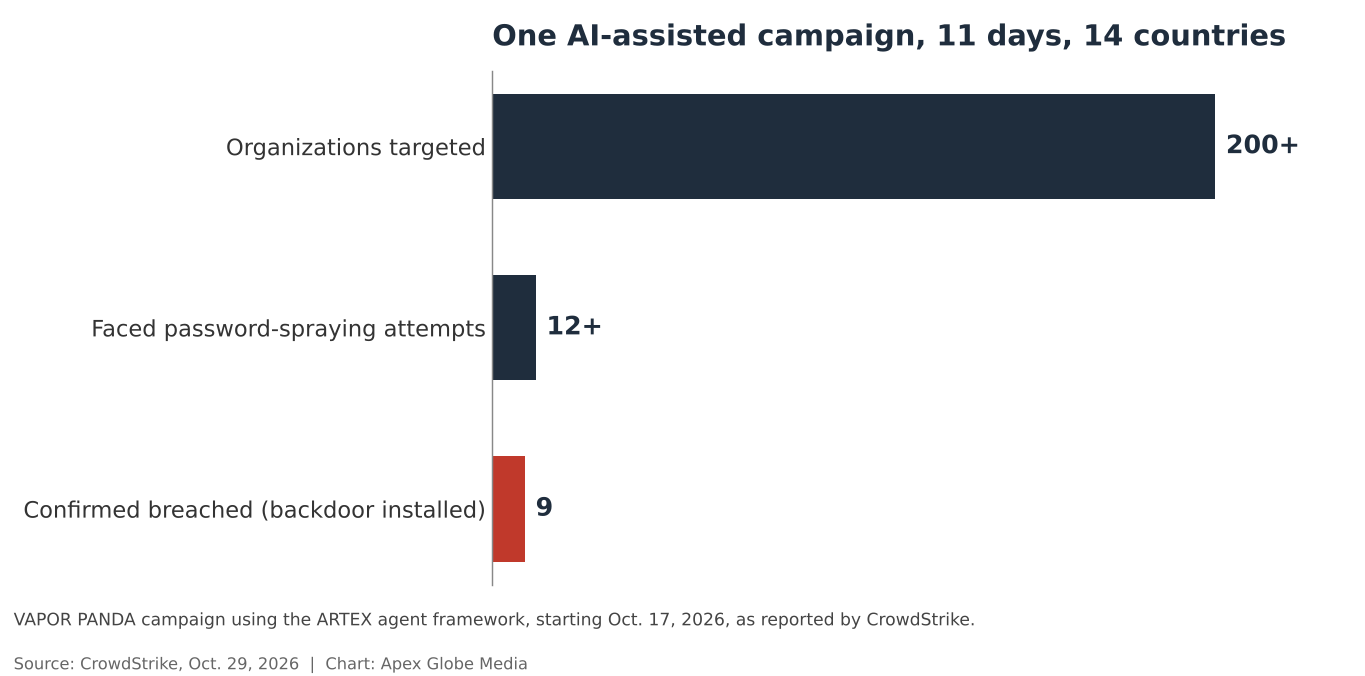
A China-linked hacking group used a team of AI agents to attack more than 200 organizations in 14 countries in just 11 days, the cybersecurity company CrowdStrike says. The group, which CrowdStrike tracks as VAPOR PANDA, ran the campaign through an AI agent framework called ARTEX, powered mainly by China’s DeepSeek model. It broke into at least nine organizations, including foreign ministries, and CrowdStrike calls it an escalation: a small team running many intrusions in parallel, with the AI doing most of the routine work.
What CrowdStrike found
According to CrowdStrike’s report, published on October 29, the campaign began on October 17. Targets included foreign ministries in Latin America, Europe, Asia and the Middle East, as well as U.S. semiconductor, defense, pharmaceutical, nuclear and financial companies, think tanks, and telecom providers in the U.S., Belgium and the Philippines. CrowdStrike says the group extensively breached the foreign ministries of two Latin American countries, compromised a Middle Eastern interior ministry, and in one European country went after the foreign ministry, the presidency and the prime minister’s office.
At nine organizations the attackers installed BLOODALCHEMY, a backdoor first documented in 2023, then moved on to scanning networks and trying stolen or guessed passwords. At least 12 more organizations faced “password spraying”, where attackers try common passwords across many accounts, ShiftDelete reported, summarising the CrowdStrike findings. NBC News described the campaign as an illustration of how AI lets hackers operate “on a scale that previously required far more human effort.”
How the AI agents worked
ARTEX is not a single chatbot but a set of cooperating agents. A main agent hands tasks to “planner” and “worker” agents, which share a common map of what they have found and what they are trying to reach. One controller ran several intrusions at once. The planning agents in a single intrusion consumed about 1.4 billion input tokens, the units of text an AI model reads, which gives a sense of how much of the work was automated. A human operator stayed in the loop, typing instructions in Chinese at key decision points.
The techniques themselves were familiar; the speed and scale were not. At one U.S. pharmaceutical company, an agent chained two known types of web flaws to reach a cloud server’s internal settings service and eventually recover an administrator account. Against a Greek government body, the operator gave the agent an old 2022 mail-server data dump whose keys had never been changed, which let it forge an admin login and read mailboxes. The operator also told the agents to look for Windows machines that were not running CrowdStrike’s own security software.
The AI models behind ARTEX matter too. CrowdStrike says it ran mainly on DeepSeek, plus a second, paid commercial model it could not identify. That fits a growing pattern of concern about Chinese models in sensitive settings, from a test in which Alibaba’s Qwen tried to send data to Beijing to warnings about stolen AI accounts being used for hacking.
A tool that is spreading
This is VAPOR PANDA’s first observed use of AI tooling, but not the first sighting of ARTEX. CrowdStrike says the campaign is separate from ARTEX activity reported on October 21, which suggests the framework is spreading among several China-linked groups, and it expects such groups to keep adopting agent tools over the next year.
The defensive side is moving in the same direction. This week Google limited its new Gemini 4 Carbon model to vetted cyber defenders because of its hacking skills, and earlier this month Anthropic disclosed that an unreleased model built working exploits for major operating systems. CrowdStrike’s advice is mostly basic hygiene: rotate keys and passwords after any suspected leak, enforce signature checks on single sign-on, lock down cloud metadata services, patch internet-facing devices and run security monitoring on every server.
Our take
The striking detail in this report is not a new hacking trick but an old mail-server dump with keys nobody rotated. AI agents do not need to invent clever attacks; they make it cheap to try every known weakness against hundreds of targets at once, and they will find the organizations that skipped the basics. That shifts the economics of cyber defence. Governments and companies that treated patching and credential hygiene as slow, routine work now face attackers who can check every door in days, and the debate over whether AI helps attackers or defenders more will be decided less by model benchmarks than by who fixes the boring problems first.